Showing posts with label Cedric Baring-Gould. Show all posts

Friday, 11 December 2020

No sex please, we're French

On the last Saturday in November (that's  how long I've been worrying at this bit of linguistic gristle) an article in The Times mentioned a reader who had been working away at an anagram for over 3 years. My mail to the Feedback column fell on stony ground, but here it is:

Leigh Carter‘s three-and-a-half year computer-assisted anagram search may have used tools that incorporated the "rule" my French master taught me more than 60 years ago: that cookery words that are based on a name are preceded by an implicit  "à la mode" and are therefore feminine - bourguignonnemayonnaise... and dauphinoise.

However, I have often reflected, as a student of philology, that rules like this are usually the sign of a linguistic change in progress; I discuss a fascinating case here (about an early Roman Latin master's list of rules proscribing common errors). My most recent dictionary (Concise OED, 2013) lists dauphinois as a headword and relegates dauphinoise to a parenthetical "(also ...)". But Onelook (a web-based finder of dictionary entries) finds only one entry - Oxford's. (In contrast, it finds four - including Oxford's) for dauphinoise.)

 Following the Onelook link I found that, although the headword is dauphinois, most of the examples, have daphinoise. In fact, in the first screenful of examples, there are only two cases of dauphinois to nine of dauphinoise, and all the cases of dauphinoise refer to a manner or mode (both feminine nouns in French) of cooking. So what explains the two cases of dauphinois?


..ois or ...oise?

The answer is suggested by the second example and confirmed by  all four cases of dauphinois in the next screenful  (with dauphinoise still in the majority, but less so: 7 out of 11). Wherever dauphinois occurs it can (mistakenly) be parsed as an adjective qualifying gratin. There are no dates on the examples, but I suspect that these "adjective qualifying gratin" examples predate the first case in my first screenful: dauphinois as an adjective qualifying gratin becomes a justification for dauphinois understood as a free-standing noun.


The second screenful

But this does not apply only to dauphinois, for which Onelook finds only one entry. In the case of bourguignon (which I vainly, and – let's face – it mistakenly) whinged about here:

... (for example bon/bonne, cadet/cadette, Bourgignon/Bourguignonne... 
<mini-rant status="stillborn">
No, I won't but... If people would just pronounce the /n/ when they say Bœuf Bourguignonne.  PLEASE.
</mini-rant> 
... etc.)

The fight in defence of the rectitude of bourguignonne (according to the "B-G rule" [B-G being the French master who taught me it]) has been well and truly lost. Google finds 

About 9,010,000 results for boeuf bourguignon 
but only 
About 311,000 results for boeuf bourguignonne.

And the ...gnon version really has the Good Housekeeping seal of approval. Teachers laying down rules are a sure sign that language is on the move.

b

Saturday, 30 May 2020

Bras dessus bras dessous

In a trail for an Eartha Kitt program  I heard once there was a song that I had never heard in the original (although C'est si bon ...
<parenthesis>
(one of those "translations" that give up the effort of actually translating, and just throw in the odd snatch of the original – Volare is another example)
</parenthesis>
...is a commonplace on the lounge circuit in an English version):
C'est si bon,
De partir n'importe où,
Bras dessus bras dessous,
En chantant chansons
And the phrase bras dessus bras dessous took me back to my French classroom in the early '60s (possibly '63-'64, otherwise '65-'66...
<autobiographical-note>
Not in the intervening year, when we were consigned to the attention of an assistant, who –  much to our annoyance at the time – insisted that we learn and use the symbols of the IPA.  I was later to realize that – unless total immersion in the environment of the target language was possible  – IPA symbols were an almost essential ...
<parenthesis>
(and that "almost" is a craven sop to the sometimes vocal language teachers who are happy to pander to the needs of  students who can't use a decent [that is, mono-lingual] dictionary)
</parenthesis> 
...tool for learning a language.
</autobiographical-note>

...). The particular memory was of Cedric Baring-Gould's mime of walking arm in arm. My reaction was not a simplistic "Aha – bras dessus bras dessous is "the equivalent..."  (whatever that means in the context)  "....of the English" ...
<parenthesis>
(the assistant had introduced us to the less formal la main dans la main [in Françoise Hardy's "Tous les garçons et les filles de mon âge].. or "was to introduce" – all these parentheses are a bit too involved even for me...
</parenthesis>
 ...."arm-in-arm".

My association of that phrase with that mime is an example of the sort of association summed up on the right hand side of this diagram I later (much later) used in a Portuguese lesson:


I've probably uploaded this to TESconnect, but here it is anyway; and if you want to change the target language, you're welcome to the Visio sources (Microsoft-backup-willing)

The question O que é? triggers the name of the object, without recourse to the arduous and time-consuming and unnatural and error-prone left-hand route.

As I wrote in an earlier post:
My memory was of the mime performed by my French master 50-odd years ago. I've mentioned Cedric before, here. I can imagine his shade smiling down with a look of smug satisfaction (like the one he used to show the difference between 'No vacancies' and 'Complet' [HD 2020: arms  folded for the latter, hands upraised for the former]). 
At this time of year [HD 2020: I was writing about the time of the rentrée des classes], teachers of all kinds may need the fillip of this post: if you're good, what you do (probably more than what you say) will let your pupils take away from your lessons much more than you think.
I'll never forget BG's figure hunched over the enormous reel-to-reel Grundig that he always carried from class to class. (The assistant had one of the new cassette players, but BG swore by his magnétophone .)

Time for my walk, if I can get this published before Minusnet ("better than damp string")  crashes again.

b

Monday, 3 September 2018

Teachers must fight computers

So said the Ottawa Citizen in a feature ironically included  in the "Science" section of that paper nearly 50 years ago (30 November 1981):
This jeremiad is reminiscent of reactions to many other enabling technologies and newly discovered ways of behaving.
  • Committing ideas to paper will make us lose the ability to memorize things.
  • Teaching people to read and write, especially with the introduction of printing with movable type, will give them ideas above their station.
  • Teaching people to read without moving their lips is an invitation to social unrest.
  • Letting people in school use paper will decimate the slate industry.
  • The use of typewriters (that is, manual typewriters) will make us lose the ability to write longhand.
  • Giving learners access to a world of information through the Internet (particularly the World Wide Web, but this Ottawa Citizen piece pre-dates that by 10 years) will hobble a child‘s ability to glean information from books.

And so on, ad nauseam. Whenever  a development threatens the old way of thinking, obscurantists decry its imagined impact on education.

But this link was posted on Twitter by the Pessimists [no apostrophe, of course – this is Twitter] Archive Podcast, who may not have been entirely at one with its message. And later in the article Dr Smith starts to talk sense:

Trusted. This is a crucial word, that should be noted by the Goves (sic) of Academe. IT, and particularly the World Wide Web,  gives access to a world of realia [that's the language teacher's jargon for actual stuff] – in text, images both still and moving, and sounds).

There is a movement in language teaching that has borrowed the name of the DOGME '95 movement in film,  which Wikipedia describes like this:
Dogme 95 was a filmmaking movement started in 1995 by the Danish directors Lars von Trier and Thomas Vinterberg, who created the "Dogme 95 Manifesto" and the "Vows of Chastity" (Danish: kyskhedsløfter). These were rules to create filmmaking based on the traditional values of story, acting, and theme, and excluding the use of elaborate special effects or technology.

Wikipedia
 A few years later (so dropping the "'95" bit of the name) a language teaching movement adopted similar principles
Although Dogme teaching has been seen to be anti-technology,[6] Thornbury maintains that he does not see Dogme as being opposed to technology as such,[14] rather that the approach is critical of using technology that does not enable teaching that is both learner centered and is based upon authentic communication. Indeed, more recent attempts to map Dogme principles on to language learning with web 2.0 tools (under the term "Dogme 2.0") are considered evidence of Dogme being in transition[15] and therefore of being compatible with new technology.

Wikipedia
Not everyone agrees with the "compatible with new technology" bit; there are language teachers who insist that the teacher must go "naked into the classroom" (as Nye Bevan so nearly said). But the Wikipedia article on Dogme '95 goes on to say that the movement was "an attempt to take back power for the director". Replace director with teacher, and the arguments about technology become insignificant. What matters, as Dr Smith said in that Ottawa Citizen article, is trust in the practitioner.
<autobiographical_note>
And if, like dear old M. Baring-Gould, he is armed with a magnétophone (reel-to-reel, given that we are talking about the mid-'60s) that doesn't make him any less trustworthy.
</autobiographical_note>

b

Tuesday, 6 March 2018

Les mots n'existent pas

My late French master (the marvellous Cedric Baring-Gould, mentioned before in this blog, here for example) used to attribute this gnomic expression to Maurice Grévisse (who, appropriately, enough, looks not ungnome-like)  

I think it means something like A word without a context has no free-standing existence. There's more to a language than a set of dictionary definitions. If anyone ever wrote it, that is  (as I haven't been able to pin down chapter and verse). And even if nobody ever did write it, it's still true.


Some time ago I wrote (here)
...I've never been a great believer in the exactitude of synonyms. I've mentioned before (several times – check in the cloud of keywords in the left-right-hand column) my old French master Cedric Baring-Gould, who was fond of quoting Grévisse: 'Les mots n'existent pas'. I haven't been able to trace the quote, which is pretty gnomic; but I think it means that words don't have an independent existence, that has no regard for context. In any case where there can be said to be synonyms, one of them will – in that context – be le mot juste.

I thought of this  during the BBC  news coverage of the March 2018 Italian elections, the morning after which  a newspaper bore the headline Tutto cambia.  "All  change" mistranslated the reporter. I imagine he knew enough Italian to know it was wrong. A condottore, reaching the end of the line, says Si cambia. If I were being charitable, I suppose the reporter had been up all night, and reached for the nearest cliché (which, after all, looks like the  sort of thing that might appear in a tabloid).

But, wearing my less charitable (more usual?) garb, I smell the sterile whiff of a dictionary in the hands of an ignoramus. "What does tutto mean? 'All'. What does cambia mean? 'Change'. Put them together, and hey presto: ALL CHANGE. Simples."

Except... no. Tutto – everything (not everyone, as in "All change"); cambia it changes. So that headline means something more like "Everything is changing" – it gives information about the new situation, rather than issuing an irrelevant order.

Just saying...

But I must get back to THE BOOK #WVGTbk2.

b

PS – A couple of clues:
  • Concealed before place of concealment? Concealed. (6)
  • Old lag getting it back a third of the way in: near the knuckle. (8)

Thursday, 14 July 2016

Bon voyage M. Dumollet...


♪♫ ♪ ...À St Malo débarquez sans naufrage 
Bon  voyage M. Dumollet
Et revenez si le pays vous plaît.

A quickie for the Quatorze Juillet


On 8 July 2016, the frigate Hermione sailed out of St Malo ...
<autobiographical_note>
("charming walled town city on the Emerald Coast of Brittany", as long-standing readers may recall from this – the blue bit at the end )
</autobiographical_note>
...bound for Brest (a little after we steamed out of St Malo – which accounts for a less than memorable photo. There are plenty of better ones here.
The Hermione is a 32-gun Concorde class frigate fitted for 12-pounder guns, completed in Rochefort by the Asselin organisation in 2014. She is a reproduction of the 1779 Hermione, which achieved fame by ferrying General Lafayette to the United States in 1780 to allow him to rejoin the American side in the American Revolutionary War.
Wikipedia entry for French_frigate_Hermione_(2014)
For the week leading up to the Quatorze Juillet there was a festival of world music at St Malo. On the 8th, one of the offerings was from an Argentine group. I imagine they knew of their link to St Malo, but I'll assume you share the ignorance I had until fairly recently

In September 1763 Louis-Antoine, Comte de Bougainville  (later to distinguish himself in that same war) set sail from St Malo on a voyage of discovery (as many ocean voyages were, at the time). In January 1764 he put in at an unclaimed group of islands, which – like so many explorers before and since – he named in a autocentric way (is that a word? Well it is now.) This is a theme I've visited before. here,)

He called the landing point Port Louis after the French king, and he named the islands after his point de départ: Les Îles Malouines. The islands were those known to Les Rozbifs as .... [but no, I know better than to spoon-feed my readers].

<autobiographical_note>
In the newspaper article about the festivities marking the end of the festival I saw the name of one of the groups playing at the Fest Noz that night. They were called Startijenn. This word had meant nothing to me until the night before, when I was reading the chapter on Breton in Lingo (a book that I'm deferring judgement on, as it refers to much that I don't know about but is not totally sound on the few things I do know about). 
But an amusing and intriguing feature of the book is that each chapter in this Language Spotter's Guide to Europe concludes with a word that comes from the language covered but has no equivalent in English. For Breton, it is startijenn.
No equivalent, that is, in formal language. But a fairly close gloss is provided by the colloquial kick-start. A startijenn is "a kick of energy, such as you get from a shot of coffee". Gaston Dorren, author of Lingo, calls it "probably derived from English start". I'd say  it's almost certainly cognate, though derived suggests rather more than that. I'll see what the  Romanisches etymologisches Wörterbuch has to say, if anything. 
</autobiographical_note>

But that'll have to be in an update.

b

PS A clue:


Floor-covering including great, if questionable,  book. (5)

2016.07.15.11:30 – Report  on  Romanisches etymologisches Wörterbuch

PPS Sorry – nothing. At a guess, I would suggest that the word is a combination of two roots:
  • Start
    In the words of Etymonline
    ...from PIE root *ster- (1) "stiff." 

    From "move or spring suddenly," sense evolved by late 14c. to "awaken suddenly, flinch or recoil in alarm," and by 1660s to "cause to begin acting or operating." Meaning "begin to move, leave, depart" (without implication of suddenness) is from 1821. 
  • -jenn
    Again from Etymonline, sv genus
    ...from PIE root *gene- "to produce, give birth, beget," with derivatives referring to family and tribal groups. 
    ...Cognates in this highly productive word group include Sanskrit janati "begets, bears," janah "race," janman- "birth, origin,"  jatah "born;" Avestan zizanenti"they bear;" Greek gignesthai "to become, happen," genos "race, kind," gonos "birth, offspring, stock;" Latin gignere "to beget," gnasci "to be born," genius"procreative divinity, inborn tutelary spirit, innate quality," ingenium "inborn character
Update: 2016.07.18 – Added PPPS

PPPS One possible (if linguistically naïve) objection to the derivation suggested in my PPS is that it makes startijenn a mongrel – derived from two sources (a supposed aberration, according to some observers).  But, as I wrote here, it is ridiculous for any language to lay a claim to a word  for all time – it's  a question of where you choose to stop the etymological clock [a metaphor I introduced here].

Television is my stock example of a word derived from two sources – a Greek prefix and a Latinate stem. A purely Greek version would be teleopsy; a purely Latin version would be ultra-vision. Another less obvious example (discussed here) is morganatic, a happy mixture of Germanic and Latin, which is more relevant as it mixes a Germanic stem with a classical affix (as startijenn does, if my guess is right).


And here are a couple more clues:

Arab returning soon, says Cockney (5)
Bloody truncheon here? (5, 5)

Update: 2016.07.2016.16:30 – Added P4S (last one, honest)

P4S Another mongrel that had always confused me until my recent visit to Bretagne is polyvalente – usually seen in the phrase Salle polyvalente; come to think of it, quite possibly some chemicals are polyvalent in English (yup). That word has a Greek prefix and a Latinate stem. In English a hall that can be put to various uses could be described as all-purpose, though in practice I've seldom met it in that context (except in special cases like "all-purpose sports hall"); we usually just say something more homely, such as village hall – although I'm probably betraying my South-Eastern commuter-belt background there. It goes without saying that such a hall is suited (or valid) for a range of purposes

This demonstrates the point first brought to my attention by M. Baring-Gould, that French tends to prefer hi-falutin (though he probably used a more diplomatic term) vocabulary.
<autobiographical_note>
The example he gave to class 2Ba...
<Pedagogical_Correctness_gone_mad> 
Oh no, none of this elitist ABC stuff, our classes were named after the first two letters of the teacher's name; it was entirely accidental that the boys who had come up from 1A had a as the teacher's second letter while the boys who had come up from 1C went into class By 
</Pedagogical_Correctness_gone_mad> 
...was carié. English does have the word carious, but the register is different. Dental professionals use it, but not the patient-in-the-chair.
</autobiographical_note>
So the words salle polyvalente, common on hitherto baffling signposts everywhere I've been in France, mean (presumably  – I haven't checked, it just seems obvious to me [NOW]) is just an all-purpose hall.

b.
Update 2017.10.01.15:15 – Added P5S   (so P4S  wasn't so final).
P5S: A few clues, the first being topical.
  • I'm upset before one and after her– Harry's peer. (8)
  • This way in Paris – about time! Gasp for a communard. (11)
  • Adjustment to famine's a statement about direction of travel. (9)
And answers:
In PS: LINGO
In PPPS OMANI and BATON ROUGE (where it was relevant at tle time)

    Update 2018.04.14.20:15 – Added P6S

    P6S The answers: HERMIONE, PARTICIPANT, MANIFESTO
    And here are some clearer photos from AFP.

    Friday, 11 July 2014

    The sportscaster's present, pt II

    This page addresses a use of the present that is peculiar to sports commentators:

    <explanatory_note>
    Like newspaper headlines and personal anecdotes ("So I'm walking down the street yesterday, and this guy comes up to me and he says ..."), sportscasting has a special affinity for the present tense. But unlike other uses of the historical present—which typically refer to past events, thus "historical" present—the sports announcer is calling a game that is playing out before our very eyes. If ever there were an appropriate time to use the present, surely this is it. So what's so strange about it?
    ...
    Both "Louise kicks the ball" and "Louise is kicking the ball" are present tense, of course. But what makes the sportscaster present remarkable isn't tense. It's a distinction known as aspect, which refers to the period over which an action takes place. The "is kicking" construction has progressive aspect, because it refers to an event that unfolds over time, whereas "kicks" is the older, simpler form that is used for a variety of purposes, including habits ("Be careful—that horse kicks" does not mean the horse is necessarily kicking right now) and verbs of thought or emotion ("I think I'll kick the ball").
    </explanatory_note> 
    I would like to consider another, also peculiar to sports commentators, but using an analogue of a device that has long been used by language teachers (both MFL [Modern Foreign Languages] and ESOL [English for Speakers of Other Languages]).

    This device is the timeline diagram. It lets students in one timeframe (the now of the lesson) think about language that deals with events that happen at different times. Timelines have been used in language teaching for many years. I remember my own French master, the sainted Cedric Baring-Gould who I’ve mentioned several times before, drawing something like this to investigate the difference between habitual action in the past and an event:

    Passé                                 Présent                                            Futur

               Passé imparfait
             L M M J V etc
          > .  .  .  .  . >
             J’allais tous les jours…


    >----------------------------------------------------|-------------------------------------------------->

            Passé composé
          
         Un jour, pendant que  j’allais …,
                       J’ai trouvé qqc

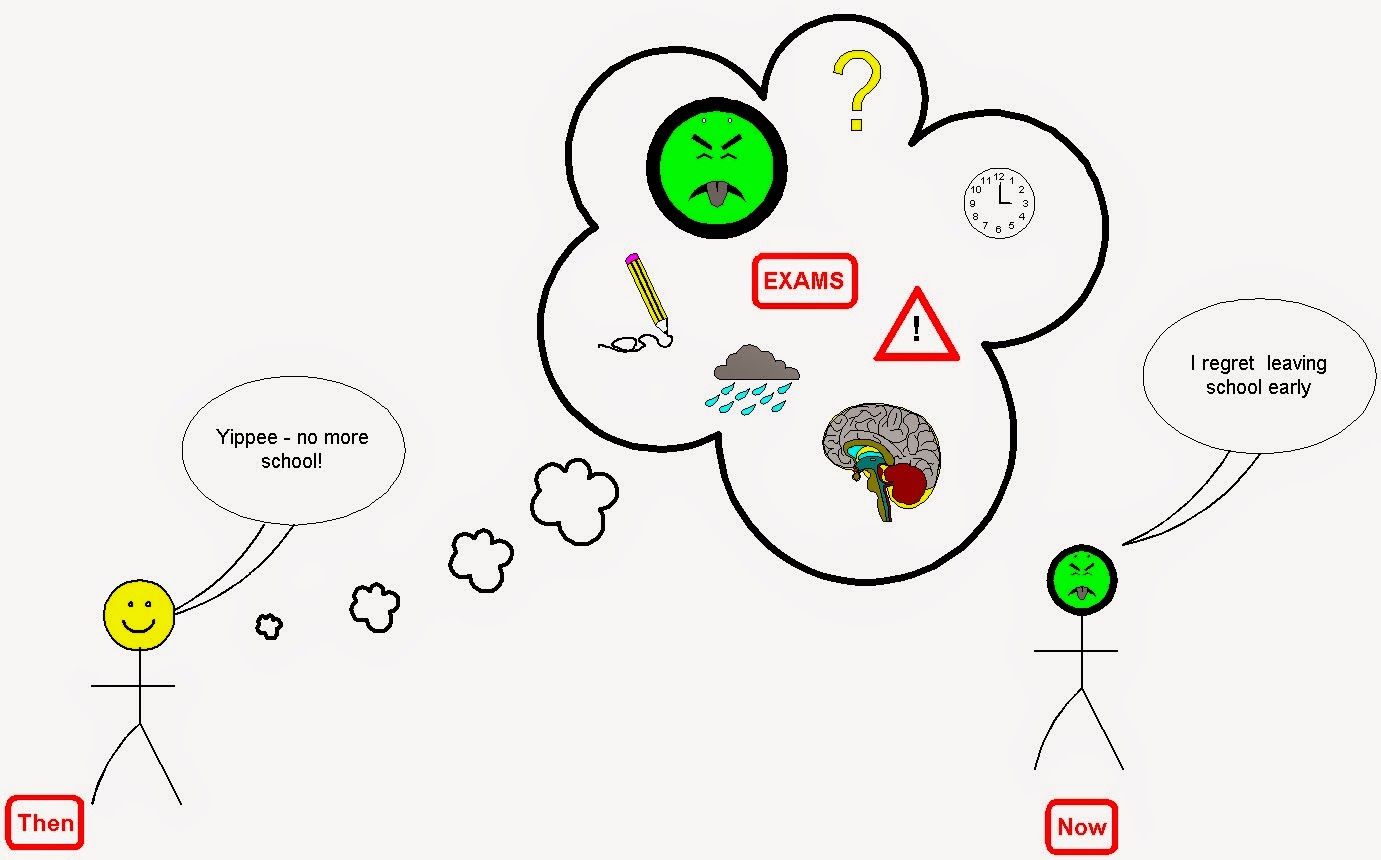
    With a bit more time and artistic inspiration, a diagram like this can become quite impressive. Here’s one  I did for an ESOL class a few years ago, where the diagrammatic paraphernalia has been reduced to Then and Now boxes, but the same principle is at work – time progresses from left to right, and the language used at any point refers to that time:


    ‘Regret leaving’
    Versus
    ‘Regret having left’

    Instead of such diagrams, which can freeze time while we look more closely at what’s going on, sports commentators have video playbacks. So they can say things like:

    [technical aside: ‘Can we freeze it there?’]
    ‘Now if he crosses it there, it’s a certain goal.’

    The simple present to express a conditional! This is one in the eye for the zeroth/first/second-type† merchants. Given the right visual context, the simple present can be used to frame a perfectly clear conditional. And supposing there’s a Pedant among the Pundits:

    [technical aside: ‘Is it possible to stop the action  there?’]
    ‘If he had crossed it at that stage, it would have been a certain goal.’

    What has this achieved? It requires the audience to tune out of a video-context and start parsing formal syntax. In what way is this better?

    b

    [Time off for bad behaviour. Back soon.]

    Update 2014.07.10.15.30 – Added this note:


    This, I realize on second reading, may need some explanation. It is a reference to a system of classification of conditionals, widely used in the ESOL world (and possibly also now in the MFL world, which I have not been involved in as a teacher for 10 years). Some people find it useful. Have a look here. It seems to me to lead to unnecessary ratiocination (or, to use a computer internals metaphor, 'thrashing' – when the computer spends all its time trying to decide what to do).

    Update 2014.07.21.10.30 – Added this note:
    For the purposes of the argument, it's not essential that you agree with the distinction (between 'regret leaving' and 'regret having left'). In fact, I'm not sure I do any more (it's about 8 years old). If I redid it now, I would at least redraw it. What matters, in this context, is just the principle of using a graphic to freeze time while a student considers appropriate language at different times.

     Update 2014.07.31.09.30 – Added explanatory note in maroon, which explains the 'part II' in the title.

    Update 2017.09.26.15.40 – deleted old footer.

    Update 2018.03.06.14.40 –  typo and format tweak.

    Sunday, 25 May 2014

    Pebbles, oyster shells, and blackballs

    The word psephologist is younger than I am – just – and it rears its ugly head (well I think it's ugly) every now and then, when there is an election in the offing. A few weeks ago a tweet appeared, pointing to this page :


    Far be it from me to question this most august of authorities, but I think there's room for a quibble here.

    Etymonline's derivation is from ψєφɩζεɩν, the Greek verb vote. And as the election in question involved pebbles (ψєφοɩ) the ultimate reference is to pebbles. But when Professor R. B. McCallum coined the word in 1952 I imagine he was thinking about the verb. Elections in recent memory haven't provided much scope for pebbles.

    A new word is like a new toy, initially very popular and then often dwindling in use. A toy that was new to me when I first came across it (and mentioned it here) was Collins English Dictionary's Usage Trends graph. This is the picture for the entire life of psephology:


    In the '50s and early '60s it was the best thing since ... errm, laminated farinaceous comestibles. Since then it has experienced a steady-ish decline, with a spike in the late '80s. I don't know whether Collins records just disappear in the last few years; but it's interesting to compare this picture with the one for pollster (not an exact synonym, I know... :
    <digression>
    but I've never been a great believer in the exactitude of synonyms. I've mentioned before (several times – check in the cloud of keywords in the left-right=and column) my old French master Cedric Baring-Gould, who was fond of quoting Grévisse: 'Les mots n'existent pas'. I haven't been able to trace the quote, which is pretty gnomic; but I think it means that words don't have an independent existence, that has no regard for context. In any case where there can be said to be synonyms, one of them will – in that context – be le mot juste.
    <meta_digression>
    Besides, it's a person rather than a discipline. So here's the picture for psephologist:


    The decline is even more extreme and continuous.
    </meta_digression>
    But...[back to pollster]):
    </digression>


    Slow and steady wins the race. Starting a decade or two earlier (1939, says Etymonline) it has been steadily increasing in frequency of use, providing a counterexample to my new toy observation.

    Anyway, the thing about those pebbles is that each one represents a person (or faction). And if an object can represent a person, what better way of ostracizing someone than scratching their name on an object and casting it outside the town walls. That object (and some of you are probably already there, but...) was an oyster shell, or in Greek οστρακον.

    In gentlemen's clubs the tradition of having an object to represent a voter extended to the idea of voting for or against candidates for membership. But a colour was added, so that white was Yea and black Nay. If you blackballed someone, you voted against membership. (Or is this folk etymology? The necessary research will have to wait for an update.)

    Tales from the wordface


    The paperback is submitted, and I hope I can get through the final proof stage tomorrow.

    Time to go.

    b

    Update 2014.05.26.12:15 – Added this PS:

    PS
    This entry appears in Dickens's Dictionary of London, by Charles Dickens, Jr., 1879:
    Travellers’ Club,  106, Pall Mall. — The following is the form of recommendation of candidates for this club:... The members elect by ballot. When 12 and under 18 members ballot, one black ball, if repeated, shall exclude; if 18 and upwards ballot, two black balls exclude, and the ballot cannot be repeated. The presence of 12 members is necessary for a ballot. Each member on admission is required to pay £42, which sum includes his subscription for the current year. Each subsequent annual subscription is £10 10s. 
    This confirms my belief in the derivation of 'blackball' – which I feared might be a victim of folk etymology. It also introduces a link between the words ball and ballot (which I meant to touch on yesterday; I wonder whether those hexagonal drums you see on bottle stalls in church fêtes  could be called 'ballot boxes' )

    Update 2014.05.27.11:30 – Added bits in brown

    Update 2016.03.26.12:50 –  A few typo fixes, and removed old footer.


    Friday, 17 January 2014

    The hunting of the proofs

    Report from the word-face

    It's a long and painful story. I shan't bother you with the details. Suffice it to say...

    <digression>
    A year ago I was discussing a point on UsingEnglish  and  said, among other things:

    The fossilized phrase 'Suffice it to say' means 'let it be sufficient to say'; a more modern idiom is 'Enough said' - but, unlike 'suffice it to say', this follows the thing said: 'I shouldn't have done it. I'm sorry. Enough said'.

    You'll have noticed that I keep saying 'Suffice it to say'. This uses the subjunctive, which is hardly used in informal British English. And as both 'it' and 'to' are unstressed in that phrase, they are easily heard as a single /t/ followed by a schwa - particularly by habitual non-users of the subjunctive. This form [HD clarification: the ITless form] is widely used, and has become almost as common as the fuller form: BNC has 53 instances of 'suffice to say' and 88 of 'suffice it to say'.

    In COCA, on the other hand, which is based on N. American usage, has [HD correction: 'there are' (I may have meant háy)] 376 (377 if you include 'sufficeit to say', of which there is a single instance which I found by accident ), and only 97 of 'suffice to say'. And that balance makes sense, considering the relative strength of the subjunctive in American English.
    Anyway, I'm an IT-man.
    </digression>

    ... that Yodel claim that someone called 'Jeffs' signed for them at some address and that's all they know for the time being. The delivery man is being questioned as we speak, although I'll be surprised if he can make any useful contribution before Monday (and indeed the usefulness quotient of his contribution is dubious at best).

    As Cedric (my French master) would have said in his dictée, 'POINTS DE SUSPENSION'.

    b

    Update 2014.01.19.16:30 – Added PS:

    PS I didn't mention yesterday that as well as trying to trace what Yodel had done with the proofs I also complained to CreateSpace (aka 'Amazon'), asking what point there was in my paying extra for a 10-day turnaround  – when after 3 weeks I still had no realistic prospect of seeing the proofs. They (to my great relief) have sent another set, which should get here on Wed. 22nd. We shall see...

    Update 2014.01.20.14:45 – Added PPS:

    I've just sent a nastygram to Yodel, masquerading as a Customer Survey. The driver they spoke to lied like a trooper. We WERE in, and the house where he claims to have had the package signed for has been vacant for nearly six months. Shame it wasn't worth stealing, but I wonder how much he makes on eBay out of 'undelivered' packages.

    Incidentally, this needless piT[oops]stop on the way through their interminable survey raised a smile:

    'And if I laugh 'tis that I may not weep' (Byron, I think).

    Update 2014.01.22.19:00 – Added PPPS: 

    They've arrived  – just over three weeks after I ordered them, no thanks to Yodel (who Disappeared the first set), and many thanks to CreateSpace (who sent a copy). Here goes...


     Mammon When Vowels Get Together V5.2: Collection of Kindle word-lists grouping different pronunciations of vowel-pairs. Now complete (that is, it covers all vowel pairs –  but there's still stuff to be done with it; an index, perhaps...?)

    And if you have no objection to such promiscuity, Like this.

    Freebies (Teaching resources: over 36,700 views  and 5,100 downloads to date**. They're very eclectic - mostly EFL and MFL, but one of the most popular is from KS4 History, dating from my PGCE, with 1852 views/860 downloads to date. So it's worth having a browse.)

    ** This figure includes the count of views for a single resource held in an account that I accidentally created many years ago.


    Tuesday, 10 September 2013

    The good is oft interréd with their bones - but not always

    This morning in a trail for an Eartha Kitt program next weekend I heard this:
    C'est si bon,
    De partir n'importe où,
    Bras dessus bras dessous,
    En chantant des chansons
     And at the words bras dessus bras dessous a synapse clicked [There she was just a-walkin' down the street singing Doo wah diddy diddy dum diddy doo. Snapping her synapses...?]. It was not the tedious 'Aha, bras dessus bras dessous MEANS "arm-in-arm"' (the sort of knee-jerk 'equivalence' that often condemns learners to endless tongue-tied ratiocination - which I've summed up in this image:


    I've probably uploaded this to TESconnect, but here it is anyway. )


    My memory was of the mime performed by my French master 50-odd years ago. I've mentioned Cedric before, here. I can imagine his shade smiling down with a look of smug satisfaction (like the one he used to show the difference between 'No vacacies' and 'Complet').

    At this time of year, teachers of all kinds may need the fillip of this post: if you're good, what you do (probably more than what you say) will let your pupils take away from your lessons much more than you think.

    But I must get on with #WVGTbook; the OO section is taking ages (and the prospect of the even more voluminous OU isn't inspiring).

    b

    Update: 2013.09.10.16:16: Teensy stylistic tweak.
    Update: 2013.09.11.11:30 Added this PS:

    My last sentence (the whinge about OU) inspired me to do some Excel stuff and produce this graph:


    The figures are crude. There is a lot of double counting: for example, for door there are 68  [PPPS: hits in the Macmillan English Dictionary for headwords that include the string door]. But they give a rough idea of relative frequencies.

    Of the 25 vowel pairs, 16 have fewer than 1,000 hits – most fewer than 500, and about half fewer than 100. Of the remaining 9, 5 have fewer than 2,000. Of the remaining 4, OU is more than 1,000 hits ahead of the second-placed EA.

    OU is daunting. But the U* pairs are much less so (and besides, I've done some of the work already for my submission to the 2012 ELTons.) Here's to the 2014 submission (deadline 22 November 2013).

    Update 2015.05.01.15:10  – Added this PPS:

    PPS This is something I wrote in the early days of the blog. I thought of it after an #eltchat earlier this week, which raised a controversy about L1 and L2;  keep an eye out for the Summary at the #eltchat site. It seems that, at DELTA level, attitudes to the use of the mother tongue are at variance with those espoused at CELTA level.

    Update 2017.08.25.14:55  – Old footer removed.

    Update 2018.03.20.15:35  – Added inline PPPS in red.

    Thursday, 1 August 2013

    White rabbits

    Notes & Queries reports this in 1909, though it must surely date back further than that. I pride myself on (probably) being the first to use it for the first blog of the month. I wonder why white , though Wikipedia reports a colourless alternative: 'rabbits, rabbits, rabbits'.

    The word bunny has been with us for some time. Etymonline dates it to the late seventeenth century Scottish dialectal 'bun'. It was suggested to me, by – I think – Joe Cremona (whom I have mentioned  several times before [and that's what meta data is for!]) that prim English nurses and governesses were keen to discourage their charges from using the word descended from the Latin cuniculus – whence come the Spanish conejo, Portuguese coelho, Catalan conill, and various other words including the English 'coney' (rabbit fur).

    The word coney was used as a rhyming euphemism for the 'female intercrural foramen', as – like honey and money – it did rhyme with cunny (Latin cunnus in which the double n yields, as often the Spanish ñ  – whence  [] coño). Perhaps the stressed vowel in our 'coney' changed from /ʌ/ to /əʊ/ for  euphemistic reasons similar to those nursemaids'. I have not met the word cunny 'in the wild', but it was used in the script of The Unforgiven in that anatomical sense.

    But I must get on. I want to get OA done by the end of the week.

    b
    Update 2013.08.01.18:00
    Added to last (full) para.
    Update 2013.08.02.10:00
    PS I assumed that, among those words derived from cuniculus, I might include Italian coniglio. But I wasn't sure at the time. I have looked it up, and it turns out that I should have had the courage of my convictions. But the dictionary yielded two other bits of information:
    • coniglio can also be used in Italian as a taunt to someone who's not brave: 'chicken'
    • 'bunny' is coniglietto
    In English, a rabbit isn't notably lacking in courage. The animals themselves are known to be timid, but the only usage that I know of that likens a timid person to a rabbit is this: the 'tail' of a cricket team – not inappropriately, given that Scottish bun, a hare's tail, is cited here as a possible source of the word 'bunny' – are sometimes referred to as 'bunnies'. I wonder if English is alone in not using some sort of rabbit as a term for a timid person. I am reminded of Le bon roi Dagobert:
    Le bon Saint Eloi
    Lui dit <o mon roi
    Votre majesté
    Est bien essoufleé. >
    <C'est vrai – lui dit le roi – 
    Un lapin courait après moi. >
     When I heard this [RIP Cedric Baring-Gould, a brilliant French teacher, ahead of his time, under-estimated by almost everyone], the irony was lost on me.

    Coniglietto  is striking for a more formal reason. It has the Italian diminutive suffix -etto/a (as in many borrowed words familar to English speakers: libretto, cornetto, bruschetta...), but coniglio is itself derived from a Latin (-ulus) diminutive.
    Great fleas have little fleas upon their backs to bite 'em,
    And little fleas have lesser fleas, and so ad infinitum.

    Back to the grindstone...

    Update 2013.09.27.13:50
    Header updated:


     Mammon (When Vowels Get Together V4.0: Collection of Kindle word-lists grouping different pronunciations of vowel-pairs – AA-AU, EA-EU, and  IA-IU, and – new for V4.0 – OA-OU.  If you buy it, contact  @WVGTbook on Twitter and I'll alert you to free downloads of the forthcoming volumes; or click the Following button at the foot of this page.)
    And if you have no objection to such promiscuity, Like this.

    Freebies (Teaching resources: nearly 32,400 views**,  and  4,400 downloads to date. They're very eclectic - mostly EFL and MFL, but one of the most popular is from KS4 History, dating from my PGCE, with 1570 views/700 downloads to date. So it's worth having a browse.)

    ** This figure includes the count of views for a single resource held in an account that I accidentally created many years ago.


    Friday, 22 March 2013

    Tempora obscuratio mea

    The University Arms. The OUP
    colophon shows just the open book: 
    This post refers to a pair of articles in last Saturday's Times, but it is hidden by those obscurantists behind a paywall. (Interesting word, 'obscurantist'; think of darkness, 'obscurity'. My first full-time employers, OUP, have a colophon that shows an open book inscribed with the words - the opening words of Psalm 27- Dominus illuminatio mea: 'The lord [is] my light':


    Domimina nustio illumea - oh how we larfed! The spreading of light, that's what text-based communication is about. Not paywalls. Tempora obscuratio mea - perhaps that should be The Times' motto. [And I KNOW OUP would have wanted an italicized The in my opening line; the Hart has its reasons of which reason knows nothing.]

    The first article is a news item on p. 11 of the hardcopy about a decision by Mid Devon Local Authority not to use apostrophes on road names; in fact. it is making official a de facto actuality that is not unique to Devon. When I moved to my current address, in 1984, I noted (with slight but admittedly risible annoyance) that my new home was in 'Spencers Wood' [sic - no apostrophe]. And in 1979 I learnt (with similar slight but admittedly risible annoyance) that book designers don't like apostrophes in display work, thinking they're visually fussy.

    But my late twentieth-century sightings of apostropho-clasm are far from original. GBS wrote
    I have written aint, dont, havent, shant, shouldnt, and wont for twenty years with perfect impunity, using the apostrophe only when its omission would suggest another word: for example hell for he’ll. There is not the faintest reason for persisting in the ugly and silly trick of papering [sic, in the Otrops article I link to below for further research. I regret having no time to find a primary source; I suspect Shaw may have used the more meaningful 'peppering'] pages with these uncouth bacilli.
    (Isn't that bacilli marvellous? Bacilli were in the news at the time, because of discoveries in connection with these stick-like [Latin baculum  'little staff'; there's that '-ulus/m' again, denoting a diminutive, as noted in a previous post] microscopic objects. Shaw was a contemporary of Fleming – who was born before Shaw but outlived him. One can imagine Shaw reading a newspaper or scientific leaflet illustrated with a slide covered with these things looking like chocolate vermicelli - and there's another metaphor, 'little worms', but that would be a digression too far). You can read more about apostrophes here, if you're that way inclined. I really can't get awfully excited about this sort of thing.

     But one of the editorialists at The Times can oh yes. No names, no pack-drill, but I have my suspicions (think of the word 'pray' tacked on coyly after  questions in the Literary Quiz). How's this for blustering grandiloquence?
    Its great virtue as a mark of punctuation [ed: my underline: useful bit of clarification here, in case we thought he was talking about its great virtue as... a table ornament?] is that it aids clarity and dispels confusion.... The residents of Mid Devon should have the uncontested right [best sort that, 'uncontested'; but has anyone contested it?] to share those benefits, [are we dealing with a Human Right here? Oh no, it's just for those happy few who have a winning ticket in the lottery of life:] which are enjoyed by the rest of the English-speaking world.
     A case in point is the unbelievably significant 'Bakers View'
    The apostrophe is a punctuation mark [phew, that possible table ornament was getting uncomfortably central in my mind, glad he's cleared that up] that drives out ambiguity [shouldn't that have been 'casteth out ambiguity'?] It allows the reader to tell immediately [useful word that, 'immediately'; clearly, the apostrophe is not one of those insidious delayed-action punctuation marks] if a word or name is a singular possessive ('Baker's View'), a plural possessive ('Bakers' View') or a plural noun followed  by a verb ('Bakers View'). [Incidentally, that last one is meaningless as captalized; given the correct lower-case v, there are only two possible meanings.]
     As it happens, the news item explains that 'Bakers View' is  a new road or building overlooking a bit of greenery already called 'Bakers Park'. So if you wanted to be really anal about it there should be no apostrophe; but I don't. I don't think sane people do.

    But maybe this bit of verbiage-generation doesn't happen behind the paywall. The repetitive and unnecessarily verbose editorial may have  been 'written' in response to a need to fill the space (about a third of the available – editorial – space). I'll never know. But I do recognize a tale told by an idiot, signifying nothing. Language changes. 'Change and decay in all around I see.' It's a bit of a shame about the fate of the apostrophe. Life goes on. 'Point final' as my old French master used to say at  the end of a Dictée. I think it meant something like 'End of.'


    b

    Update 2013.03.24 PS * I was right about peppering. The source is George Bernard Shaw, "Notes on the Clarendon Press Rules for Compositors and Readers." The Author, 1901. (It is a happy coincidence that Shaw's words come from a review of the forerunner of the very rules that I mentioned with respect to another bit of quaint arbitrariness – the italicized The in The Times though not in, for example, 'the New York Times'.) I have this information from a fuller and more reliable piece on the apostrophe than the Ostrop piece I cite in the main post. For fuller information, see here. I've taken this opportunity also to update the usage figures in the section that follows.
    * Update 2013.04.05: It's here.

    Update: 2017.08.12.12:05 – Deleted old footer