Showing posts with label etymology. Show all posts

Monday, 5 February 2024

The War Against Error, Take 2


Not too much of note happened in the last week of November 2015. Infoplease defines it with its two termini : the downing of the Russian aircraft in Turkey on the 24th  and the beginning of the Climate Talks on the 30th (both of which may come to generate much of import in the future (the latter for good and the former for ill) – but in between  the world news cupboard was bare. So the Independent published a strange filler:

The 58 most commonly misused words and phrases

(58; not a solecism more, not a solecism FEWER, as Jeffrey Archer might have observed.)

The piece starts out promising to be a review of  Steven Pinker's The Sense of Style:
The book is like a modern version of Strunk and White's classic "The Elements of Style," but one based on linguistics and updated for the 21st century.
Hmm. I'm not convinced by this use of linguistics as if it were some kind of magic added ingredient – Now with added Linguistics, they say, much as the makers of Pedigree Chum used to say Enriched with nourishing marrow-bone jelly in the '60s (not sure why that illustration swam up from the mental depths). Writing a style guide using insights provided by a study of modern linguistics (not "based on linguistics" whatever that means) is a good idea. I don‘t think "like ...Strunk and White..., but ... based on linguistics" quite does justice to the idea.

But the last six words of this sentence (a paragraph later) let the cat out of the bag (revealing it to be a pig in a poke...? a mixed metaphor too far, perhaps):
We've highlighted the most common mistakes according to Pinker using examples directly from his book along with some of our own.
As a result, it's impossible to identify the source of some of the slips (many of which I suspect aren't Pinker's, although I detect in some of his preferences that linguistic conservatism common in countries with a history of British colonialism: Canada, USA, Australia, India...).
You might be shocked by how many words you've been very slightly misusing.
it warns in the sub-headline. Well, no and no. I first discussed such nostrums here. More recently I wrote this. But this topic seemed worth yet another visit.

There is, in this list, a clutch of the Usual Suspects disinterested/uninterested, hung/hanged...
<autobiographical_note>
which I can never read without hearing, in my mind's ear,  Rex Harrison's
By rights he should be taken out and hung

For the cold-blooded murder of the English tongue
in the soundtrack recording of My Fair Lady. Oh how we larfed.
</autobiographical_note>
... depreciate/deprecate, flaunt/flout, irregardless, practical/practicable, proscribe/prescribe, protagonist/proponent, unexceptional/unexceptionable, effect/affect (which I looked at a couple of years ago in a post entitled "Enother old favourite"}, lie/lay...   AHA
<eureka certainty="iffy">
Perhaps alphabetization/lack thereof in  the Independent's list is a clue to the provenance of different items: Pinker's are alphabetical and the Indy threw in a few at the end to make it up to a round ... hmm, not so much...58.
</eureka>
But there are odd omissions and strange choices, identifying a problem area but citing an uncommon  symptom credulous, for example, rather than credible whereas the chief solecism I've met is incredulous/incredible (which aren't mentioned). BNC finds 35 cases of credulous and 428 of credible but 171 of incredulous and 1174 of incredible. OK, a total of 1345 instances of incredulous/incredible don't imply that many instances of confusion, but they far outweigh those for credulous/credible (3:1)  that's three times more occasions of sin (as my RE teacher would have said).

The fatal inter/intern confusion

And has anyone ever used urban myth to refer to someone like Al Capone,  confused meretricious with meritorious, or used New Age to mean futuristic? Does anyone confuse averse/adverse, inter/intern...? Maybe they do in Canada.

Also, there are assertions of "mistakes" that aren't mistaken, as for example:
Cliché  is a noun and is not an adjective
OK, some people believe that; British English dictionaries assert it. But Merriam-Websters, for example, accepts it as either a noun or an adjective. I suspect the Indy's simple (and simplistic...
<linguistic_mechanism>
Incidentally, this is how these once-decried (first deprecated, then depreciated, and ultimately accepted as standard) confusions commonly bear fruit. Cases arise where either is acceptable; and the process grinds on. And not just with words; also with grammatical forms. Guy Deutscher, recounts in The Unfolding of Language how the 'going to' future arose from usages that referred to both travel and futurity:  'they are going to see him'. More of this in an update...
</linguistic_mechanism>
 ...) "A not B" does not reflect Pinker's careful academic aloofness. I suspect that the careful avoidance of etyma (who could define "meretricious" without referring to ladies of the night?) derives from Pinker's studious avoidance of the Etymological Fallacy discussed in several Harmless Drudgery posts. This "A not B" approach reflects that of the Reichenau Glossary, discussed hereVESPERTILIONES was right; CALVAS SORICES wrong. But, irregardless, a French bat is a chauve-souris. 

So I must read Pinker's book; surely the Indy's howler-ridden piece can't do justice to it?  Who knows what Santa may bring?

b

PS And here are a couple of clues:

Profoundly disappointing: baby's male – begone! (7)
Parental – sort of care before parturition. (8)

Update 2015.12.21.11.10  – Added afterthought in blue.

Update 2015.12.22.11.50  – Added picture; really must get an artist 

Update 2016.04.06.17.25  – Added answer to 2nd clue (still working on the first...anyone?) and removed footer.

PS PRENATAL

Update 2016.07.30.12.15  – A couple of typo fixes. I STILL can't get that first clue. 

Saturday, 20 June 2020

Reservio Dogs...

(a tribute to Google, which helpfully suggested that I might have mis-typed, or to  use my own coining, committed a stenoglurch.)

Remember Consignia (a short-lived attempted rebranding for  grouping together all the one-off brands that used to form part of the "GPO")? As  the BBC put it at the time, under the headline Consignia: Nine letters that spelled fiasco :
A duffer. A howling waste of money. 
The most ruinous decision since the biblical scam that saw Esau swap his birthright for a bowl of stew. 
Think "Post Office Group", think trust, honour, gritty postmen braving blizzards to save a child's smile. 
Think "Consignia", the name which replaced it. Think, um, Roman general? Footballer? Tummy bug? 
More

This was not the only company in the early noughties that went in for a fancy foreign-looking ...
<apologia>
(not that I have anything against foreignness  – indeed, whenever someone starts a sentence with "So" and a pause, I experience one blissful moment of hope that they will continue "is  the French for bucket"}
</apologia>
...word that ended with a diphthong. Our local tip (or to give it its more woke name domestic refuse recycling facility) has instituted a system of reservations – called "Reservio". At first I thought this must be a child of the fancy of some Veolia (they're the recyclers) executive with no sense of the ridiculous.

But Reservio, it turns out, is another of those noughties coinings  (or very nearly – the website was registered in   2010, so there must have been a series of meetings in 2009 when the creation of this chimera was mooted.)

Translation News


Meanwhile, back at the Stephen Spender  Prize, which I suppose is nearly an annual tradition (since I entered last year too) I've been thinking about the relative fortunes of complacent and complaisant – apropos of nothing much (except that one of them cropped up in what I was doing). They don't necessarily mean the same (though there's a good deal of potential overlap, and Collins goes so far as to say that they used to be synonymous in British English and still can be in American English.

They differ, when spoken, in only the voicing of the /s/|/z/ phoneme, which (what linguists call "homonymic clash" and ordinary people call "pun") usually in the development of languages leads to the ousting of one (somewhere in this blog I've cited the case of "let" as in the legal  jargon "let or hindrance" and the tennis player's "let" – both meaning something like obstacle).
<rant fierceness="a million suns">
(and the commentator who insists on saying "let-cord", suggesting that it's something to do with the net-cord, rather than just SOMETHING GOT IN THE WAY. As a matter of fact, it usually is the net-cord that gets in the way, but it could be a pregnant albatross or a drone, anything. And not only a thing. It could be a flash of lightning. They'd still play a let. 
When this bloke (I think it's only one) says "let-cord" it  makes  me want to... count to ten and think of my Happy Place, because otherwise I might have a seizure).
</rant>
When the Great Vowel Shift made the impeding sort of "let" and the allowing sort of "let" uncomfortable bedfellows, one of them had to go; so now "let" almost always means "allow" (except for fossils like the ones I've mentioned, on passports, say – even on the red-covered pre-Brexit ones).

Well, Google displays these unattributed graphs:
The demise of "complaisant"
The rise of "complacent"

Call me old-fashioned, but I'm not a fan of unattributed citations, so I went to Collins again (whose trend charts are at least attributable, even though they stop short 2 years shorter, and don't give quite so clear a picture of the reciprocal fortunes (if I was more of a geek I'd overlay these 2 curves; I'll have to leave that to your imagination.)

The Collins charts are:
"Complaisant":( I wonder why the bottom fell out of the market in the 18th century.)

"Complacent": a steady-ish rise in fortunes

Time I continued with the Great Garden Furniture Refurbishment. There's just time for one more item of Translation news. In the John Dryden Translation Competition my entry (mentioned in an autobiographical note in this post) made the Long List (but got no further). Top quartile but no cigar, as they say. Oh well, onwards and upwards.

b

Friday, 5 June 2020

Brother Lawrence / in the scriptorium / with a quill

Medieval Cluedo?

Yestreen...
<gloss>
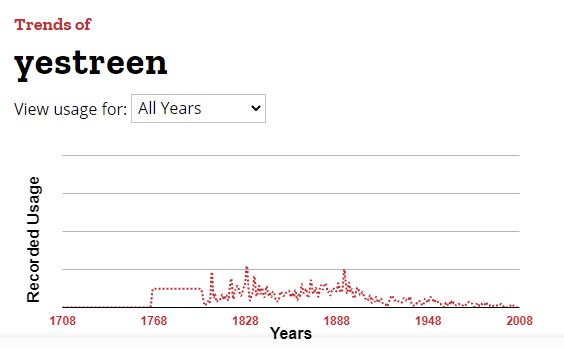
I'm trying to get this charming abbreviation for "yesterday evening" re-adopted.


According to Collins it's Scottish and pretty rare But their "usage trends" graph shows that (back in the nineteenth century) it was all the rage.
</gloss>
... my choir sang this:
Manuscript from Reading Abbey, but probably produced in Oxford.
(see David Crystal, The Stories of English [2005], p. 108)

In  The Stories of English David Crystal says
Reading Abbey did not have a scriptorium, so the manuscript was probably copied at Oxford.
This gives the rota or "round" a double relevance to our choir, as a good few of us live in the Reading area, and both our MD and our accompanist studied at Oxford.

But why Sumer? Isn't it the wrong bird? The cuckoo arrives in Britain in April. Crystal gives the answer:
There was no contradiction, because in Middle English sumer was the only word available to describe the period between the vernal and autumnal equinoxes. The word spring to refer to the season is not recorded in English until the mid-sixteenth century.  
The Stories of English
That Crystal book has reminded me of a pipe-dream I discussed here
<digression theme="pipe-dream" likelihood="0">
Penguin missed a trick (or more likely decided that the trick wasn't worth the outlay) with this book. It was written like a coffee-table book, with two or three sorts of text and standalone features, quite like Words: An Illustrated History of Western Language (which I had a small part in publishing – but a bigger part than I wanted [and that's a whole 'nother story] ). But Penguin just squeezed it all together with tiny margins and no kind of visual clues to what sort of text was which. 
<inline_ps date="2020">
"No sort of visual clue" is strictly a bit of an exaggeration. The designer has done what he or she could in the cost-reduced circumstances of what the trade knows (or knew in my day) as a "mass-market paperback". If you know what to look for it makes sense. There's a vertical rule down the margin of the standalone features; but it's easily missed, and the reader only realizes what's happened when the syntax of two unrelated sentence parts makes the inconsistency felt.
</inline_ps> 
The reader's never sure whether the current text is part of the main argument or part of an illustrative aside. It needs changes in line-length or font or shade of paper to make it a smooth reading experience.
<sub_digression>
In fact, the writing so obviously has this sort of treatment in mind that I suspect it was written to order for another publisher but that the contract fell through. The typescript then got bought by another publisher whose needs were at odds with the book as written. Maybe not though – who knows...?
<sub_digression>
My fantasy – though I haven't discussed this with the good Professor – is to win a large amount of money and become a proper publisher. My Rights department would negotiate with Allen Lane to acquire the rights for a properly designed book, and my Design department would make this book CanDo Publishing's lead title.
<digression> 
<tangent>
In researching this post I've come across my latest nomination for a Tezzy ("Time-wasting Site of the Year".  I haven't dabbled yet, but imagine the temptation will get the better of me in the end.  Here it is, the British Library's Medieval Manuscripts Blog
</tangent>
Enough for now.

b
PS An irrelevant quandary:

My attention has been brought to this petition, and I'm in a quandary about signing it. I know I shouldn't be, as it obviously addresses a critical issue.
<parenthesis>
(My first choice of wording in that last sentence was "It clearly addresses", but while it does obviously address the issue, clarity is hardly characteristic of the way it goes about it. The "writer" has had a thought, taken a number of words in the relevant area, and spewed them out onto the page in the hope that the reader will organize them into something meaningful; with any luck, that meaning will match the meaning intended. 
I am reminded of Sheridan (père's) words (used to drum up business for a teacher of how to write)
We write with ease to show our breeding 
But easy writing's curs'd hard reading. 
</parenthesis>
I want to subscribe to the gist without subscribing to the woeful wording. I do wish people would give some thought to what they're writing, rather than scatter-brainedly  conjuring up a bunch of more or less relevant words and leaving it to the reader to arrange them into a thought. How's this for a doozie?
It is important to learn about Black History and unteach this ignorance as some children may not choose to educate themselves and just listen to the people around them and be influenced causing people to hold racist views and pass them down many generations meaning the cycle of racism and systematic oppression will never end.
Fifty-five words with no punctuation. and daisy-chain syntax. The people the petition is addressed to are almost guaranteed to dismiss it as intemperate ravings.

I guess I'll sign, but with a heavy heart.

Update: 2020.06.06.16:20 – Added inline PS.

Friday, 8 November 2019

The Etymological Clock

Last year, in a belated update to this very early post, I recalled how a bit of wartime parlance happened to get adopted into the Knowles family lexicon.
<TO-BE-EXACT>
I say "Knowles family lexicon" as I haven't come across this usage anywhere else. But the word "salvage" may have a wider application in this sense.
</TO-BE-EXACT>
Recycling waste paper is not as trendy a thing as some of the greenwash we get from politicians might lead one to think. In my childhood, in the 1950s we distinguished between household waste (which went in the bin)  and clean waste paper (which went in 'The Salvage Box'). We had no idea, nor any need to know, what salvage meant; the linguistic 'clock' just happened to stop in WWII, when salvage mattered.
This is what I have called in that  post and elsewhere the etymological clock...
<weasel-words>
(I may not have used those precise words; but the post did use the Corpus Chronophage [look it up] as a metaphor for linguistic change)
 </weasel-words>
... – the engine that drives the coining of new words and expressions, and just stops at seemingly random moments, leaving us with  a reference to some arbitrarily fleeting expression like "nine days' wonder" or the semantically similar "flash in the pan", whose provenance most present-day English speakers don't know about and neither care nor need to know about.
<EXAMPLES which="Those two">
  • Flash in the pan
    A reference to a long-gone firearms technology, which I've mentioned before – more than once. Here, for example:
[I]n a flint-lock, the trigger sparked off an explosion in a pan which itself set off the main explosion. Sometimes there was a flash in the pan, but the main charge was unaffected.
  • Nine days' wonder
In 1600, William Kemp, an Elizabethan clown actor, who is thought to have been the original Dogberry in Shakespeare's Much Ado About Nothing,1599, danced a morris dance between London and Norwich. He took up the challenge for a bet and covered the distance of a hundred miles or more in nine days (spread over a few weeks). Some doubted that he had achieved this and, to quell dissent, he wrote 'Kemps nine daies vvonder', published in 1600:
More
 But that's not the last word on that derivation (or rather it's not the first word) as further reading of that Phrase Finder excerpt explains. In short, the expression had been around for about 300 years when Kemp used it (dubiously). As so often, the etymological clock just happened to stop at a juicy (and quite old) publication date. 
<and-another-thing>
Another example, heard on the radio just now, is "Parts of the Australian outback are a tinderbox". Tinderboxes haven't been in regular use for over two hundred years, but the metaphor lives on.
</and-another-thing>
</EXAMPLES>

Where was I? .... Got it: a Radio 4 programme about Bonfire Night food led me to recall another instance of such wartime jargon (words such as salvage, that is) becoming domesticated. (The context – food – was irrelevant to the memory, so I‘m not bothering with a  link; it just triggered the memory of what I used to wear  on 5 November in the  mid ‘50s.)

The garment was in modern parlance a onesie  though Lexico dates this word to the 1980s,  "... from Onesies, a proprietary name for a garment of this type, based on one + -sy."  But this was a good 30 years before that word was coined. We called it a siren-suit...
<CULTURAL-APPROPRIATION defence="Moi?">
I say "we", though in this case the words  had a much wider application. For Wikipedia's take, click away.
</CULTURAL-APPROPRIATION>
.... Being the second youngest of six children,  I  have a brother who was alive during the war, and at the time was about the right size to bequeath me this hand-me-down. When the air-raid siren sounded at night, a siren-suit was a one-piece garment to wear over pyjamas.

Enough for now. This post was originally intended for a 5 November publication date. Events, doncherknow.

b

Sunday, 9 June 2019

Alexa: What is alexia?

People of my vintage, hearing the prompt: "5½ yards?" will unhesitatingly respond "1 rod, pole, or perch" (well, maybe not all of them) , remembering those glossy red exercise books with tables on the back (I never did find out what "Troy weight" was, though I'm pretty sure the number 20 came into it somewhere; ounces in a pound, maybe.) Anyway, this information was hardly crucial to anything very much, and I don't think any less of people who don't have it at their fingertips.
<digression theme="5½ yards">
Although this measurement is not in wide use today, it may be of interest to those of an etymological bent. Another of those numbers on the back cover of 1960s exercise books was "22 yards = 1 chain".

That quantity crops up all over the place: in measurements (10 square chains = 1 acre); in the phrase chain boy (mentioned in a previous post...
But staying with the subject of measurements (the grit at the centre of this ... erm, whatever) someone on  that programme mentioned how memorable measures (resisting metrication) tended to be monosyllabic – foot, inch, yard, and so on. Which brought to mind another such monosyllable –  chain – which was mentioned too. But what wasn't mentioned, on the subject of persistent obsolete technology metaphors, was the surveyor's assistant: chain boy. (The term was current when my brother was one in the 1970s, and a quick Google search confirms that it's still in use [though sometimes, in a diverse workforce, with PC tweezers]).
...); (oh yes, this sentence is still going; it started back at "That quantity..."); in arbitrary measures, such as the length of a cricket pitch...
<sporting_aside>
On a Rugby Union pitch, early in my rugby-playing career, this arbitrary 22 yards thing was avoided. The line about a quarter of the way down the pitch was 25 yards away from the goal line. But the numerological gods were not satisfied: the number 22 ought to crop up arbitrarily in sports fields. Along came metrication to save the day; the "25 yard line", commonly referred to as "the 25", became "the 22 metre line". In fact, 25 yards is very much closer to 23 metres (22.86), but truncation rather than rounding was chosen; I suspect the numerological gods may have been involved.
</sporting_aside>
...(Phew, NOW the sentence is ended.) 

But this digression started out on the subject of 5½. Probably – I haven't checked – the idea of a quarter of 22 yards is the root of the naming of a quarterstaff.
<Hmm>
I have checked now [couldn't resist], and Wikipedia says it's "probably" derived from something else. I'm not convinced.

Per contra
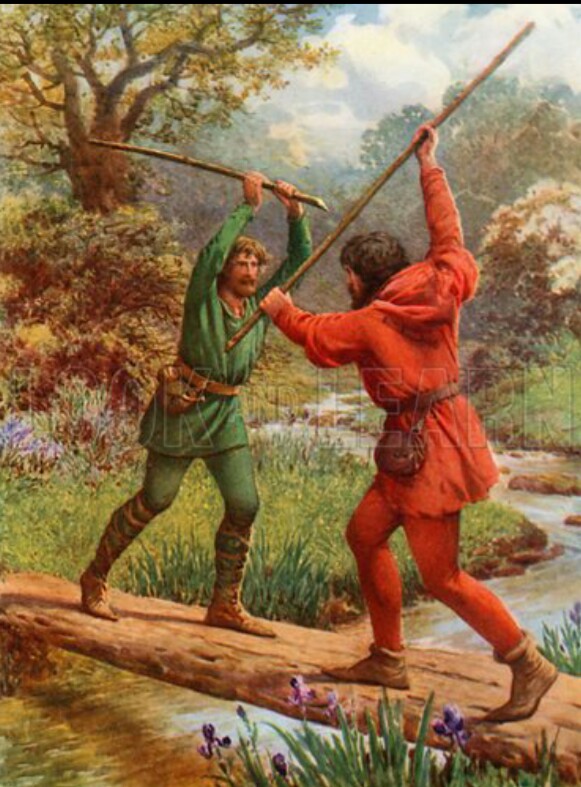
,  a fighting implement 5½ yards long  would be pretty unwieldy even for Little John (who was wielding the first quarterstaff I ever met [in a picturebook, about sixty years ago]).
</Hmm>
</digression>
But a recent survey for Mashable (I say "recent" because the Mashable report is recent; the video itself has no datestamp). But the issue of telling the time on an analogue clock has been around for some time. The late lamented Dave Allen had a routine about it which is worth 6'03" of anyone's time. And many other commentators have said that telling the time from an analogue clock is not a crucial skill for a 21st-century child. (It's just struck me that the ability to read an analogue clock is as irrelevant today as, when analogue clocks were invented, the ability to read a sun-dial became – it can be an impressive trick, but that's all.)

It's not crucial; but losing any skill is a shame. And a risk inherent in any new  technology is that it fosters dependence on it. In case of power cuts it's wise  to keep a few candles handy; and a box of matches. (Luckily, when friction matches replaced tinder boxes, power cuts were a thing of the future.)  But how many new boxes of tricks erode our abilities? Since agreeing (reluctantly...
<comparative_linguistics>
I feel the word doesn't have the force of the Spanish a regañadientes, with its implication of gritted teeth.
</comparative_linguistics>
...) to the use of SatNav,  I've noticed a reduction  in the accuracy of my sense of direction (never great).

Which brings us to alexia (see the subject line). It's related (etymologically, at least, though I have no idea whether the two disorders share any part of the same cognitive mechanism) to dyslexia. but a- instead of dys- – so not-at-all rather than mistakenly).  I wonder what Alexa would make of that. And I wonder whether 22nd-century people (provided that homo sapiens's sapience extends to the avoidance of self-annihilation for that long) will have their ability to read – while probably not entirely eradicated – at least attenuated.

Anyway, cricket calls.

b

Tuesday, 28 May 2019

Schwarzkopf and the harpsichord

Quirks of a translator's life – sitrep

In the course of my translation work (towards the Stephen Spender Prize for Poetry in Translation mentioned before in some recent posts to this blog), I've come across a word with a fascinating cluster of meanings. I've also started to use a new function of Google Sheets – a function that provides a Google Translate version (one word) on the fly.

The syntax of the new function is

=GOOGLETRANSLATE(<cell-to-translate>"<source->","<target>")

for example

 =GOOGLETRANSLATE(A4,"pt","en")

(This function call tells Google Translate to look at the Portuguese word in cell A4 and translate it into English.).

As anyone involved with language knows, meanings of words depend almost entirely on context. So the disembodied words thrown up by Google Translate in its Google Sheets incarnation  can be a bit off-the-wall.

I rather forced that incarnation into the last sentence, as it provides a link to one of the meanings of the keyword, the Portuguese cravo. This can mean "carnation", a meaning that possibly has a more than accidental link with "incarnation", if the derivation for that word (Etymonline lists several possibilities) is the Latin for flesh:

...Or it might be called for its pinkness and derive from Middle French carnation "person's color or complexion" (15c.), which probably is from Italian dialectal carnagione "flesh color," from Late Latin carnationem (nominative carnatio) "fleshiness," from Latin caro "flesh" (originally "a piece of flesh," from PIE root *sker- (1) "to cut"). OED points out that not all the flowers are this color. 
More here
Another possible meaning of cravo is (my source here is the Collins Portuguese Dictionary) "harpsichord". But these language1-to-language2 dictionaries often raise more questions than answers in a translator's mind; I suspect that the equivalent instrument might rather be a clavichord which doesn't sound or behave the same.
<example>
A strangely neglected album has Oscar Peterson playing with Joe Pass in an arrangement of excerpts from Porgy and Bess for clavichord and guitar, exploiting this unique quality of the clavichord: that the thing that strikes the string also defines its length. 
<aside subject="defines">
A deliciously apposite word. The word "determines the length" would be similarly appropriate for those of an etymological bent, as the tangent (that's what the doofer inside a clavichord is called) provides the terminus ad quem the string vibrates.
</aside>
This lets the keyboard  player bend a note, as does a blues guitarist.
</example>
In a harpsichord, on the other hand,  the strings are plucked.
<maybe_though>
(On the other hand, the clavi- bit of the word just means key [as in clef, clavicle, or the French clé] so any keyboard instrument might have been called a "clavi<something>". The makers of the Clavinova were the second (after whoever named the clavichord)  to exploit this neologizing open goal.)
</maybe_though>
Yet another possible meaning of cravo is "nail" or "stud", which – if you think of a nail driven home so that only its head is visible – accounts for the metaphorical use which for reasons best known to Google is the meaning fixed on by Google Translate (try putting that function call 

=GOOGLETRANSLATE(A4,"pt","en")

into a Google Sheets spreadsheet and you'll see what I mean: hint – Schwarzkopf.)

b

Update: 2019.05.28.08:55 – Added PS

PS In my rush to hit the <Publish> button yesterday I left out the one meaning of cravo that applied to the passage I'm translating. Again, it's metaphorical, but unlike blackhead (aha – THAT was it, Schwarzkopf, geddit?) which is animal, this meaning is vegetable: clove.

Monday, 22 April 2019

Heaven, I'm in heaven...

...When we're laid together rotting feet to feet.

This rather ghoulish image will be explained in the fullness of time. It's a long story:
<autobiographical_note date="Summer 1973">
After my first year of Portuguese I went to a summer school at the Universidade de Coimbra, which gave me both a tan and a useful addition to my stock of adjectives-turned-nouns, as every day I caught o eléctrico to the University.
<etymological_note>
I've mentioned this before. In short, one of the engines of word formation is that people get
used to dropping the noun in an
<adjective-noun> pair. A peach is a Persian, and cheese is
formed
or moulded in some languages.
For the full story, see here.
</etymological_note>
Um elétrico is a tram. 
Every Saturday the students were  taken on a guided tour led by a little man who was a geographer, and obsessed with land reclamation. So everywhere we stopped he gave us a lecture on the particular sand of the area. There are several sorts of sand in Portugal, but more than that I couldn't say – as the Portuguese spoken by the students wasn't up to his patter. 
The one other recurring theme of his lectures was the tragic love affair of the prince dom Pedro and his mother‘s lady-in-waiting (Don't queens EVER learn?) Inêz de Castro. One Saturday we visited the Monastery of Alcobaça, where the lovers are buried. The Atlas Obscura recounts:
...King Afonso IV, Pedro’s father, finally had Inês murdered before her children’s eyes. Pedro, heartbroken and enraged, rose up in open rebellion against his father, but ultimately failed in his quest for revenge and justice.  
Two years after Inês’ death, Afonso died and Pedro became king; and here’s where things go a little sideways:  
The tomb at Alcobaça
Legend holds that Pedro ordered Inês’ body to be disinterred, her corpse dressed in finery and propped up in the throne room. Pedro then ordered his vassals to pledge their obedience and loyalty to this corpse he called his wife and queen, and further demanded that they kiss her dead hand. 
Formalities thus dispensed with, Pedro had his corpse bride installed in a lavish tomb...
 Source 

</autobiographical_note>

According to Camões (the author of the piece I‘m working on for the Stephen Spender Prize for Poetry in Translation) her burial place is no less weird – feet-to-feet with her prince, so that the lovers’ first sight (when ‘raised incorruptible’) would be each other....
<inline_ps>
Sounds odd to me (not that the whole thing is particularly unodd). I thought the God-fearing rules required the body to be buried a  particular way round. Besides, shouldn’t they have their minds on higher things? (If they had minds, of course).
</inline_ps>
...The notes to the World's Classics edition  say that the exhumation story "speaks of some derangement", going on
Yet his decree that they should be buried feet to feet... so that hers will  be the first face he sees at the resurrection, seems the action of a lover.
How old is this guy? Has he forgotten? Are passionate romantic love and derangement mutually exclusive?

I had come across the name Inêz de Castro in my study of Golden Age Spanish literature as the subject of a missing work by Lope de Vega (that 'missing' is shorthand for "well-we've-only-got-Lope's-word-for-it-that-it-ever-existed" – but he did write quite a lot of other stuff, so we've no reason to think he was just bumping up his cv by claiming to have written another work); but I thought no more of it at the time.

Interesting though this story is, it may not be suitable as an entry for the Spender Prize for Poetry in Translation. The rules restrict explanations to "a commentary of not more than 300 words". And as Os Lusíadas was first published when Shakespeare was only a
whining schoolboy, with his satchel
And shining morning face, creeping like snail
Unwillingly to school
there are single phrases that call for 300 words of explanation. I've started the translation now though, so I'll finish.

b

Update: 2019.04.22.18:55 – Added inline PS.

Tuesday, 9 April 2019

That's that

I have referred many times to the problems thrown up by the relative adjective/pronoun that.
<digression>
Incidentally, this relative  that, though spelt the same as the subordinating conjunction, is phonologically distinct as it's always pronounced /ðæt/: examples – "I want thAt one"; "Don't give me thAt"), with the vowel never reduced to /ə/. The subordinating conjunction is often reduced to /ðət/: examples – "She told me that she had gone" (/ðət/) but "She told me that (/ðæt/) she had gone, not why".  My guess is that the /ðət/ form is the more often used, and that the chief exception is when there's contrastive ...
<aside>
Ho-ho. The infernal machine has given that word a red underline, and helpfully suggested I might mean contraceptive.
</aside>
...stress (as in my second example). Machine-generated speech often gets this wrong. The latest example I've noticed  was in the first of the new series of Ability.
</digression>
I've  mentioned the which/that controversy here :
<grammar_point importance="negligible" skip="yes, if you value your sanity" status="shibboleth"> 
Suppose I have two lawn mowers. The green one is in the shed and the red one ... is in the garage. Woe betide you if you refer to the green one as 'the mower which is in the shed'. However, you will have Mrs Thistlebottom*'s blessing if you say 'The red mower, which is newer, is in the garage.' 
</grammar_point>
And earlier I had written here about the grammatical inflexibility, as a relative, of THAT in contrast to WHO and WHICH:
The mower that is in the garage is red 
The mower thats power source is petrol... 
The mower on that you can sit while mowing...
To sum it up, here's a table: (I'm not proud of the layout, but still...)

Case     THAT     WHO     WHICH   
Subject         that    who    which   
Object         that    whom
(with or without preposition)
  
which
 (with or without preposition)
Possessive           whose   whose
(a rather old fashioned-sounding borrowing from WHO; most speakers today – especially younger ones – say of which)     
This area of syntactical inflexibility  causes much grief. One can forgive Paul McCartney for "this cold and hungry world in which we live in"; in fact for years I gave him the benefit of the doubt and heard it as "... in which we're livin'". But people with a more thoughtful (if less creative) approach to the language are often left with egg on their faces. In a recent BBC News interview Jacob Rees-Mogg said (right at the start of that recording, about 14 seconds in) that "the EU should be careful for what it wishes for".
<possible_extenuation>
When I first heard it on the radio I thought he had just changed horses in mid-stream; the linguist's word for this is anacoluthon (mentioned before in early posts, here for example: the song I  mentioned in the last para of that post starts like this: [to the tune of Anna*, of course] 
Ana... [backing vocals continue: "...coluthon"] 
Is when a sentence starts one way
But then it begins to stray; 
You start out with one sentence structure 
But it's really different 
In the end  
[Some critics may notice that "structure" and "different" don't rhyme; delivery of this non-rhyme is a matter of performance: a degree of self-editing may be suggested.]
). He started out with the Mrs Thistlebottom version ("for what it wishes"), realized it sounded prissy, and went for the more demotic "what it wishes for"; so that what he said was "be careful f... (thinks: "no, that sounds like a caricature of an Old-Etonian prig") what it wishes for". 
But on a second hearing (recycled on the TV news) I decided my initial generosity of spirit was misplaced; he just got it wrong.
</possible_extenuation>
Enough for now.

b

* Incidentally, the attribution of the song to "J.P. McCartney" on that clip is wrong. This track was on the Beatles' first album, before they had settled on their default setting of <all-songs-home-grown>. In fact the idea of singers writing their own songs was so out of the ordinary that the pop media of the early '60s were full of the word "self-penned", new to me at the time (although, as so often with suspected neologisms, it had a long history before the 1960s – more than 100 years, according to Merriam-Webster). Some of their promotional literature at the time gushed  that Lennon and McCartney had written enough new material to keep them in the charts until 1975!!! (HD: as Wikipedia might say, "citation needed").

Wednesday, 20 June 2018

The Brexicon


Whether you parse my subject line as Br[itish]+ exit + lexicon or Br[itish] + exit + con[fidence trick] is a matter of personal conscience. I couldn't possibly comment (well, I could,  but as the whole sorry shambles reduces me to incoherent/impotent rage, my comments woudn't have much force either way).


On 25 March of 2018 The Westmnster Hour included an item that dealt with the language of Brexit "[f]rom Cakeism and Remainiacs, to Regulatory Alignment and Insufficient Progress" as the iPlayer blurb puts it. The programme as a whole is not available, but iPlayer's largesse makes up for this, by making available a "clip" of about 8 minutes.
The Prime Minister has repeatedly told us that Brexit means Brexit. But what do the words associated with Brexit mean? The Westminster Hour's John Beesley has been exploring the etymology of the Brexit lexicon. 

More here
Graeme Davis, Profeeor of Humanities at Buckingham University, gives the interviewer some basic pointers to start with. It all started with Grexit – which, as you may remember, referred to a putative exit of Greece from the Euro. Britain was never in the Euro, so Brixit [sic, with an i – an early form that didn't catch on] wasn't just about money.

Brexit spawned various spinoffs, includind Brexiter and Brexiteer. Dr Davis calls the first of these  "I suppose, relatively neutral" [hmmm – not sure what that "relatively" is doing; just – suppose  academic feigned diffidence] and the second "has quite a positive spin on it".  Again, hmmm; I think the direction of the spin depends on the attitude of the hearer. If you think Brexit is A Bad Thing, then Brexiteer has more of the negative spin of racketeer (one might link this word with capitalists with off-shore wealth profiteering from the chaos which is bound to... No Bob, don't go therre. Even words like privateer and buccaneer have spin that can be either positive or negative, depending on which end of the cutlass is involved. 

And the addition of the prefix arch- seems to me to impart renewed negativity. If I call Jacob Rees-Mogg an arch-Brexiteer, I don't think there's much risk of my being thought to  approve of his antiquarian antics. 
<apologia>
Excuse the gratuitous assonance; I can't hear a word without being tempted down playful back-alleys. At least I spared you the 'Jacob Real-Smug' gag...
<whoops>
No I didn't.
</whoops>
</apologia>
In the end, I didn't find the Westminster Hour clip very enlightening. But I did find the words of Kathleen O'Grady ("a journalist with a special interest in linguistics") interesting:
German is currently the most widely spoken native language  about 16% of the EU speaks German as a native language. But once you take into account people who speak various languages as a second language, English then quickly overtakes both German and French, and also Italian – which is quite widely spoken. So 38% of adults in Europe speak English as a second langage. If you compare that to the total of German speakers – both native and as a second language – that's only 27%.
And she goes on to refer to research that suggests the use of English may be boosted by Brexit:

After the UK leaves, most people speaking English in the EU ...
<you_what?>
Most people? Perhaps she has some Astérix-like vision of a redoubt of hardy native speakers of English among all the second-language speakers – perhaps led by Nicola Sturgeon in the Astérix role, with Alex Salmond playing Obélix...
</you_what?>
will be on the same footing. If everybody's on the same footing, everybody's speaking it as a second language, people might be more happy to use it.
This is strangely reminiscent to me of David Crystal's work in Original Pronunciation (OP)  and his observation that OP gives non-UK actors ownership of the text. I heard this at a British Council talk a few years ago., but the same point is made by David Crystal's son Ben:
The accent draws him [HD: the actor using OP] more out of the head of the standard accent and into the heart. This, he believes, brings “an ownership over Shakespeare that is rare,” both for the actor and the audience. Americans, he notes, have sometimes told him that they feel like Shakespeare isn’t theirs because “we can’t do your accent,” but that many of the vowel sounds in O.P. may in fact be more accessible naturally to Americans than to modern Brits.

More here
So Globish will go sailing off pluckily into the unknown, leaving us speakers of RP clinging to the wreckage.

But this isn't getting the lawn patched. Bye for now

b
PS: A couple of clues:
  • Hostile response to insult, with intervention of mountain bike in reverse; formidable. (11)
  • Men and girl conspiring to put a spanner in the works (7)
Update: 2018.07.12.09:30 – Shame-faced typo-fixes (involving acute accents).

Wednesday, 6 June 2018

Advertorial or what?

Generally speaking, I'm in favour of the BBC. No prizes, though,  for detecting a none-too-faint whiff of adversity (or but-ness) in the offing.  A while ago the first of three facinating programmes was aired. The second and third programmes were a vast improvement...
<rant>
 (although it's hard not to judge the acuity of the analysis  on the basis of a scarcely credible abuse of incredulously 15'17" into the third, as if bacteria were going around scratching their tiny heads – but one shouldn't be snobbish about... hell yes I will:

this is BBC Radio 4 for pity's sake, and we
can expect at least a MODICUM of literacy
<loaded_term value="literacy">
Tricky word that one. I've seen it used in the context of an infant ...
<etymological_fallacy risk="high">
And I have to admit that when I use the word "infant" I have a perhaps over-zealous regard for its root. Sorry, but I regard 'infant who has not yet learned to talk' as pleonastic; infants haven't.
</etymological_fallacy>
...recognizing and responding to the golden arches indicating a certain McFood outlet. But here I'm using it in the specific sense of ability to use words to convey meaning. And don't try any clever-clever stuff about "the meaning of meaning"; you know what I'm talking about.
</loaded_term>
         )
</rant>
But the later programmes were less of a hook-line-and-sinker regurgitation of a press release from the company that has the very same name as the BBC series (which took the name verbatim from the market leader in this area: The Second Genome...
<small_mercies>
At least they didn't add the TM. Here's the  iPlayer link
</small_mercies>
...) At the time of the series I made a note in a draft that I was inspired to dust off by last Tuesday's Life Scientific, which dealt with the immune system. To quote the programme's précis:
Traditional descriptions of the human immune system bristle with military analogies. There are "lines of defence" against "enemy invaders"; "border guards" at "strategic points. And when barriers are breached, there's "a call to arms". That's before you mention Natural Killer Cells.

But Professor of Immunology and Public Engagement at the University of Manchester, Sheena Cruickshank, tells Jim that as well as the war-like descriptions, our immune system is now being understood in terms of its capacity for diplomacy too. Jaw-jaw as well as War-war.

Our immune system has to know when to tolerate the trillions of microbes that live on us and in us, to hold fire but also to know when full-scale immune activation is required.

More here
But the whole thing  is well worth a listen. Give it a go.

I, meanwhile, must go and learn my words for this – less than 3 weeks away as I type:


(One or two notes could do with some attention as well.) 

Sadly it'll be our  Musical Director's UK swansong with the choir; I say 'UK' specifically because he and the choir will be performing in France in August.

b

PS: A couple of clues:
  • Blackbird embracing upstart noose in a big way (10)
  • Mistaken queen preceding onerous with queen coming first. (9)


Wednesday, 30 May 2018

Oh what a tangled web we weave...

...when we try to organize our thoughts about language ...
<digression>
(and it's no accident that the idea of weaving is at the root of the word text – 'from PIE root *teks- "to weave, to fabricate, to make; make wicker or wattle framework."', as Etymonline puts it. They quote Robert Bringhurst, from The Elements of Typographic Style:
An ancient metaphor: thought is a thread, and the raconteur is a spinner of yarns -- but the true storyteller, the poet, is a weaver. The scribes made this old and audible abstraction into a new and visible fact. After long practice, their work took on such an even, flexible texture that they called the written page a textus, which means cloth.
</digression>
I've written before about the damage done by thinkers about language, who create their whole petty world of Mrs Thistlebottom's "rules", policed by Strunk & White, purveyors of jackboots to all discerning grammar Nazis. Here, for example, I wrote
When Dr Johnson defined a lexicographer as 'a harmless drudge' I think he knew what he was doing. Lexicographers can make life much more difficult for students. They say 'Look, what a boon is standardization'; but look at the mess they make!
(Interested readers can look in that post for examples of the mess.)

But, as  a representative of a pattern-loving species I have to put my hand up for the fault of  seeing rules where there is only (messy, almost chaotic) usage.


In The Changing English Language (my entree into Linguistics, which I first read in the late 1960s), Brian Foster wrote:

Nouns ending in "-ee" have long been a feature of the English  vocabulary, and such a modern-looking  formation as "payee"  goes back to the 18th century, while "recognizee" (the person to whom one is bound in a recognizance) is dated 1544 by the SOED, These particular examples show the fairly characteristic passive meaning implied by this suffix..

There are many examples of this passive sense. The Macmillan English Dictionary (not a notable authority, but the publisher of the dictionary software I happen to use) lists addressee, amputee,  appointee, deportee, detainee, employee, evacuee, franchisee, inductee, internee, interviewee, licensee, nominee and payee – all unarguable  patients of the verb in question. An element of indirectness is discernible in referee: the person is not referred; what is referred (to the referee) is a point of fact or interpretation. Devotee is also different, in  that the actor and the patient of the act are one and the same – except in the case  of forced conversions (where "devotee" would in any case be a misnomer). And the passiveness in the case of retiree is questionable; some people "of pensionaable age" are happy to put their feet up; it is only their more dedicated colleagues who fit the passive pattern and are retired  against their will.

But Brian Foster goes on to say

Such indeed is the usefulness of this device that an endless succession of nonce-words based on it  is made possible,  like the one made up by Gilbert Harding when he wrote in his Book of Manners that '... a hug from the Russian bear might well crush the huggee to death.' This semi-humorous [HD Only semi- ? Well, maybe not a rib-tickler, but definitely jocular] procedure is not a new one, for in Mr.  Sponge's Sporting Tour, published in 1853, R. S. Surtees refers to a person being toasted as the 'toastee'.

But, he goes on

... the possibility of using this suffix in an active sense is old-established, because 'absentee' goes back to 1537 and 'refugee' came into the language in 1685, the year of the Edict of Nantes by Louis XIV when many French Huguenots fled the country to escape persecution. Escapee is attested in 1865...

Hang on, I thought when I read this. S'abstenir is reflexive anyhow, so someone who does it to him/herself is an absentee with no problem for the seeker after passives. And both  s'échapper and se refugier are as my old French master would have said verbes de déplacement: someone who has escaped s'est échappé[e], and someone who has sought refuge s'est refugié[e]; again, there's no problem for the passive-o-phile. (If you've met the argument about 17th- and 18th-century grammarians making the mistake of trying to force English into the grammar of Latin [so, for example, no sentence-final prepositions], you may get a sense of dêjà vu here: it's just that the mistake here is the adducing of French grammar.)

So despite evidence to the contrary, I still have a quiet resentment of arriviste non-passives like attendee.
<autobiographical_note>
This issue came to a head when I was in a working group that had rotating minute-takers. Many of my colleagues had knocked up a clever bit of time-saving software that highlighted differences from meeting to meeting. As I was their junior, and they expected a flag to mean Something's new rather than Bob's at it again, I soon learnt not to change Attendees: to Present:
</autobiographical_note>

But that evidence to the contrary  (to the contrary, that is, of the passive implication of -ee endings) keeps mounting. Attendees are joined by resignees, even dilutees (unskilled workers who dilute the skill-level of a group of skilled workers).  I feel that these new -ee words with no passive implication are in some sense regrettable. But they happen, and a student of language can only recognize it and avoid creating yet another angels-on-a-pinhead  "rule" for the unwary to stub their toes on (and yes, I did write their).  

b

PS 

Some clues:
  • Before? After? Get up, with last going first. Ridiculous! (12)
  • Truncated Hamlet done recast as contemporary political thriller. (8)
Update: 2018.11.22.10:30 – Added PPS.

PPS: The answers: PREPOSTEROUS and HOMELAND.

Saturday, 21 April 2018

Et in arcadia Lego

What people say and the way they say it often grates with me. This is my problem rather than theirs, but as I've said elsewhere, I'm a prescriptivist in descriptivist's clothing, Believe me, my life would be a lot easier if I didn't have a gnome brandishing a red pen sitting on my shoulder  muttering 'That's wrong' all the time. Meanwhile, on my other shoulder, the Good Fairy of Descriptivism says 'No it's not. Take a chill pill. That's how language works.'

Politicians are frequent offenders, because of the need to produce verbiage at the drop of a hat (or maybe that should be at the thrust of a microphone). As it happens – with no particular political axe to grind – my latest irritant has come from the mouth of Theresa May, who in a Commons debate accused Jeremy Corbyn of letting anti-Semitism run rife in the Labour Party.


"Run RIFE"? The British National Corpus (hereafter "BNC")  has no instances of run rife, and 1 of ran rife. [With this and other BNC searches, click on the link and sit back while the search engine does its stuff – which might take a second or two, depending on the usual computicle variables: Your BIT-RATE May Vary] .

On the other hand, in BNC, with the searchstring * riot, run riot is 3rd most common with 44 instances, running riot is 11th most common with 16 instances, ran riot is 12th most common with 15 instances, and runs riot is 20th most common with 7 instances. Running is what happens in the vicinity of the word riot: or, as a bean-counter might say "run is the most common verb to appear in collocation with riot"; this search (for any verb preceding riot) confirms it; (the figures don't match; I don't know why [e.g. 44 instances of run riot according to the first search, but 36 in the second],  but they're in the same ball-park).

But whenever the prescriptivist gnome says "That's wrong" I risk coming a cropper. Another Corbyn-related word supplies an example, only this time he was the speaker; the word was ram-packed. When he used it I thought "Well, he means jam-packed, doesn't he, he just made up this new word to emphasize how people were crammed in [to a Virgin train, if you must know]."

BNC  is too small to have a statistically convincing number of examples of jam-packed, so I've turned to the less authoritative but much more populous {if that's the word – one populates a database, so no one can say people have to be involved} Google. Given the Google treatment,  jam-packed has more than nine million hits  – more than a match, I thought, for the arriviste "ram-packed" (which of course the Good Fairy says is fine, but...).

However, ram-packed is more than a match for jam-packed, as this search shows; 22.5 million, rather than a piffling 9.27 million. It was an arriviste to my limited ken, but not to English.  Wiktionary says it was formed from ram and packed (natch)
... originally (since at least the 1940s) literal, referring to something packed with a ram. (Possibly reinforced by the rhyming synonym jam-packed.)
So he who hesitates has a chance of getting things right.

b