Showing posts with label Eça de Queiroz. Show all posts

Saturday, 20 June 2020

Reservio Dogs...

(a tribute to Google, which helpfully suggested that I might have mis-typed, or to  use my own coining, committed a stenoglurch.)

Remember Consignia (a short-lived attempted rebranding for  grouping together all the one-off brands that used to form part of the "GPO")? As  the BBC put it at the time, under the headline Consignia: Nine letters that spelled fiasco :
A duffer. A howling waste of money. 
The most ruinous decision since the biblical scam that saw Esau swap his birthright for a bowl of stew. 
Think "Post Office Group", think trust, honour, gritty postmen braving blizzards to save a child's smile. 
Think "Consignia", the name which replaced it. Think, um, Roman general? Footballer? Tummy bug? 
More

This was not the only company in the early noughties that went in for a fancy foreign-looking ...
<apologia>
(not that I have anything against foreignness  – indeed, whenever someone starts a sentence with "So" and a pause, I experience one blissful moment of hope that they will continue "is  the French for bucket"}
</apologia>
...word that ended with a diphthong. Our local tip (or to give it its more woke name domestic refuse recycling facility) has instituted a system of reservations – called "Reservio". At first I thought this must be a child of the fancy of some Veolia (they're the recyclers) executive with no sense of the ridiculous.

But Reservio, it turns out, is another of those noughties coinings  (or very nearly – the website was registered in   2010, so there must have been a series of meetings in 2009 when the creation of this chimera was mooted.)

Translation News


Meanwhile, back at the Stephen Spender  Prize, which I suppose is nearly an annual tradition (since I entered last year too) I've been thinking about the relative fortunes of complacent and complaisant – apropos of nothing much (except that one of them cropped up in what I was doing). They don't necessarily mean the same (though there's a good deal of potential overlap, and Collins goes so far as to say that they used to be synonymous in British English and still can be in American English.

They differ, when spoken, in only the voicing of the /s/|/z/ phoneme, which (what linguists call "homonymic clash" and ordinary people call "pun") usually in the development of languages leads to the ousting of one (somewhere in this blog I've cited the case of "let" as in the legal  jargon "let or hindrance" and the tennis player's "let" – both meaning something like obstacle).
<rant fierceness="a million suns">
(and the commentator who insists on saying "let-cord", suggesting that it's something to do with the net-cord, rather than just SOMETHING GOT IN THE WAY. As a matter of fact, it usually is the net-cord that gets in the way, but it could be a pregnant albatross or a drone, anything. And not only a thing. It could be a flash of lightning. They'd still play a let. 
When this bloke (I think it's only one) says "let-cord" it  makes  me want to... count to ten and think of my Happy Place, because otherwise I might have a seizure).
</rant>
When the Great Vowel Shift made the impeding sort of "let" and the allowing sort of "let" uncomfortable bedfellows, one of them had to go; so now "let" almost always means "allow" (except for fossils like the ones I've mentioned, on passports, say – even on the red-covered pre-Brexit ones).

Well, Google displays these unattributed graphs:
The demise of "complaisant"
The rise of "complacent"

Call me old-fashioned, but I'm not a fan of unattributed citations, so I went to Collins again (whose trend charts are at least attributable, even though they stop short 2 years shorter, and don't give quite so clear a picture of the reciprocal fortunes (if I was more of a geek I'd overlay these 2 curves; I'll have to leave that to your imagination.)

The Collins charts are:
"Complaisant":( I wonder why the bottom fell out of the market in the 18th century.)

"Complacent": a steady-ish rise in fortunes

Time I continued with the Great Garden Furniture Refurbishment. There's just time for one more item of Translation news. In the John Dryden Translation Competition my entry (mentioned in an autobiographical note in this post) made the Long List (but got no further). Top quartile but no cigar, as they say. Oh well, onwards and upwards.

b

Saturday, 25 April 2020

From spine-tingling to nerve-jangling

The starting point for today's jaunt...
<note_to_self>
Must check on the etymology of jaunt. Looks a bit Indian to me. like jamboree and jodhpurs and juggernaut.
<cut_to_chase>
Couldn't help myself. 'Unknown origin' says Etymonline. But the trip to that source wasn't entirely wasted, as it's added to my stock of words that have done a somersault and reversed their meaning (as, for example, has backlog, discussed here (and elsewhere, from time to time: you know the drill).

There's not a lot on Etymonline to justify this switch in polarity; well. nothing really:
1670s in modern sense of "short pleasure trip," earlier "tiresome journey" (1590s), from jaunt (v.)
</cut_to_chase>
  <note_to_self>
 ...is a virtual choir recording in which I have a paternal interest. I'm not a fan of most web content (as they say) – most of it a mixture over-sentimentalized verbiage and meretricious clickbait – but this really does live up to its billing as both "spine-tingling" (though the headline wasn't that concerned about hyphenation) and "spellbinding" (a word that recalls to me that Bennet madrigal discussed in an update to this: "music the time beguileth").

In 2016 this Tallis piece displaced Spem in Alium – (House Song of the Van Helsings [no, that's Allium, 'Hope in Garlic'] {This is getting very silly}) – as my favourite (by that composer), as my choir prepared for the tour mentioned, tangentially (you know the drill), here.

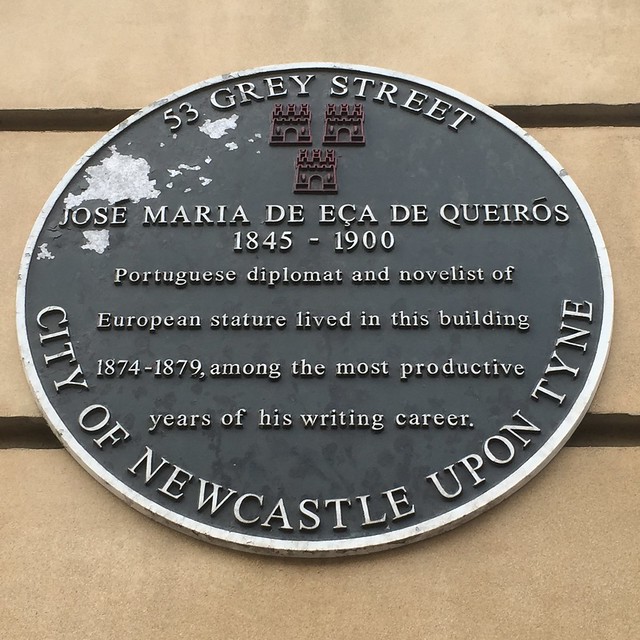
On our first night in Newcastle a bunch of us ate at a restaurant on Grey Street, where I noticed this plaque (not a blue plaque, I noticed, perhaps for some reason: Black for foreigners that nobody's heard of? Or maybe it's more subtle than that: grey to match the street.


José Maria de Eça de Queirós black plaque | Open Plaques

Well I had (heard of him), and read a good deal of his oeuvre (or obra as we say in the trade).
<autobiographical-note>
and earlier this year (2020, keep up) I entered  a translation of some of his work for 

THE JOHN DRYDEN
TRANSLATION COMPETITION 
(Excuse the shouty typeface; I cut/pasted it from the entry form.). As well as being a novelist and a diplomat he was also a journalist, and a posthumous publication in 1905 assembled much of his work as Cartas de Inglaterra. He was a sort of fore-runner of Alistair Cooke, writing "Letters from England". 
I was first introduced to his work at a summer school at the Universidade de Coimbra, where they had a proprietorial interest in him as an old boy more than a century earlier.
<aside>
The lecturer had a quaint way with pronunciation, joining together two vowels with a... No.  TMI. Vivid memory though.
</aside>
</autobiographical-note> 
Returning to Tallis, I also sang the piece as a visiting Old Member at my Cambridge College in May 2018.
<autobiographical-note>
We visitors were each flanked by members of the present Corpus Christi Chapel Choir, who had mostly been raised as trebles in cathedral schools. So they had a trained reflex to raise a hand when they (rarely)  made a mistake. If I had done the same I would have given myself RSI.
</autobiographical-note>
And more recently we sang it at the WCS choral workshop back when the only place in Corona lockdown was Wuhan; and the (sadly few) basses made such a mess of our E'en the spirit of truth entries that it was not so much "spine-tingling" as nerve-jangling.

But I have secateurs to wield
And sheds to fix before I shield...

<apropos enemy="covid19", first-casualty="language" >
Which reminds me: I'm finding it hard to say 'I'm shielding' (which is the magic word for people especially at risk).  The health chappies (Witty et al.) are obviously not conversant with the Sapir-Whorf hypothesis – which sprang partly from Benjamin Whorf's experience working with insurance claims. He recognized that the way people described situations often contributed to misfortunes; for example, the phrase "empty petrol cans" encouraged people to underestimate their flammability, as "empty" can mean null or void or having no effect – as in "empty threat" "empty promise" and so on. 

Similarly (at last, the point) the verb shield implies strength. A (hero) shields B (vulnerable person) from C (danger). So saying 'I'm shielding' invites the belief that I'm strong. So when I was recently ordering some pills online I asked for them to be delivered to my home address rather than asking MrsK  to queue outside the pharmacy (which I gather we're saying now instead of chemist – I'm tempted to do the full Shakespeare and say apothecary). But I didn't want to say "I'm shielding" in case someone who spoke English misinterpreted it. (On the international stage I reckon this might be more of a problem. People exposed daily to Wittygrams know all about this (ab)usage; but not Johnny Foreigner.)

Just saying. People planning resistance campaigns of all kinds need to think about the language they're using.
</apropos>
...And sheds to fix before I shield. 

That's all for now

b

Update:2021.01.1610.55 – Added PS

PS
You see? Thin end of the wedge. The syntax of the verb 'to shield' was threatened by covid, and now the door's open for further abuse. Emily Maitlis, on yesterday's Americast, used the expression "He was shielding" to mean "He was sheltering" – with no hint of a virological meaning.

PPS
Come to think of it, the verb 'shelter' has precisely the kind of transitive/intransitive flexibility that 'shield' is beginning to have. 

Tuesday, 30 May 2017

Make Hay while the author signs

In Spring an old man's fancy turns to books.

According to Heinrich Wallau, writing in The Catholic Encyclopedia:
Gutenberg was the son of Friele (Friedrich) Gänsfleisch and Else Wyrich. His cognomen was derived from the house inhabited by his father and his paternal ancestors "zu Laden, zu Gutenberg". The house of Gänsfleisch was one of the patrician families of the town, tracing its lineage back to the thirteenth century."
<autobiographical_note theme="Wikipedia strikes again">
Ever since 2009, when I saw a Stephen Fry documentary about Gutenberg (that link is to iPlayer's TOUGH BANANAS page – the programme is no longer available) I have wondered about the status of Gänsfleisch. Was his name Gutenberg or was it Gänsfleisch? And I wondered why, when Fry touched a Gutenberg Bible and said he had gooseflesh, he didn't exploit the pun (Gänsfleisch means gooseflesh).

A partial answer (the surname thing, not Fry's self-denial [perhaps explained by the lamentable brevity of the mini-series – I wonder what other gems were swept up from the cutting-room floor]) comes from an examination of Wikipedia's source
His surname [my emphasis] was derived from the house inhabited by his father and his paternal ancestors ...
Wallau's word was cognomen. Johannes was as much Johannes Gutenberg as Leonard Woolf was Leonard Hogarth  (whose business just took its name from Hogarth House). I imagine the wikipedioscribe saw cognomen, wondered what it meant and looked in some benighted dictionary that went for tight-lipped and simplistic one-word "equivalences" such as Dictionary.com's
 

... without bothering to read the rest of the definition.
</autobiographical_note>
I have a note that "Gutenberg pre-sold  in Mainz"; I have no source for that snippet, but he was at least born in Mainz – so-called not because of its nearness to the Main river, but still the coincidence is pleasing). Today the hub of the universe, in the matter of pre-sales of books, is the Book Fair at Frankfurt am Main the Frankfurter Buchmesse).
<digression>
Maybe this week's Book of the Week was sold there (that is non-German book rights). It bears all the hallmarks of a tolerable but not quite good enough translation, with near-miss malapropisms (like consistent for constant [on Monday]; today's was "war-horses need to be attuned [sic] to gunfire" – not habituated/accustomed/inured...?)

And another sign of translation rights having been pre-sold is this sort of illustration...


...or quotes such as this:


...Massey-Ferguson?

Sometimes translation is not really possible; some texts need to be localized as well. And international book fairs such as "Frankfurt" (to use the jargon of the publishing business) do their best to ignore this. It's in the interests of the Foreign Rights Seller to say that everything will be hunky-dory, and leave it to the poor translator to make a fist of it.
</digression>
Ah well. I have more to say but DIY to do. Stay tuned.

b

PS And here's a clue:
  • Sounds like it calls for retreads all round? Too late for that. (10)
Update: 2017.06.02.16:45 – Added afterthought.PPS

A recent televising of a Maigret story reminded me of the name Quai des Orfêvres – the legendary (not to say inaccurate [but cp "Scotland Yard"]) address of the Direction Régionale de Police Judiciaire de Paris . When I first  read Simenon, I just let the address wash over me: Orfêvres was a name, tout sec.

But it slowly seeped into my understanding of the word that it was built from or (of course) and fèvre; to quote the French Wikipedia page 'ancien terme désignant un ouvrier travaillant le fer...'. In other words, Orfêvres means GOLDSMITHS
<linguistic_note> 
But why not  Fêvres d'Or? I don't know, having cunningly avoided the History of French paper for reasons possibly explained elsewhere in this blog, but boiling down to sloth on my part...
<rant>
(and I do wish more speakers of English would observe the distinction between on the part of  and on behalf of – even the BBC does it [with notable, not to say noble, exceptions]. It's got so that I am starting to doubt myself. Collins suckered me into a sense of self-righteousness with this:


But then they hit me with the sucker punch:


Oh well: yet another  solecism that I shall forever avoid but increasingly hear.
</rant>
... but I expect it's something to do with the Strassbourg oaths, discussed elsewhere (with an important proviso here) which divided France between languages that put the defining word first (Neuchâtel) and that put it second (Châteauneuf).
</linguistic_note> 
The original users of that wharf, at one time home to La Police Judiciaire, were Goldsmiths.

Finally. another snippet from Lingo, which ends each chapter with a word that has no direct "equivalent" in English. The chapter on Icelandic ends with this: Jólabókaflóð. Erm...

I'm sensing a whiff of The Great Eskimo Vocabulary Hoax. I concede that English has no one-word equivalent, but in what sense is this "one word" (except in the trivial orthographic sense that it has what Primary school teachers used to call a fingerspace at each end [with obvious exceptions for punctuation marks])? If I were to say "Yule book flood", that would be  a phonological word. So what's the big deal? The multifaceted Victorian literato/diplomat Eça de Queiroz noticed this flood (tanto livro!) in the (as yet) untranslated Cartas de Inglaterra (a sort of Letter[s] from America, but written by a Portuguese observer, writing for a Portuguese newspaper, and based in England.).

Update: 2017.06.02.21:45 – Added PPS

PPS What has this to do with the price of fish? you may well ask. Well earlier this week I heard an interview with Jane Goodall, whose observation of chimps "fishing" for termites with a stripped rod showed that tool-making was not a specifically human activity. The pre-existing belief  was epitomized (that‘s one for the etymologists) in the book Homo faber , and it was the Latin faber (the root of fèvre) that brought the Maigret memory to mind. Though this seems madness yet there is method in‘t.

Update: 2017.06.26.20:55 – Added PPPS

PPPS That crossword clue answer: RETIREMENT. And here‘s another:
  • If opened, cynical deal with DUP‘s a way of guaranteeing this. (10,3,6)
Update: 2017.12.20.21:05 – The answer: CONFIDENCE AND SUPPLY


Tuesday, 1 November 2016

Siege perilous


For the last month or so, though no longer – as atrocities redefine atrocity and the word enormity reclaims its self respect – I couldn't hear the name Aleppo without recalling an early Richard Curtis sketch.
<autobiographical_note time_span="1976.07:1976.09" venue-"Edinburgh">
Like much (all?) Richard wrote at the time, it was a vehicle for Rowan Atkinson. That star of the Oxford Theatre Group one-man show (with a cast of 9) – mentioned here and, briefly,  in the update to this post – was a conductor in tails and white gloves and with a baton, conducting (in the hilarious sort of random juxtaposition, so typical of Oxbridge humour at the time) a rehearsal of a scene from Othello. The Moor was delivering the lines 
"...that in Aleppo  once...
I took by the neck the smitten dog and circumcised him thus" 

[I've underlined the two typoes for the benefit of bardophiles who may know the original and gloss over them.]
At this, the conductor tapped his lectern, frowned, and indicated that Othello should try again. Othello did, still with the words "smitten dog ...circumcised". The conductor stopped him again. [Repeat ad lib as long as the audience is laughing]. Eventually, Othello got the words right: "circumcisèd dog...smote".
</autobiographical_note>.
Now though I can hear the word Aleppo without that irrelevant memory popping its irreverent head over the PC parapet. Now it's the word siege. that distracts me momentarily from the horror.

I discussed  chairs a while back, here, but said nothing about siege at the time. In Mallory's Morte d'Arthur the vacant seat at the Round Table was the siege perilous, and this was the earliest meaning: a chair. Etymonline says
siege (n.) Look up siege at Dictionary.com
early 13c., "a seat" (as in Siege Perilous, early 13c., the vacant seat at Arthur's Round Table...[F]rom Old French sege "seat, throne," from Vulgar Latin *sedicum "seat," from Latin sedere "sit" ...
Only then does the entry go on:
...The military sense is attested from c. 1300; the notion is of an army "sitting down" before a fortress.
That is to say, siege had been around for about a century with the meaning chair before it acquired its military sense. Sadly (considering the fate of the besieged) the military sense became the predominant one

But that "Vulgar Latin *sedicum" (and its more reputable Latin relatives) left many other traces, from courts in session to recording studios (with session musicians); in a less formal musical environment, a guest musician may sit in (and of course they don't just sit). In Portuguese, where Spanish has catedral (which Portuguese [Continental Portuguese, that is; to call my grasp of Brazilian Portuguese rudimentary would be a gross overestimate]  can also use, having many such pairs*), the word is (in Coimbra, in the summer of 1973 I used to catch the eléctrico at a stop called Sé Velha). The Holy See is a Santa Sé


Of course, English too has see in this sense (that is, not just in the abstract sense of Holy See, but in the concrete sense of bishopric). Cathedrals, sees and all sorts of hierarchical seats...
<digression type="potential" status="LOOK IT UP">
When discussing hierarchies it's worth remembering what ἱερός  means.
</digression>
...form an all-enveloping web of words and meanings.

Back to Real Life...(at present I'm caught in the crossfire of two WSIWYG tools, which disagree about what constitutes well-formed HTML – aha, that's it, #headslap [different versions of HTML]!)

b

 *Eça de Queiroz  is notable for using such pairs: a bottle, for example, is sometimes uma botelha and sometimes uma garráfa.

PS And here's a clue:
 Feigning incapacity when malign reign gets the treatment. (11)

Update 2016.11.03.09:10 – Added PPS

PPS The penultimate sentence in that Etymonline entry for siege ended ...from Latin sedere "sit" (see sedentary). The entry for settle (the noun) ends with the same cross-refernce:

settle (n.) Look up settle at Dictionary.com
"long bench," 1550s, from Middle English setle "a seat," from Old English setl "a seat, stall; position, abode; setting of a heavenly body," related to sittan "to sit," from Proto-Germanic *setla- (source also of Middle Low German, Middle Dutch setel, Dutch zetel, German Sessel, Gothic sitls), from PIE *sedla- (source also of Latin sella "seat, chair," Old Church Slavonic sedlo "saddle," Old English sadol "saddle"), from root *sed- (1) "to sit" (see sedentary). 

That [PIE] root has many progeny.

PPPS – And here's another clue:

Unprepossessing discount store stocking entertainer. (8)

Update 2016.11.03.14:35 – Correction in red.

Update 2017.12.19.19:30 – Added P4S

The answers: MALINGERING, GRIMALDI.

Friday, 20 March 2015

Sony and Scott de Martinville

A bit of mail the other day asked if I'd review something I'd bought: the subject line helpfully told me There’s still time to review your recent Argos purchase. Normally I'd've ignored it, but as it reminded me of an impulse buy that I'd regretted I followed the link thinking 'OK Argos, you asked for it' and ranted away.
<rant> 
After a sentence or two I noticed the warning Maximum review-length exceeded by 243 characters. How very dare they,  invite me to vent and then pull the rug out from under my... er... keyboard? So I gave them a couple of dismissive sentences, and stored my words of wisdom for future recycling.
It was hard to set up, because the ON/OFF switch was hidden away at the back. With the radio I was replacing the ON/OFF switch was at the front. This was convenient because switching off with this button was more graceful (in engineering terms); think of a Windows PC – it has to be shut down properly. Switching off my previous  DAB radio directly at the socket made an audible popping sound (increasing wear on the speakers). With a button on the front, switching off properly was easy.
But, as it happened, this radio did not have a graceful way of shutting down; the popping sound was equally loud whether I switched off at the wall or using the inconveniently placed ON/OFF switch. So I ignore the popping sound and switch off at the wall. People who know me personally will know how to interpret the word 'ignore'.
 </rant> 

OK, what's bought is bought; Quod empsi empsi.

But this serves to introduce the theme of sound transmission technology. Recently I caught the end of a TV series that asked How we got to now with Steven Johnson and as his name was part of the title I assumed he was an expert. Perhaps so [definitely, it appears], but not in all things, in particular with respect to phononograms. [Oops – I misheard his accent; he gets it right, but with a confusingly trans-Atlantic twang.]

The phonautograph, a precursor of Edison's Earth-changing invention, is described here (about 9 minutes in). Johnson asks
Why has nobody heard of this guy? Because, unbelievably, Scott's design was missing one crucial feature: playback.
It could record, but not reproduce. This is strangely (inversely, in every way, including commercial success) like the Sony Walkman, which was based on an existing dictation machine, but with the recording facility neutered. (For all I know the technology was still there inside the box, but as it had no User Interface it might as well not have been. This cnet piece may tell you.)
<autobiographical_note>
This reminds me of a project I worked on in the late 1980s, which similarly involved taking an expensive bit of kit and bastardizing it – 'cost-reduced engineering' was the buzzword du jour.
</autobiographical_note>
So whereas Sony made a mint by taking a sound recorder and removing the ability to record sound  – a sound recorder that couldn't record     Édouard-Léon Scott de Martinville made not a sou by inventing a machine that could record but couldn't play back.

Ho hum. I wanted to find a quote from one of  Eça de Queirós's Cartas de Inglaterra. Eça was a sort of 19th-century Alastair Cook, based in England, and writing home not to the UK but to Portugal.

Full details here
When he hears reports of Edison's 1877 invention, he imagines their primary use will  be in making 'living wills' – understandable really as (in the words of that Johnson TV programme)
For the 100,000 years since language developed, every word  ever spoken by anyone was immediately lost to the air.
And one of the video clips used to illustrate these words is a death-bed scene. Letting the dead speak was a major selling point of sound recording technology. But that quote will have to wait until after the concert I'm singing in on Saturday. Don't miss it.


Update: 2018.03.10.17:05 – Removed old footer.

Tuesday, 30 September 2014

The Times it is a-changing

Some time in early Spring 1966 The Times dropped a bombshell. Since the year dot (and in the case of The Times this is a pretty remote dot – 1785, says Wikipedia): in place of the classified ads that had previously appeared on the front page (Wikipedia says 'the front page featured' them FFS. But the point is that the front page was featureless) they were going to print news. What a thing for a newspaper!
<autobiographical_note date_range=1965-6>

This was about the time my big brother came home with a nylon-stringed guitar that had a broken back, repaired with a three-inch screw where the fretboard met the body. Above the octave, the strings were a good half-inch away from the frets.This meant that before a string met the fretboard it stretched; so the higher up the fretboard you played, the sharper the note became not so much the Well-tempered klavier – the Ill-tempered vihuela perhaps.
  <excuse>
Took a bit of a liberty with the instrument there, but the consonance (all three vowels) was too good to miss. 
<excuse>
In the spare time that pubescent boys had in those pre-National-Curriculum days, I started to pick out tunes. Mick had borrowed a 'teach-yourself' LP (on the Argo label) which tied a particular style of accompaniment to one song: 'hammering on' – 'Trouble in Mind'; arpeggios – 'Black Girl'; 'clawhammer'  – 'There Were Three Bothers'; calypso – 'Dip and Fall Back' ...and so on.

When the news of The Times' concession to sensationalism hit, Bob Dylan was still in his protest phase. 'The times they are a-changin'' was in the Zeitgeist. And the title of this post 'came up' from the depths of my mind (and you might have detected, in that 'came up', my current interest in subvenire). But I hadn't got far enough in my guitar 'studies' (I could do a pretty impressive accompaniment to  'Trouble in Mind', but nothing else) to think of making that first line into a song. I squirrelled it away, and here it is at last.

 </autobiographical_note>
Well,  John Walter who founded The Times on the 1 January 1785 as The Daily Universal Register, will be spinning in the family vaults (which his mortal remains have occupied since November 1812). This Saturday The Times had neither classified ads nor news on its front page, but a photograph taken on the occasion of a celebrity wedding. OMG or what? Murdoch hadn't forked out for the actual wedding photos, but the grubby intent was still there.

This calls to mind a scene from my as yet unpublished (as yet undone, except for a 30-odd page sample that I hawked around a few publishers in the late '70s) translation of Eça de Queiroz's Cartas da Inglaterra (a sort of Victorian Letters from America, but written by a London-based Portuguese diplomat and man of letters [no pun intended, and none taken I hope]). It was a breakfast scene, with a daughter doing her filial duty and saving Papa's eyes by reading from The Times over breakfast. But some filthy bounder, an infamous scoundrel of the first water (whatever that is), had breached 'The Thunderer''s Victorian firewall and somehow amended the proofs, substituting obscenities. When his daughter read the results of this cruel deception, Papa nearly choked on his kedgeree.  (I meant to quote this properly, but the translation, and indeed the text, is In a Box in the loft. Allegedly. Fingers crossed.)

My reaction on Saturday morning was similar. Well, all right, The Times did make a concession to the news of an insignificant little war somewhere East of Suez. But don't worry, there'll be no 'boots on the ground', only 'suits in the board-room'.

Or perhaps they could use pogo-sticks; no dusty boots then.

b
Update 2014.09.30.14:20 – Added this clue (not  relevant to anything in this post)

Evacuation without a breach of faith. (9)

Update 2014.10.01.14:30Esprit d'escalier, in blue.
Update 2014.10.01.14:20 – Encore plus, in maroon.
Update 2015.09.10.09:25 – Added PS
OK, time's up: DEFECTION

Update 2017.06.27.16 Removed old footer