Showing posts with label David Crystal. Show all posts

Friday, 5 June 2020

Brother Lawrence / in the scriptorium / with a quill

Medieval Cluedo?

Yestreen...
<gloss>
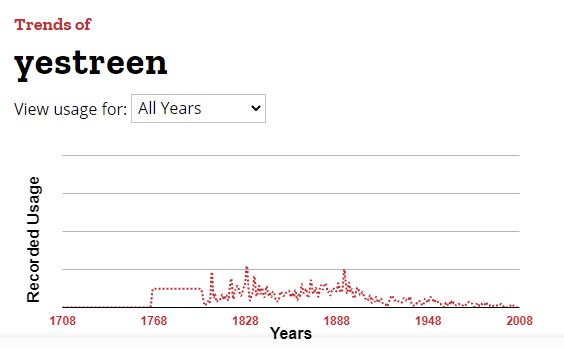
I'm trying to get this charming abbreviation for "yesterday evening" re-adopted.


According to Collins it's Scottish and pretty rare But their "usage trends" graph shows that (back in the nineteenth century) it was all the rage.
</gloss>
... my choir sang this:
Manuscript from Reading Abbey, but probably produced in Oxford.
(see David Crystal, The Stories of English [2005], p. 108)

In  The Stories of English David Crystal says
Reading Abbey did not have a scriptorium, so the manuscript was probably copied at Oxford.
This gives the rota or "round" a double relevance to our choir, as a good few of us live in the Reading area, and both our MD and our accompanist studied at Oxford.

But why Sumer? Isn't it the wrong bird? The cuckoo arrives in Britain in April. Crystal gives the answer:
There was no contradiction, because in Middle English sumer was the only word available to describe the period between the vernal and autumnal equinoxes. The word spring to refer to the season is not recorded in English until the mid-sixteenth century.  
The Stories of English
That Crystal book has reminded me of a pipe-dream I discussed here
<digression theme="pipe-dream" likelihood="0">
Penguin missed a trick (or more likely decided that the trick wasn't worth the outlay) with this book. It was written like a coffee-table book, with two or three sorts of text and standalone features, quite like Words: An Illustrated History of Western Language (which I had a small part in publishing – but a bigger part than I wanted [and that's a whole 'nother story] ). But Penguin just squeezed it all together with tiny margins and no kind of visual clues to what sort of text was which. 
<inline_ps date="2020">
"No sort of visual clue" is strictly a bit of an exaggeration. The designer has done what he or she could in the cost-reduced circumstances of what the trade knows (or knew in my day) as a "mass-market paperback". If you know what to look for it makes sense. There's a vertical rule down the margin of the standalone features; but it's easily missed, and the reader only realizes what's happened when the syntax of two unrelated sentence parts makes the inconsistency felt.
</inline_ps> 
The reader's never sure whether the current text is part of the main argument or part of an illustrative aside. It needs changes in line-length or font or shade of paper to make it a smooth reading experience.
<sub_digression>
In fact, the writing so obviously has this sort of treatment in mind that I suspect it was written to order for another publisher but that the contract fell through. The typescript then got bought by another publisher whose needs were at odds with the book as written. Maybe not though – who knows...?
<sub_digression>
My fantasy – though I haven't discussed this with the good Professor – is to win a large amount of money and become a proper publisher. My Rights department would negotiate with Allen Lane to acquire the rights for a properly designed book, and my Design department would make this book CanDo Publishing's lead title.
<digression> 
<tangent>
In researching this post I've come across my latest nomination for a Tezzy ("Time-wasting Site of the Year".  I haven't dabbled yet, but imagine the temptation will get the better of me in the end.  Here it is, the British Library's Medieval Manuscripts Blog
</tangent>
Enough for now.

b
PS An irrelevant quandary:

My attention has been brought to this petition, and I'm in a quandary about signing it. I know I shouldn't be, as it obviously addresses a critical issue.
<parenthesis>
(My first choice of wording in that last sentence was "It clearly addresses", but while it does obviously address the issue, clarity is hardly characteristic of the way it goes about it. The "writer" has had a thought, taken a number of words in the relevant area, and spewed them out onto the page in the hope that the reader will organize them into something meaningful; with any luck, that meaning will match the meaning intended. 
I am reminded of Sheridan (père's) words (used to drum up business for a teacher of how to write)
We write with ease to show our breeding 
But easy writing's curs'd hard reading. 
</parenthesis>
I want to subscribe to the gist without subscribing to the woeful wording. I do wish people would give some thought to what they're writing, rather than scatter-brainedly  conjuring up a bunch of more or less relevant words and leaving it to the reader to arrange them into a thought. How's this for a doozie?
It is important to learn about Black History and unteach this ignorance as some children may not choose to educate themselves and just listen to the people around them and be influenced causing people to hold racist views and pass them down many generations meaning the cycle of racism and systematic oppression will never end.
Fifty-five words with no punctuation. and daisy-chain syntax. The people the petition is addressed to are almost guaranteed to dismiss it as intemperate ravings.

I guess I'll sign, but with a heavy heart.

Update: 2020.06.06.16:20 – Added inline PS.

Wednesday, 20 June 2018

The Brexicon


Whether you parse my subject line as Br[itish]+ exit + lexicon or Br[itish] + exit + con[fidence trick] is a matter of personal conscience. I couldn't possibly comment (well, I could,  but as the whole sorry shambles reduces me to incoherent/impotent rage, my comments woudn't have much force either way).


On 25 March of 2018 The Westmnster Hour included an item that dealt with the language of Brexit "[f]rom Cakeism and Remainiacs, to Regulatory Alignment and Insufficient Progress" as the iPlayer blurb puts it. The programme as a whole is not available, but iPlayer's largesse makes up for this, by making available a "clip" of about 8 minutes.
The Prime Minister has repeatedly told us that Brexit means Brexit. But what do the words associated with Brexit mean? The Westminster Hour's John Beesley has been exploring the etymology of the Brexit lexicon. 

More here
Graeme Davis, Profeeor of Humanities at Buckingham University, gives the interviewer some basic pointers to start with. It all started with Grexit – which, as you may remember, referred to a putative exit of Greece from the Euro. Britain was never in the Euro, so Brixit [sic, with an i – an early form that didn't catch on] wasn't just about money.

Brexit spawned various spinoffs, includind Brexiter and Brexiteer. Dr Davis calls the first of these  "I suppose, relatively neutral" [hmmm – not sure what that "relatively" is doing; just – suppose  academic feigned diffidence] and the second "has quite a positive spin on it".  Again, hmmm; I think the direction of the spin depends on the attitude of the hearer. If you think Brexit is A Bad Thing, then Brexiteer has more of the negative spin of racketeer (one might link this word with capitalists with off-shore wealth profiteering from the chaos which is bound to... No Bob, don't go therre. Even words like privateer and buccaneer have spin that can be either positive or negative, depending on which end of the cutlass is involved. 

And the addition of the prefix arch- seems to me to impart renewed negativity. If I call Jacob Rees-Mogg an arch-Brexiteer, I don't think there's much risk of my being thought to  approve of his antiquarian antics. 
<apologia>
Excuse the gratuitous assonance; I can't hear a word without being tempted down playful back-alleys. At least I spared you the 'Jacob Real-Smug' gag...
<whoops>
No I didn't.
</whoops>
</apologia>
In the end, I didn't find the Westminster Hour clip very enlightening. But I did find the words of Kathleen O'Grady ("a journalist with a special interest in linguistics") interesting:
German is currently the most widely spoken native language  about 16% of the EU speaks German as a native language. But once you take into account people who speak various languages as a second language, English then quickly overtakes both German and French, and also Italian – which is quite widely spoken. So 38% of adults in Europe speak English as a second langage. If you compare that to the total of German speakers – both native and as a second language – that's only 27%.
And she goes on to refer to research that suggests the use of English may be boosted by Brexit:

After the UK leaves, most people speaking English in the EU ...
<you_what?>
Most people? Perhaps she has some Astérix-like vision of a redoubt of hardy native speakers of English among all the second-language speakers – perhaps led by Nicola Sturgeon in the Astérix role, with Alex Salmond playing Obélix...
</you_what?>
will be on the same footing. If everybody's on the same footing, everybody's speaking it as a second language, people might be more happy to use it.
This is strangely reminiscent to me of David Crystal's work in Original Pronunciation (OP)  and his observation that OP gives non-UK actors ownership of the text. I heard this at a British Council talk a few years ago., but the same point is made by David Crystal's son Ben:
The accent draws him [HD: the actor using OP] more out of the head of the standard accent and into the heart. This, he believes, brings “an ownership over Shakespeare that is rare,” both for the actor and the audience. Americans, he notes, have sometimes told him that they feel like Shakespeare isn’t theirs because “we can’t do your accent,” but that many of the vowel sounds in O.P. may in fact be more accessible naturally to Americans than to modern Brits.

More here
So Globish will go sailing off pluckily into the unknown, leaving us speakers of RP clinging to the wreckage.

But this isn't getting the lawn patched. Bye for now

b
PS: A couple of clues:
  • Hostile response to insult, with intervention of mountain bike in reverse; formidable. (11)
  • Men and girl conspiring to put a spanner in the works (7)
Update: 2018.07.12.09:30 – Shame-faced typo-fixes (involving acute accents).

Friday, 22 December 2017

Be'ind the harras

My attention to words that include the string *AR* has brought to my attention (not that it was ever totally unfocused, rather that I now have done a bit of relevant browsing  in dictionaries) a word (or group of associated words) that points to an ongoing change in pronunciation. And there is a coincidental surge in that word's frequency of use, starting with Harvey Weinstein  and ending (for the time being, though the boor is always with us) with Damian Green. No prizes for guessing that the mot du jour is  harass.

The dictionary I use for my daily grind (the Sisyphean sonorants book) is the Macmillan English Dictionary  (more by historical accident than for any actual preference). It is happy to recognize two stress patterns for this word, both with British English vowels and with American English vowels:

And the Cambridge English Dictionary is equally accommodating, although it gives only two audio examples:


And the two audio snippets are in line with the (mistaken)  view that stress on the second syllable is in some sense American: the "UK" one is is /'hærǝs/; the "US" one is /hǝ'ræs/.

The Oxford Dictionaries site goes one step further, favouring (in its order – which echoes the order that the Cambridge English Dictionary specifies for the US pronunciations) the version with iambic stress (dit-dah):

On the page that calls up a specifically US definition, the same site points to the move:


(Note that this is on the American English site: the prejudice against the iambic stress is felt on both sides of the Atlantic.)

I remember a note in a VIth form text book that said that Shakespeare stressed the word aspect iambically.  I imagine this would be confirmed in David Crystal's The Oxford Dictionary of Original Shakespearean Pronunciation.

I wonder if that's the way harass is going (though in reverse: aspect => aspect, but harass => harass).

But we are in the twilight world in the midst of the change, so that in a single TV interview (which I can't track down right now, but which I heard yesterday, honest) the two stresses are both used: Kate Maltby says /'hærǝs/ while Laura Kuenssberg says /hǝ'ræs/.

But in the words of Tom Lehrer, Christmas time is here by golly. Gorra go.

b
PS: Some clues:
  • In disarray, she'll claim me a famous introduction. (4, 2, 7)
  • After Tom Jones, trifled (with emotions, perhaps). (7)

Update: 2018.04.30.15:30 – Added PS

PS: The answers: CALL ME ISHMAEL and FLIRTED

Friday, 1 April 2016

Long time no screed

See what I did there?

I was thinking last week about Maundy Money, and of course its derivation – the derivation not just of the word Maundy but of the ceremony itself (the distribution of largesse [well, not that LARGE]). What was given  out at the ur-ceremony was not so much largesse as a service.

The One True Church commemorates this in The Washing of the Feet.
    <autobiographical_note theme="Been there, done that">
    At the service on Maundy Thurday
    <digression>
    THINKS
    : must look up the other day names: I can do Easter Sunday, Holy Saturday, Good Friday, Maundy Thursday OK, and I think it's Spy Wednesday (ridiculous, really, as if Judas was a Fifth Columnist rather than a flawed bloke – as was Peter in the same story); but I have a feeling there are epithets for Monday and Tuesday too.
    <digression>
    The celebrant (priest numero uno, in my case Father Abbot) re-enacts Christ‘s emblematic washing of the apostles' feet – except that they were really dirty after a typical dusty Palestinian...
<digression>
Always with the dust,  already. In Saturday‘s concert we sing, in Laudate Pueri, about the Lord de stercore erigens pauperem, "translated" as "raising up the poor from the dust". But dust was the least of your worries in ancient Palestine; stercus means something a lot more organic than dust: dung, says Etymonline under scatology. (And if you think you've detected metathesis there – see Letters playing leapfrog [and elsewhere] – you're learning)
</digression>
    ... day in sandals, rather than still smarting from Auntie Katy‘s attentions with nail brush and pumice stone (as the part of the apostles was played by a dozen altar boys).<autobiographical_note> 

Mandatum novum do vobis, ("I give you a new commandment...") said Christ (according to the Vulgate).

French made this order mandé, and that nasalized a became in English aun.* At least, that was the story we were given at the time. In later years I have to admit that I suspected a trace of pious folk etymology – as with the Doomsday Book (which I long believed came from Domus Dei, an inventory of newly Christianized Britain (not that Christianity hadn't been around for several centuries – it's just that William was a True Believer): the House of God. Plausible, but rubbish).

So I did a bit of checking, and found that Maundy is related to  mandé:
          Maundy Thursday Look up Maundy Thursday at Dictionary.com
Thursday before Easter, mid-15c., from Middle English maunde "the Last Supper," also "ceremony of washing the feet," from Old French mandé, from Latin mandatum "commandment" (see mandate)...
(Courtesy of Etymonline as usual, with no apology for recourse to the usual source; I can't afford an OED subscription. But in case you want another reference, they're easy enough to find. Here's one, for example or  here, or ...)
And while we're on the subject of the etymology of Easter words, try this. Fancy simnel cake being related to semolina (spot the phonological change process: hint – look at the consonants in simnel/semolina).

But I must go and prepare for the Big Day. –

b

PS: a couple more clues:
  • Nothing but going over the same ground again and againdull as ditch-water,
    for example.
    (12)
  • Onset of season after climate change makes a climber. (8)
Update 2016.04.04.17:35 – Added link to review.

PPS – And here's a review of last Saturday's concert.

Update 2016.04.19.11:00 – Added footnote:

* Looking for something else (as ever) I just saw this confirmation of the "French -an => English -aun" spelling oDavid Crystal's blog:
 ...France is usually spelled France in the First Folio, but it is spelled Fraunce when the French are speaking (suggesting a pronunciation of 'frawnce'). Henry is also given this spelling when he is trying to speak French to Kate - and he has it just once when he is speaking English. 

Update 2016.05.16.10:25 – Crossword answers: ALLITERATION and CLEMATIS

Monday, 15 February 2016

Progress with Unity (or was it Nancy?)

Wordwatch

I can date with some precision my first exposure to the horrid "going forward" (in the meaning from now on (which saves a few characters, saves one syllable, doubles the opportunities for sensible line-breaks – go-ing? for-ward? – and has the added advantage of NOT MAKING YOU SOUND LIKE A TOTAL WALLY).  I was reminded of this quite unexpectedly when I happened to see a flurry of tweets such as these:


Not being a close follower of a Presidential Election that's not going to take place for another nine months – we haven't reached Peak Bull$h*t  yet, not even close – it was news to me that she was even in the running for nomination (until she wasn't).

In September 2001 Ms Fiorina, in only her second year as CEO of HP (or "H-P" to use the rather quaint style favoured by the Wall Street Journal) made her play for Compaq (the shrimp that had engulfed the Bostonian lobster that I had started to work for in 1984, acquired by Compaq in 1998). A short time after her arrival in my world (probably in late 2001, or possibly early in 2002 – I have a feeling that she may have wished us well for the Holiday period, but I wouldn't swear to that memory) she spoke to her worldwide empire in a huge video conference. I was one of the few hundred employees crammed into the canteen at DEC Park – or the employee cafeteria at Worton Grange as we were corporately adjured to call it. But we were one little outpost; questions were phoned in from all over the world.

Revenons à nos moutons  – "going forward". In that video conference (a description that grossly overstates its interactivity – it was really a TV broadcast with a few carefully sanitized phoned questions tacked on at the end) Ms Fiorina outlined her view of HP's future (which didn't include the bit about her being kicked out in 2005), and during this rose-tinted vision she used the phrase going forward several times. The first time she used it –  although it was not difficult to interpret, because of English's (and most [if not all?] other natural languages') use of the spacetime metaphor – it took a moment to sink in; had she really said that? Well, she had, and went on to do so several times more. Maybe it was current then in the American business world. But it is now, even in the UK.

I referred in my last paragraph to 'the space → time metaphor' . I think I've provided examples of this somewhere in my earlier posts. I'm sure I've come across it in works by David Crystal and Steven Pinker (not in collaboration [!]) But links to these will have to wait for an update 'for I have promises to keep and miles to go before I sleep and miles...' (you get the idea).

b


Update 2016.02.16.15:55 – Added PS:

PS. Here are some of the links I promised.

The Pinker one is from The Stuff of Thought: Language as a Window into Human Nature (edition-specific reference; other editions are available) p. 191 et passim:
The similarity between space and time is limpid enough  that we routinely use space to represent time in calendars, hourglasses, and other time-keeping devices. And the cognitive similarity  also shows up in everyday metaphors, where spatial terms are borrowed to refer to time.
My post was about transport rather than space, though speed (space/time) is central to that idea. Here's a taste:
He [Ed: Brian Foster, in The Changing English Languagewrites:
'Cavalcade', etymologically a procession  of horsemen, has given rise in American English to a series of words in which the -cade element denotes the idea of 'spectacular display', e.g. aquacade, musicade and motorcade. Of these only 'motorcade' has penetrated into British use.... It remains to be seen how productive this ending will be in Britain....
Well, he was writing in 1968 (or before), so I think we can stop holding our breath;  -cade's hopes of becoming a productive suffix in British English, can wave forlornly to that slow-moving motorcade, or cortège, that follows many a linguistic speculation like this.
But elsewhere automobile-based metaphors pervade the language. A person who is not at their best can be said to be 'not firing on all four [cylinders]'. Rather than rush you can 'put the brakes on' (or, with a nod to former times, you can 'hold your horses'). If you're in a hurry you either 'put the pedal to the metal' (which must come from American English, as the wordplay is better with an American accent) or 'step on it' or 'burn rubber'. The point where, for the walker 'the shoe pinches' is where 'the rubber meets the road'. And while we're on the subject of tyres, assessing the suitability of something in a desultory way, with no clear intention of buying it (either literally or figuratively) is 'kicking the tyres'. People who need to get moving should 'get their a$$ in gear' and someone who's making progress is 'going through the gears'.
I must have dreamt the Crystal quote, or – more probably – just can't find it. Anyway, the metaphor is clear and suggestive, or to use Pinker's word limpid, which I'll trump, if I may be so bold, with a word I've just come across: NITID. This word, defined by Collins as (poetic) bright; glistening deserves, I think, a new lease of life. The Collins Usage Trends graph shows this sad decline (meteoric, in the falling-rapidly sense). In the 18th century the word must have been on everyone's lips:

Where was I? Commonness. The future is in front of us; the past is behind us – everyone knows that. And I'll bet that no language teacher could ever have taught the past tense without pointing back over their shoulder. En seguida ['following'], sur-le-champs ['on the field' – hmm, not sure how that one works; perhaps it's the field of battle, where you have to make split-second decisions...], langsam ['lengthily', to mean 'slowly']... there must be hundreds (thousands?) more.

Update 2016.02.17.12:55 – Added PPS:

1965 coat of arms
PPS. I've just realized that my subject line (Progress with Unity...) makes little sense to anyone not having knowledge of my early drafts. The word progress suggested itself to me as a possible meaning for going forward – "as we  progress". Progress with Unity is the motto of the Borough of Ealing – "QUEEN OF THE SUBURBS" as  it was once known.

1902 coat of arms
In the '60s, with Ealing, Acton, and Southall conglomerated, the burghers of Ealing realized that they needed a new coat of arms; the old one, granted in 1902, was reworked. "The boring old elitist Latin obviously had to go – but hang on, what did it mean anyway?"

Coincidentally, it exemplifies that space/time metaphor this blog was looking  at earlier: "Look back [and] Look forward". "Well," said that burgher (talking in the Swinging Sixties) "Look back? Where's THAT at? But Look forward – that works."

So, ironically, the new motto does "Look back", in that it keeps the idea of looking forward from the 1902 version.

b


Tuesday, 10 November 2015

Litigious software engineers?

This extract, particularly the use of actionable, was in line for a FOGGY. But I thought better of it. The word, as they say, does what it says on the tin, so what grounds have I to be sniffy about it?
Each day, our society creates 2.5 quintillion bytes of data (that’s 2.5 followed by 18 zeros). With this flood of data the need to unlock actionable value becomes more acute
Source: Coursera
The word actionable is not in the Macmillan English Dictionary  (except, of course, in the legal sense) or in Collins English Dictionary or Cambridge Advanced Learner's Dictionary, or in the 1913 edition of Websters. In the first of these the word has a URL that suggests it is 'American' (a common, usually mistaken, gibe – but that's another story, brushed on in this blog,  passim).

But Webster's New World College Dictionary has the new sense: 
This has taken two steps away from the Path of [prescriptive] Righteousness:
  1. 'Action' is verbified
  2. The 'new' verb (which is not really new) has had the suffix '-able' applied, to turn it into an adjective (with the 'suffixer' oblivious to the fact that the neologism treads on the toes of a  pre-existing word that has an unrelated meaning).
And the Oxford Advanced Learner's Dictionary has caught up with the second meaning too. 

It's a change that has been coming for some time, which is indicated by the Collins frequency graph showing actionable's frequency (although, as I've noted above, Collins doesn't note the new meaning):
Frequency graph from Collins English Dictionary

I suspect, though proving as much would take more corpus-query nous than I have*, that the rapid rise from the mid-'80s...
<autobiographical_note>
When I started my involvement with writing about  computer networks, in 1984, I had to get used to (and learn to live with) several new applications (there's one, for example) of words I'd been happily using for years. One of these was 'actionable', frequently used in the world of nets&comms where, as I understand it, it is used to describe a chunk of data that the software knows what to do with [and excuse the personification – that was another trick I had to get used to: a software engineer who means ‘the software assesses the data and sends it to X' {where X is another software module being developed by engineer N} says ‘I sniff the data and hand it to N'; a neat bit of jargon, but one that calls for quite a bit of decrypting]. This Google search shows that on a single site (w3.org  – home of the relevant geeks) there are 1,750 hits.
</autobiographical_note>
... is due to the spread of the new meaning.

All of which is pretty plausible... Except that I have conveniently cherry-picked my data.  Going back a further 50 years the same Collins site shows this frequency:
A tale of litigiousness in the Roaring 20s?
So what's the message? Perhaps this just underlines a point  made by David Crystal in his treatment of the 100th word, twittersphere, in The Story of English in 100 Words:


What causes language-change? Events, dear boy, events – among other things.

b

Update 2015.11.10.20:40 – added this note:
*It was easier than I expected. This BNC search throws up 87 hits for "actionable". Of these, 66 are marked as academic, and of those 64 have the sub-class W_ac_polit_law_edu. So, making the safe assumption that the ones in that sub-class had the legal meaning, there were only 23 to trawl through by hand. Out of the 87, all but 2 have the legal sense.

Update 2015.11.11.09:20 – added this PS:
PS This note, I now realize, suggests the precise opposite of  what I wanted it to. I wondered if the American story would be different. This COCA search shows that things are very different for American English:

This calls for further reflection, but not now. 

Update 2015.11.12.22:20 – Updated TES stats.

Update 2015.11.15.19:20 – made addition in blue to autobiographical bit.


Mammon When Vowels Get Together V5.2: Collection of Kindle word-lists grouping different pronunciations of vowel-pairs. Now complete (that is, it covers all vowel pairs – but there's still stuff to be done with it; an index, perhaps...?)

And here it is: Digraphs and Diphthongs . The (partial) index has an entry for each vowel pair that can represent each monophthong phoneme. For example AE, EA and EE are by far the most common pairs of vowels used to represent the /i:/ phoneme, but there are eight other possibilities. The index uses colour to give an idea of how common a spelling is, ranging from bright red to represent the most common to pale olive green to represent the least common.

I'm thinking about doing a native iBook version in due course, but for now Mac users can use Kindle's own (free) simulator.

Also available at Amazon: When Vowels Get Together: The paperback.

And if you have no objection to such promiscuity, Like this

Freebies (Teaching resources:  
Well over 49,900 views  and nearly 9,000 downloads to date**. They're very eclectic - mostly EFL and MFL, but one of the most popular is from KS4 History, dating from my PGCE, with nearly 2,700 views and nearly 1,100 downloads to date. So it's worth having a browse.)

** This figure includes the count of views for a single resource held in an account that I accidentally created many years ago.


Thursday, 5 November 2015

Taking things to ♥

In last night's talk at the Great Hall, Reading, David Crystal mentioned a change on Twitter (a tweak?) that has caused ructions. Not being a daily user of Twitter –  a twenizen or twabitué – I was aware of it but could not date it so precisely; a has become a ♥ ; at my latest visit, I just noticed and thought  Whyever did they do that?
The had a pleasing ambiguity. I have used it in the past for two things:
  1. As a marker for the last tweet  I had read (back in the days when I tried to at least cast an eye over all the tweets in my timeline). This mimics the First Unseen command of my one-time great love VAX Notes – which I may have mentioned before.
  2. As a way of keeping a record of tweets I wanted to remember (typically, pointers to web pages).
Unlicensed screengrab from
https://www.youtube.com/watch?v=w9lmCpIzhFo
So, as I saw it,  the star was a marker for my use. I had not, then, come across the concept of a social media Like. In the world of social media there is a growing trend in favour of expressing approval of things, by awarding a Like (not a precise synonym for 'a like' in the analogue world – which is a habitual preference, as in likes and dislikes). Well, to call it  'a growing trend' is something of an understatement; it's more an outpouring of unEnglish bonhomie, which is gradually seeping into British English among users of social media. A digital Like is a notch in your digital gun (or, for Not The Nine O'clock News fans, a hedgehog symbol on the cab of your lorry). It's something to be proud of, and a public statement of your worth.

I realized the importance of this distinction when posters of tweets that I had marked with my no. 1 sort of 'like' (when the nearest sense to liking was in the implied You [i.e. I –  this is an internal monologue, remember] may LIKE to note that you've seen everything before this one) started thanking me.

A questioner after the talk asked whether Crystal expected the reinstatement of the  alongside the ♥.  Many users of Twitter had complained, Crystal had said – particularly (or at least most vocally) journalists, who didn't want to Like a picture of a beheading,  for example, when they just found it noteworthy. And this called to mind an example from a forum thousands of times smaller than Twitter.
<autobiographical_note> 
When I first started using UsingEnglish.com there was no way of symbolically expressing approval. This was in 2006, when many users still had slow dial-up lines. It was frustrating to spend <however long> (90 seconds?) downloading the latest reply to a note you were subscribed to, only to see the word Thanks (or even just tx or ;) ). So the powers that be introduced a Thanks button. 
But the forum, which used the vBulletin package was, in time, social-ized. You could have Groups and Friends and stuff – all those social impedimenta that we nerds are uncomfortable with. And as part of this social-ization (or in its wake [I'm not sure of the relative dates]) the Thanks button was re-labelled Like
This was not popular. People wanted to be able to give Thanks without the emotional incontinence of spraying Likes around like an over-excited puppy. Some time afterwards  – I don't know how soon after the change to Like, as a job intervened and I took a sabbatical from my moderating duties  – a new Thanks button was introduced alongside Like. This effete contempt for Likes has backfired. The Facebook page for WVGTbook has amassed a pitiful 60-odd Likes in about 2 years. He who lives by the ... umnm, this sentence has lost its way. 
 </autobiographical_note>

So, if I were a betting man, I would put money on Twitter following suit with their symbols. Look out for a  alongside the  ♥.

b

PS My occasional award of a Tezzy (for the Time-Wasting Site of the Year) goes to this site. Unlike previous Tezzy laureates, it's not really the site itself that is the time-waster – but rather the activity that the site invites.

Update 2015.11.09.10.10 – Added this note:
Crystal-watchers will note that this prediction is at odds with the Professor's insistence on  avoiding predictions  about language-change (except the certainty that something will change). I  – no doubt unwisely  –  am less careful.

For example, in a recent reply in the UsingEnglish forum I wrote:

If I were to say 1 is wrong [HD – the question was about a dog 'perking up' or 'pricking up' its ears], I would expect a chorus of disapproval from people who thought I wasn't aware of how language changes. And one of those ways is the ultimate acceptance of something that initially was a mistake. Elsewhere I wrote

The word VESPERTILIONES was glossed in this document [an early list for travellers of equivalent phrases and mistakes] as CHAUVE-SOURIS. Elcock goes on:
.... In fact, bats are not noticeably bald..., and one is tempted to infer that CALVAS SORICES is a product of 'popular etymology', hiding a quite different word. In most French patois bats are called 'flying-mice' or 'bird-mice'; it may well be that CALVAS is in reality *KAWAS [the asterisk is a convention used to mark a supposed, not attested, form], the Germanic word which survives as the root of Fr, chouette 'owl'.
'Owl-mouse' - for chauve-souris - would make much more sense. But what caused the change from *KAWAS to CALVAS? ...
So I would say the use of 'perk up' given in 1 is not entirely acceptable yet, but it's understandable and therefore becoming more widely accepted. If you ask the same question in 50 years, the answer might be 'Yes, it's right', but somebody else would be answering!


Mammon When Vowels Get Together V5.2: Collection of Kindle word-lists grouping different pronunciations of vowel-pairs. Now complete (that is, it covers all vowel pairs – but there's still stuff to be done with it; an index, perhaps...?)

And here it is: Digraphs and Diphthongs . The (partial) index has an entry for each vowel pair that can represent each monophthong phoneme. For example AE, EA and EE are by far the most common pairs of vowels used to represent the /i:/ phoneme, but there are eight other possibilities. The index uses colour to give an idea of how common a spelling is, ranging from bright red to represent the most common to pale olive green to represent the least common.

I'm thinking about doing a native iBook version in due course, but for now Mac users can use Kindle's own (free) simulator.

Also available at Amazon: When Vowels Get Together: The paperback.

And if you have no objection to such promiscuity, Like this

Freebies (Teaching resources:  
Well over 49,800 views  and nearly 9,000 downloads to date**. They're very eclectic - mostly EFL and MFL, but one of the most popular is from KS4 History, dating from my PGCE, with nearly 2,700 views and nearly 1,100 downloads to date. So it's worth having a browse.)

** This figure includes the count of views for a single resource held in an account that I accidentally created many years ago.


Monday, 2 November 2015

Fantasy footfall

My theme today is remarkably stupid bits of pseudo-academical 'truth' that are readily swallowed by the gullible. I have two cases in mind, though the meme (or trope as we used to say in those heady days 'Before The Selfish Gene') is a common one.  Besides, meme seems to be now, Anno Dawkinsii, coming to mean something like video-of-funny-looking-pet-doing-something-improbable.

The first was gross enough to rouse the sleeping blogger from purdah (or should that be blurdah?). David Crystal, who has better things to do, wrote this, ending thus:
...It's yet another example of how the tabloid media masquerades fiction as fact, in the interests of what they think is a good story. TheGuardian, for example, ran a piece debunking the myth, but that will hardly have an impact on the many readers of the Mirror and the Daily Mail (which also ran the story prominently) who will have read it, believed it, and repeated it. It's really depressing. This kind of journalism makes the job of a linguist so much harder.
Here's that article: Guardian  by an Australian commentator (which explains the Is and wes):
...[I]t was with considerable amusement that I read the explosion of chatter about the alleged origins of the Australian accent this week. Dean Frenkel, a public speaking expert, wrote in the Age:
Our forefathers regularly got drunk together and through their frequent interactions unknowingly added an alcoholic slur to our national speech patterns. For the past two centuries, from generation to generation, drunken Aussie-speak continues to be taught by sober parents to their children.
(It got worse from there: “It is possible that our national speech impediment is a symptom of inferior brain functioning.”)
The second is a ridiculous piece of 'research' published in Current Biology a few years ago and only coming to my attention last week (in the too short Robert Newman's Entirely Accurate Encyclopaedia of Evolution series, relevant episode here. A Daily Telegraph article discussed this research, which mentioned (among other things)  an apparent preference for pink among women, and a suggested palaeo-genetic reason for its selection:
The reason could have its origins in the hunt for food on the African savannah millennia ago.  
Evolution may have honed women's preference for pink, perhaps because it helped them to find ripe fruit ... 
"This shifts their colour preference slightly away from blue towards red, which tends to make pinks and lilacs the most preferred colours," said Prof Hurlbert. 
She said she could only speculate about the preference for blue: "Here again, I would favour evolutionary arguments. Going back to our 'savannah' days, we would have a natural preference for a clear blue sky, because it signalled good weather. Clear blue also signals a good water source."
Stands to reason, dunni'?

...Except that colours as flags signifying gender (Blue Peter for boys and Red Duster for girls?) weren't always that way. As a Smithsonian article, reviewing Jo B. Paoletti's Pink and Blue: Telling the Girls From the Boys in America puts it:
The march toward gender-specific clothes was neither linear nor rapid. Pink and blue arrived, along with other pastels, as colors for babies in the mid-19th century, yet the two colors were not promoted as gender signifiers until just before World War I—and even then, it took time for popular culture to sort things out... 
For example, a June 1918 article from the trade publication Earnshaw's Infants' Department said, “The generally accepted rule is pink for the boys, and blue for the girls. The reason is that pink, being a more decided and stronger color, is more suitable for the boy, while blue, which is more delicate and dainty, is prettier for the girl.” 
Other sources said blue was flattering for blonds, pink for brunettes; or blue was for blue-eyed babies, pink for brown-eyed babies, according to Paoletti.
In 1927, Time magazine printed a chart showing sex-appropriate colors for girls and boys according to leading U.S. stores. In Boston, Filene’s told parents to dress boys in pink. So did Best & Co. in New York City, Halle’s in Cleveland and Marshall Field in Chicago.
So all that hunters → blue, gatherers → pink stuff is not only stuff  but also nonsense, or as Crystal puts it, with reference to the drunken Aussies story, bol... (but no, you can read it here – in the first para).

b

Update, 2015.11.02,22:10 – Fixed dodgy text (sorry) with small addition in blue.


Mammon When Vowels Get Together V5.2: Collection of Kindle word-lists grouping different pronunciations of vowel-pairs. Now complete (that is, it covers all vowel pairs – but there's still stuff to be done with it; an index, perhaps...?)

And here it is: Digraphs and Diphthongs . The (partial) index has an entry for each vowel pair that can represent each monophthong phoneme. For example AE, EA and EE are by far the most common pairs of vowels used to represent the /i:/ phoneme, but there are eight other possibilities. The index uses colour to give an idea of how common a spelling is, ranging from bright red to represent the most common to pale olive green to represent the least common.

I'm thinking about doing a native iBook version in due course, but for now Mac users can use Kindle's own (free) simulator.

Also available at Amazon: When Vowels Get Together: The paperback.

And if you have no objection to such promiscuity, Like this

Freebies (Teaching resources:  
Well over 49,300 views  and nearly 9,000 downloads to date**. They're very eclectic - mostly EFL and MFL, but one of the most popular is from KS4 History, dating from my PGCE, with nearly 2,700 views and nearly 1,100 downloads to date. So it's worth having a browse.)

** This figure includes the count of views for a single resource held in an account that I accidentally created many years ago.