Showing posts with label Harmless Drudgery. Show all posts

Tuesday, 31 March 2020

State of the onion

From time to time (more often in the heady days of Harmless Drudgery's youth) I take stock....
<inline_ps>
Well I just got it myself. Stock...  onion... Oh well.
</inline_ps>
 My last report (18 months ago) started thus:
In its first twelve months, from October 2012 to September 2013, the Harmless Drudgery blog attracted just over 7000 visits. July 2013 was the only month with more than 1000 visits (1070, to be precise). In the first 5 days of September 2017, the total was just over a thousand (1053 to be precise – another 17 would have supplied a pleasing symmetry, but the gist is clear)
'So shaken as we are, so wan with care' as Henry IV Part One put it 'Find we a time with frighted peace to pant'. Well, not 'frighted peace', exactly, whatever that is...
<translation type="informal">
I think what he meant by 'find we a time...to pant' was 'Let's have a bit of a breather'.
</translation>
... but self isolation (which is, I suppose, a sort of 'frighted  peace').

Anyway, the blog is not maintaining that 200+ hits a day level (1000+ in 5 days), but the present performance is not too shabby (nearly 80 a day this month – a good deal healthier than I reported here
At the end of last year I referred to a growing following, then reaching an average of 35 daily visits. Well 35 schmirty-five. This has been a record month (an average of over 55 visits per day)
back in the pre-referendum era):

Last 12 months' 'page visits' to Harmless Drudgery
I suspect the latest month's improvement may have something to do with people
having an unwonted amount of time on their hands
<autobiographical_note>
That 2015 post has called to mind  a song I wrote in the style of Peter Starstedt (he of Where Do You Go To (My Lovely)?  [and little else] fame), which underlines the mistake perpetrated in a review I read in The Times a good few months ago (needs citation, as they say in Wikipedia,  but the object of the review was probably this). It was a review of a biography of Paul Simon, which said that Simon's experience of singing to uninterested audiences in Greenwich Village explained the words 'people writing songs that voices never shared'. I'm not sure whether it was the reviewer or the author who came up with this nonsense, but it was (nonsense, that  is). If the words  had been 'people writing songs that nobody ever listened to, the rotten swine' then maybe the writer's observation would've been less banal, less simplistic, less platitudinous
It's fairly obvious to me (and to anyone else who has written a song that nobody else ever sang – or  even heard) that Paul Simon was referring to precisely that sort of splendid isolation – people writing songs that were never heard outside the song-writers bedroom. 
</autobiographical_note>
But it's time for my constitutional.

b

Update: 2020.04.05.19:55  – Added inline PS

Update: 2020.0414.14:30 – Added PPS

Further evidence of a link between lockdown and blog-readership; (daily figures courtesy of Blogger):


Friday, 8 September 2017

Eeny, meeny, tekel, upharsin

One of my occasional "State of the Notion" posts, with a suitable mixture of weighing-in-the-balance and counting (in the otherwise totally arbitrary subject line).

In its first twelve months, from October 2012 to September 2013, the Harmless Drudgery blog attracted just over 7000 visits. July 2013 was the only month with more than 1000 visits (1070, to be precise). In the first 5 days of September 2017, the total was just over a thousand (1053 to be precise – another 17 would have supplied a pleasing symmetry, but the gist is clear):

HD visits, courtesy of Blogger
(Of course there are more at time of going to
<whatever> -- almost, already, as many as in August)
Given a following wind, the  total for September should exceed the peaks in April and May of this year, and might approach the December 2016 peak (which I imagine represents teachers catching up with their blog reading over the Christmas break [there's a similar peak at Easter, but attenuated because the lawn has started to need mowing]).

b


PS My  nomination for a TEZZY goes to this site. 
<explanation reference="passim">
The TEZZY awards go (irregularly) to the Time-wasting Site of the Year. The Ur-TEZZY was awarded nearly 3 years ago :
The prestigious Time-wasting Site of the Year Award (familiarly 'Tezzy') goes to the University of Nottingham [2017: a site that explains the origins of place names].
</explanation>
Avoid this one if you have a deadline to meet: it's a guessing game based on sound clips from world languages. I don't know how big the corpus of clips is, but it‘s big enough to keep you "busy" for several kilo-yonks.

b

PPS And a couple of clues:
  • Organic solution is close, but not quite good enough (2,5)
  • Imprisoned the subject of genealogy – jolly angry. (12)
Update: 2017.09.08.15:20 ‐ Added PPPS

PPPS Also, while I think of it, do sign this, although I'm  not sure what good it will do: the meddlesome priest will just have his zealotry heightened. The more signatories to the petition, the greater the Celestial-Jobsworth's self-regarding sense of martyrdom.

Sunday, 6 November 2016

A dog's Brexit

What a mess. I blame Cameron for kowtowing to the hate-filled pseudo-politics of Little Englanders. Hate-filled...
<phonological_digression>
In my youth, hateful meant the first of these two definitions (from the Collins Dictionary of English):

I wonder if, in a country full of speakers of English as a second language, this anomalous definition (as opposed to the many -ful words that have a clear sense of filled-with-<noun>, like careful) the word was readily confused with the very similar-sounding hate-filled  [especially if, as is often the case, the /d/ is not fully released]). Not, of course I suppose I still have to make this clear (although I keep making the same point) that I'm saying the newer sense is wrong.
</phonological_digression>
Examples of hate-able-ness
  • Trump, Farrage et al blithely going around, whether intentionally or not, inciting the sort of violence that claimed the life of Jo Cox
  • as Caitlyn Moran called it in Friday's The Times (referring to Twitterstorms  the sadly predictable avalanches of vitriol and bile provoked by Lily Allen and Gary Lineker's good-hearted expressions of compassion) "denouncing people for being kind"
  • threats of death and rape made, criminally, to Gina Miller after her brave and constitutionally impeccable stand 
  • etc, etc
For pity's sake, these are PEOPLE we're talking about. In the words of Sky Masterson. Let's keep the party polite.

Stats update

Back in January 2015 I wrote (on the subject of visits per day to this blog
Footfall (eyefall?) has been markedly higher in the first two weeks of 2015: a smidgen under 50 (49.85, as of midday on the 14th).
That was then. As I write, in the first 4.5(-ish – as I have said before. these stats are based on an Internet-day, based [presumably] on some arbitrary stretch of 24 hours: maybe PST) days of November, daily visits are averaging about 110 per day. So that growth over the last year (to August 2016) was fairly flat at just over 16,000; until the most recent quarter, when it was just short of 20.000. [Update: Just before midnight UTC on  5 November it was well over 120 per day.]

b

Update 2016.11.06.15:50 Added PS
PS Stop Press – Daily Page Views now over 125  and counting.

Update 2016.12.13.15:40 Added PPS

PPS: Another update: Novembers uptick is continuing; nel mezzo del cammin di nostro Adventu, as Good Ol' Mr terza rima himself might have put it, December's well on the way to matching November. But I have promises to keep etc, learning words for Saturday week.


Update 2016.12.21.16:55Added PPPS

PPPS Last one, honest :-)

In the last fortnight the blog has gone from cliché to cliché. In the last 3 months there have been nearly 19 thousand  page views; and there are several more blogging days left before the month's end. In the previous 12 months there were just over 17½ thousand. An update to the graph is left as an exercise for the reader.

Monday, 1 August 2016

Monte Cristo (Olympics Special)

Getting my retraction in first
I  know I know. I made the same mistake I was analysing. The YouTube  thing is fine. The Jobim song doesn't mention the Pão de Açúcar at all. I've left the text as-is rather than unpick it all.

The Hunchback (Corcovado, Rio de Janeiro) is sometimes called Monte Cristo (although the statue of Cristo Redentor is not on the hunch itself – assuming, as I do, that the hunch is the eminence just over half-way up).

For reasons that aren't entirely clear to me, Wikipedia says that Corcovado is sometimes confused with nearby Sugarloaf Mountain. Evidence of this confusion  – which I admit I thought unlikely when I read it  –  is provided by this YouTube clip, which has this image for a performance of the Jobim song Corcovado (sung here by Nara Leão):

A possible explanation of this confusion is the song's lines
Da janela vê-se o Corcovado, 
O Redentor que lindo.
It's a list of what the reflective guitarist sees from the window (da janela). The view must include both Corcovado and Sugarloaf Mountain (as does the photo below  – although the singer would have had to be on a ship to get this view).

When I first came across this name I assumed that it referred to some kind of Brazilian pastel. It was only much later, when I was visiting a National Trust kitchen, that I saw a real sugarloaf. As Elizabeth David explains in English Bread and Yeast Cookery
Households bought their white sugar in tall. conical loaves, from which pieces were broken off with special iron sugar-cutters (sugar nips). Shaped something like very large heavy pliers with sharp blades attached to the cutting sides, these cutters had to be strong and tough, because the loaves were large, about 14 inches (36 cm) in diameter at the base, and 3 feet (0.91 m) [15th century]
So that other mountain dominating the Rio skyline is well-named; Sugarloaf  (a name that is used for various mountains all over the world) could be added to my list of culinary metaphors.
Sugarloaf Mountain with the much taller Corcovado 
(nearly twice the height) in the background
So much for Brazil.

But before I sign off, here are a couple of  statistical pictures, relating to the popularity of this blog – Citius, Altius, Fortius [Quicker, higher, stronger*]  (which is about as close as this post is going to get to the the Olympics  ). Before my choral tour 10 days ago, visits for the first three weeks of July amounted to just over 700; they looked to be heading for a monthly total of about 900. For the last few days, though, the average has been over 100, giving a monthly total of nearly 2000 (a record). Hardly viral, but quite satisfactory

But before I get too excited by this rise, I've collected  the data for this graph, showing quarterly totals, which show more of a plateau:

b

PS
Clues
  • Penny-pinching trust of late (8)
  • Sounds like Tessa's insolence is too close for comfort (5-2-4)
  • Mistaking area for regional leader leads to decoration. (7)
Update: 2016.08.01.18:40 – Added preamble in red.
Update: 2016.08.02.12:50 – Added footnote.

* Possibly there may still be people who would prefer it if the translation reflected the comparative adverbs: more quickly, more highly, more strongly. The synthetic comparative adverb (with an ending simply added to a stem) did not make it into Vulgar Latin. If you're interested in the way Vulgar Latin created an analytic one, by compounding a feminine adverbjective (of course) with -mente ("in that state of mind"), I tell the tale here.

Tuesday, 12 May 2015

A foghorn conclusion

Tales from the word-face

My trawl through words containing -el- has brought to my attention the words: haveli (an Indian English word that refers to a big/imposing  house/mansion) and "hovel". I wonder whether they are related in any way...

Etymonline, and other dictionaries (eg Collins) say  hovel's origin is unknown, and that it was first found in English written sources in  the 15th century.

..."shed for animals" (mid-15c.), of unknown origin. Meaning "shed for human habitation; rude or miserable cabin" is from 1620s...
          More here

Portugal, says Wikipedia, was the first European power with a presence in India, starting in the early 16th century.

I focused on "a European power" because that's in my comfort zone, and it seemed to me at first that the word favela  might be involved, though there's obviously a century[at least]'s dislocation in the timeline. But here‘s one view about this word:
The word favela is commonly associated with the word slum, shantytown, squatter community or ghetto. Each of these words carries a negative connotation, slum implies squalor, shantytown suggests precarious housing, squatter community hints at illegality and ghetto presupposes violence. None of these definitions do justice to the richness of favela culture or acknowledge the historical place of the favela in Brazilian history.
...The term favela is first found in 19th century Portuguese dictionaries, referring to the favela tree commonly found in Bahia.
After the ‘Guerra de Canudos’ (Canudos War) in Bahia (1895-1896) government soldiers, who had lived amongst the favela trees, marched to Rio de Janeiro to await their payment. They settled on what is one of Rio’s hills and renamed the hill ‘Morro da Favela’ after the shrubby tree that thrived at the location of their victory against the rebels of Canudos. 
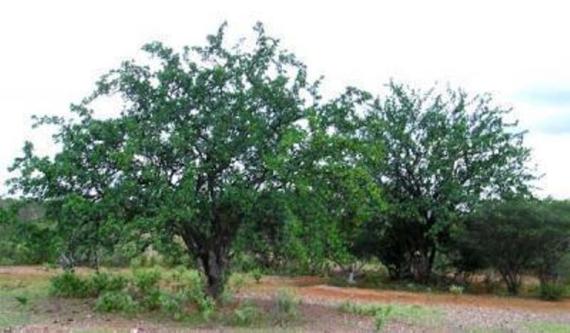
favela trees

favela / hovel...? The alternation between initials f and h is not uncommon in Romance Philology, especially in the languages spoken in the Iberian Peninsula: for example, Latin filiu(m) gives Portuguese filho but Castilian hijo; and then the h can lose its sound, and be dropped altogether.

But the dates are all wrong. Besides, why bring Portugal into it just because I'm more at home with European sources? Hovel could have left India in the 14th century on the back of Timur's conquests leaving behind haveli. After that, its route into English is anyone's guess. Maybe Arabic [or something Oriental] was involved: whenever a dictionary says 'origin unknown' it's a fairly safe bet that a non-Roman writing system was involved. In fact, 'origin unknown' is a bit like the geographer's terra incognita and 'Here be dragons'; it's a euphemism for 'outwith the scope of traditional scholarship'; and it's not a final sentence.

But why should one word have diverged into two opposite meanings? Well, that's quite common – as is the reverse (flammable vs inflammable, pace the Health and Safety Executive); I just used one such word (quite as in "quite reasonable interesting" and "quite extraordinary".  And after two words diverge, with different meanings, they are subjected to different phonological pressures (elsewhere I have discussed the strange case of grammar and glamour). Elsewhere (again!) I have written:
...in Portuguese there is formoso -a and in Spanish hermoso -a. (And that f/h thing, incidentally, is at the root of Ferdinand and Isabella's royal emblem - the fennel plant: Aragonese had a word starting with f and Castilian had an for the initial letter of the word for 'fennel'. But that's a whole nother kettle of red herring.) 
So the case for a link between haveli and "hovel" is [at best]  not proven. But a man can dream. [What he can't do though, is put off any longer the resumption of that trawl {in preparation of that book of word-lists}!].

b
Update 2015.05.14.09:20 – Correction of example, in the colour of shame.

Update 2018.08.12.15:55 –Added clarification in last line, which made more sense unexplained three years ago.

Monday, 27 April 2015

Quando coeli movendi sunt et terra

Those words are from the text of the Requiem mass... 'when the heavens and the earth are moving'. 

The recent terrible events in Nepal reminded me of three things.

The first  was 'The Great Peruvian Earthquake' of 31 May 1970. Again there was a complete   breakdown in communications. As it happened there was something  else going on not too far away, kicking off on that very day: the Mexico World Cup. The father of a member of the group I sang and played with was Peruvian, and was trying in vain to get news of his family. It struck me as ironic that at a time when hundreds of journalists with millions of pounds worth of hi-techery (which we had been told about in awestruck tones for weeks beforehand by Jimmy Hill  and his fellow pundits – the instantaneous action-replay  was a new invention at the time
<weasel_words>
...well maybe not brand new. Perhaps like many technological sporting innovations it was known of but thought too expensive – until an excuse for conspicuous consumption arose (something REALLY IMPORTANT like the FIFA World Cup.)
</weasel_words>
, and was going to revolutionize football commentary) were so nearby (well, on the same page of the map at least), the plight of the Peruvians was so dire.

I being in my Peter  Starstedt  phase (Where Do You Go To (My Lovely)?  had spent 4 weeks at no. 1 a few months previously) I wrote a song – another of Paul Simon's 'songs that voices never shared':
<digression> 
In homage to Starstedt's whimsical Zeitgeist-y references ('You sip your Napoleon brandy, and never get your lips wet'...) I had odd portentous sallies like 'What have you done, Jules Rimet?' The most heavily ironic touch  was a setting  of the football chant
Ee Aye Addio We won the Cup
in a minor  key. Pretty poignant, I think you'll agree.  
</digression>
The second was a reflexion on musical settings relating to earthquakes, which I wrote nearly a year ago here, and which I felt merited another airing:
The going rate for the (musical) difference between heaven and earth seems to be about an octave. (This is an open goal for musicologists – my theoretical knowledge of music is minimal. Please comment if this needs another update.) Verdi, as I said, drops an octave from coeli to terra (after a bar containing higher notes). [Update: the main piece had referred to Verdi‘s Requiem, which, at the time, I had recently sung.]
Fauré, an enfant terrible who was nick-named Robespierre during his Directorship of the Paris Conservatoire because of his reforming zeal, toys with expectations in his setting of Libera me [part of his Requiem].
Quando coeli movendi sunt
Et terra ...
The words are describing the Day of Judgment. Quando coeli movendi sunt – 'not too scary; a clap or two of thunder. But hang on ...et terra. Not just thunder, that felt to me like an earthquake – I've got a REALLY BAD feeling about this.' 
But the drop isn't quite an octave. This minor seventh coincides approximately with the 'that felt to me like an earthquake' in my imaginary commentary. What coincides with the words 'I've got a REALLY BAD feeling about this' is the octave drop at '...Dum veneris' {='when you [will††] come'}. Taking the music along with the text you get an even more intensely growing feeling of impending doom. 
††This is not to suggest that the original writer had any choice about using the future (if he [almost certainly a he] used a finite verb, that is). Latin, like many languages, just does this; ESOL students in fact, find it very difficult to buy in to the English way (and even when they've 'bought in', a pretty reliable bear-trap remains – a potential error that few manage to avoid!) I only insert the 'will' as a way of underlining the fact that the Latin makes it very clear that THIS IS GOING TO HAPPEN. A common way of dealing with this in English is the addition of an expression like '... And it's a question of WHEN rather than IF'.

The third was to wonder if there was any remote etymological link between 'terra-' and 'terror' – and it seems there's not.  It's just a coincidence that earthquakes (Sp. terremotos
<digression>
I use terremoto rather than tierra lest anyone think 'But of course  tierr- is not the same as terr-.'  A Spanish speaker wouldn't feel this, being used to the e/ie variation under conditions of stress in some sorts of /e/. This accounts for many irregular Spanish verbs, such as tener – with stressed tiene [='he/she/it has'] but unstressed tenemos ['we have'] (well, not totally unstressed of course, but unstressed in the relevant syllable). (Italian doesn't do this: terracotta but also terra.)
</digression>
) are both terrible and terrifying.

The Proto-Indo-European root for tierra is given in Etymonline‘s entry for 'terrain':
...from terra "earth, land," literally "dry land" (as opposed to "sea"); from PIE root *ters- "to dry" 

Meanwhile, under 'terror', the source is different:
...from terrere "fill with fear, frighten," from PIE root *tres- "to tremble" (see terrible).
         See more here (if you're that way inclined).

And the possibility of a metathetical link between *ters- and *tres- doesn‘t seem to me worth fretting about; that would be a supposed phonological development in a language that exists  only in  the minds of a few linguists.

OK – Real Life calls.

b

Update: 2015.04.28.11:20 – Added notes in red.
Update: 2015.04.30.09:20 – Added PS.

PS At the end of last year I referred to a growing following, then reaching an average of 35 daily visits. Well 35 schmirty-five. This has been a record month (an average of over 55 visits per day), and the latest version of the graph I gave then reflects this:

Update: 2015.05.01.22:55 – Added illustration  from the Libera Me.
Update: 2016.01.23.11:30 – Embellished reminiscence in purple.

Friday, 17 April 2015

Outside the box

Last week, as part of the wall-to-wall election coverage (UK readers will know what I mean; non-UK readers can be extremely thankful that they are not involved in what is misleadingly called the democratic process – these guys wouldn't recognize democracy if it bit them) I heard Nigel Farrago saying 'I am outside the box'. UKIP's PR-machine seems to have leapt into action, as all the web accounts I can find have the text 'repaired' to something that uses the words 'thinking outside the box' . But I'm convinced the aforementioned populist said either 'I am' or 'We are...' – which seems to me to point the way that this idiom is likely to go (further and further from its [fairly recent] origins).
[I]ts origin is generally attributed to consultants in the 1970s and 1980s [this source places it a decade earlier] who tried to make clients feel inadequate by drawing nine dots on a piece of paper and asking them to connect the dots without lifting their pen, using only four lines:
          See more here 

But origins, as I've said before, aren't a clincher in discussions of  'what words "really" mean'.
An interesting blog from the OED stables refers to th[e] tendency to be hung-up on a supposed 'original' meaning based on etymology and calls it the 'Etymological Fallacy'.
The issue of original meaning struck me this morning when a non-native speaker of English referred to an aeroplane doing aerobatics as 'very acrobatic'. To the dyed-in-the-wool etymologically-anal word-Nazi,  any aeroplane in flight – however sedate its behaviour – is acro[Gk άκϱος ="high"]-batic[Gk βαινω [a very irregular verb, meaning "go"].  'Acrobatic', in this perverse sense of 'high-going', DEFINES the performance of  an aeroplane. But good ol' BNC lists 115 nouns that collocate with acrobatic, and none of them is aeroplane .


Tales from the Word-face

[excerpt from forthcoming offering – offered not without a certain shame-facedness (as it's not really up to scratch)]:
[HD In the first para. I mention 'the evolution of the sequel to WVGT'. As a background to this, there has also been evolution in the idea of WVGT itself. When Vowels Get Together dealt with vowels getting together with each other. Future issues will deal with vowels getting together with other phonemes (starting with the most interesting ones [as far as changes to vowel quality are concerned]: the sonorants. The Introduction goes on:] 
I'll make this issue available asap, but.... Back to the drawing board...

b

Update 2013.04.20.10:00 – Oh dear – easier said than done. Amazon have a minimum cover-price (not possible to publish a free book), and I'm blowed if I'll charge for this thing. So I went to Google Play, whose  Ts&Cs start like this:


Hmmm. I recognize the problem that the 'writer' had. S/he put  the links in a draft, and a reviewer said 'These URLs may change. What can we do about it?' The writer, of course had a deadline to meet, so rather than work something out (after all. the stuff on those linked pages constitute two out of the three documents YOU MUST READ AND ACCEPT,  so getting it right mattered). But, adopting the totally meaningless 'meaning' of  'as such' that seems to be the fashion nowadays [ignoring the fact that ‘such'  needs to refer to a noun, and that in the expression ‘as such' it needs to refer to a preceding noun], s/he strung together some words  about changing URLs and copiedNpasted a couple of parentheses regardless of how unintelligible it made the resulting 'sentence'.

As it happens they have both changed. The first gives a 404 error, and the second at least takes you somewhere – although  the pages there don't seem to use the term 'FAQ'. 

In other words, there's a lot of sorting out to do....


Mammon When Vowels Get Together V5.2: Collection of Kindle word-lists grouping different pronunciations of vowel-pairs. Now complete (that is, it covers all vowel pairs –  but there's still stuff to be done with it; an index, perhaps...?) 

And here it is: Digraphs and Diphthongs . The (partial) index has an entry for each vowel pair that can represent each monophthong phoneme. For example AE, EA and EE are by far the most common pairs of vowels used to represent the /i:/ phoneme, but there are eight other possibilities. The index uses colour to give an idea of how common a spelling is, ranging from bright red to represent the most common to pale olive green to represent the least common.

I'm thinking about doing a native iBook version in due course, but for now Mac users can use Kindle's own (free) simulator.

Also available at Amazon: When Vowels Get Together: The paperback.

And if you have no objection to such promiscuity, Like this

Freebies (Teaching resources:  
Nearly 48,000 views  and  7,800 downloads to date**. They're very eclectic - mostly EFL and MFL, but one of the most popular is from KS4 History, dating from my PGCE, with over 2,600 views and 1,050 downloads to date. So it's worth having a browse.)

** This figure includes the count of views for a single resource held in an account that I accidentally created many years ago.


Wednesday, 31 December 2014

Free at last, FOGgies (pt 5), and a new look

Free at last

I am now the pleasantly confused owner of an Android device. This could mean a change in modus operandi, but after a 20-years' exposure to the dreaded 'Windows' virus I am perforce more at home in that environment; indeed, there are times  when a sort of Stockholm Syndrome starts to take over and I find myself wishing for the Bad Old Days.  Possibly I will in due course be blogging away happily on my new tabletty thing, but first things first; I must learn to walk before I run [off at the mouth?]

FOGgies round-up

I have mixed feelings about the FOGgies – recognition of distinguished contributions to the corpus of bad writing. Apart from the seasonal misfire [well it made sense at the time, but a correspondent soon put me right see the Update], there were four posts. The first gave two awards:
Most Meaningless String of Abstract Nouns 
Best Epithet Given Inappropriate Subject Status
The second gave only one, going to town rather on the award for
Most Misleading Use of Headlines

The third gave another two awards, for
Most Unnecessary Use of Management Jargon
and a
special 'Clusterbomb' award for a family of inter-related euphemisms

The fourth gave one:
The FOGgy for Hasty Sub-editing (or 'Can they really have meant to write that?)  

There would have been more, but as I  said in that last post (which sounds appropriately final, in a bugle-y sort of way)  'Waves of apathy for the FOGgies – reflected in the Blogger statistics – have persuaded me ... to put an end to the FOGgies'.

They may be back next year, but with more planning.

The New Look

<digression theme="Man proposes, Blogger disposes">
This was my planned text:
Attentive readers may have noticed that hitherto each Harmless Drudgery post has had a footer that points to my TESconnect resources and Amazon links, and that the statistics given in this footer are time-specific. I update them from time to time, but some of the older posts have footers that are well past their sell-by date. 
From now on, the 'footer' information will be on a separate page.
But things aren't working as I expected them to, and I have things to do before the end of the year. So you'll have to make do with the same old same old.
</digression>

A happy New Year to  all our readers (a growing number, averaging about 35 visits a day). Here's an interesting graph, showing  fairly steady, if not meteoric growth (as I said recently, meteors fall anyway). I'm not sure what happened in the year to September, but otherwise the trend is in the right direction.


b

PS – A few clues to be going on with:

Confused stab in the dark – not for them! (4)
Whinge and throw fish back with space for grasping motto. (5, 4)
Marooned sailor finds shell (7)

Andrupdoid  2015-01-01-17:20  – just to prove I can, and to fix a typo.

Update 2015.02.12.15:05  – Added PPS

PPS  – A few clues to be going on with: And the answers:

bats
carpe diem
abalone [the first fruit of my -AL- work]


Mammon When Vowels Get Together V5.2: Collection of Kindle word-lists grouping different pronunciations of vowel-pairs. Now complete (that is, it covers all vowel pairs –  but there's still stuff to be done with it; an index, perhaps...?) 


And here it is: Digraphs and Diphthongs . The (partial) index has an entry for each vowel pair that can represent each monophthong phoneme. For example AE, EA and EE are by far the most common pairs of vowels used to represent the /i:/ phoneme, but there are eight other possibilities. The index uses colour to give an idea of how common a spelling is, ranging from bright red to represent the most common to pale olive green to represent the least common.

I'm thinking about doing a native iBook version in due course, but for now Mac users can use Kindle's own (free) simulator.

Also available at Amazon: When Vowels Get Together: The paperback.

And if you have no objection to such promiscuity, Like this

Freebies (Teaching resources:  
nearly 48,200 views  and over 6,500 downloads to date**. They're very eclectic - mostly EFL and MFL, but one of the most popular is from KS4 History, dating from my PGCE, with over 2,400 views and nearly 1,000 downloads to date. So it's worth having a browse.)

** This figure includes the count of views for a single resource held in an account that I accidentally created many years ago.


Saturday, 23 November 2013

The pulveropause

Last month, in my first anniversary posting I wrote this (about visits to this blog):
Birthday posts often include reams of statistics, but I'm afraid the schedule doesn't allow me to collect them. So here's just one: in the first 3 months of the blog (roughly BPS [Before Publication of the Schedule]) the site had under 1,900 visits – about 600 a month. In the 9 months since, the site had 6,700 – about 750 a month. This isn't a huge improvement (I reckon something like 25%), but given that it's been achieved in spite of (or because of?) less regular posts, and more work on #WVGTbook it's quite satisfying
Now that the dust surrounding the ELTons deadline has settled (I submitted it on the 21st, and dealt with a rather disturbing query first thing on the 22nd [they couldn't download it from the Kindle Store] and was told that afternoon that everything was OK [ or "παντα καλωϚ εχει", which I gather is Classical Greek for 'Everything's hunky dory']), I can look more carefully at the HD stats.

In the first full three months – Nov. 2012 to Jan. 2013 – the blog registered just under 1,450 visits (I don't know where the higher figure I reported before came from – I had other things to think of at the time); that's under 500 per month. In the most recent three months (well, 2¾) it's had nearly  over 3,200 (more like 3,500 by the end of the month). This suggests that interest has more than doubled. That sounds a bit better.

Here's a picture:

b

Pulveropause, geddit?
Update: 2013.11.24.16:45 – new picture and updated footer.
Update: 2013.11.29.11:05 – another new picture
Updated picture.
† Update: 2015.08.28.10:15 – and another:more recent months this time:

In the first, only 3 months exceeded 800 visits pcm.
But for the last year monthly visits have
always exceeded this number


 Mammon (When Vowels Get Together V5.2: Collection of Kindle word-lists grouping different pronunciations of vowel-pairs. Now complete (that is, it covers all vowel pairs –  but there's still stuff to be done with it; an index, perhaps...?)

And if you have no objection to such promiscuity, Like this.

Freebies (Teaching resources:  nearly 34,400 views**  and  4,800 downloads to date. They're very eclectic - mostly EFL and MFL, but one of the most popular is from KS4 History, dating from my PGCE, with 1637 views/740 downloads to date. So it's worth having a browse.)

** This figure includes the count of views for a single resource held in an account that I accidentally created many years ago.