Showing posts with label Yiddish. Show all posts

Tuesday, 2 July 2013

Sleep faster, we need the beds!

I'm told that this is a Yiddish saying, and my informant had ethnic authority, so I have no reason to doubt him – except that  we were compiling copy for a CU Footlights programme at the time; so invention was in the air. (I'd better not say what he called this section of the programme; it might start a race riot. )

Anyway, the subject of the first #eltchat on 26 June 2013 recalled this [apocryphal?] note:
There are some things that can't be done quickly, and maybe learning a language is one of these. Teachers can certainly help to make the process quicker, chiefly by facilitating students in taking charge of their own learning – becoming autonomous to use the #eltchat buzzword!


There were. as usual, many strands to the #eltchat, sometimes diverging sometimes converging, sometimes getting hopelessly tangled. One of the more notable breakdowns in communication was this exchange:

It turned out to be '5K-20K'.

But these were the main strands:
  • The articles
  • Fostering  Learner Autonomy. (All roads lead here!)
  • Speed of learning. Whether it was possible and what were the drivers of that need.
  • How long language learning takes and what are its prerequisites.
  • Teaching and learning methods

The Articles

 The grist for the mill of our discussion was two articles:
  1. an American Physical Society article about learning a language quickly – here
  2. a Science NOW article about the conditions for learning a foreign language – here
(Not much was said about the 2nd of these; I've started a blogpost about it, but it may be a week or two before I get round to finishing it. Keep an eye on this blog; I'll also tweet a pointer.)

Here are a few signposts along the way:
 This was probably a typo for '1 word'.

These last two show how learner autonomy and cultural awareness kept turning up during the #eltchat.

Learner Autonomy

These next two show two themes crossing back:

Everyone agreed with this last point; LA not only helped them in the classroom, but also equipped  students who had 'finished' with the skills to continue to improve. LA was felt to be a key to motivation:
And last but by no means least, food:

On the question of food and culture, I didn't say this at the time – and in any case the example involved teaching another language – but my students (of Portuguese) really enjoyed a festa I arranged at the end of one term. There was Portuguese music, food, and conversation.

Speed of learning

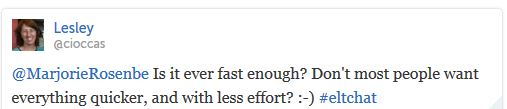
There was much discussion of the speed of learning. Here are some pointers to the discussion:

 

That last one shows another recurrent theme; people were always looking to find lessons they could derive from the observations. Sometimes there were what seemed from the record like dead ends, but they were really things that would take more effort/reflection before bearing fruit. Phil Bird was a lone voice asking if anyone (else?) had thought about 'Hattie's effect sizes'. Nothing came of this question at the time, but in due course I suspect many of us will be thinking about this:

How long it takes

A lot of numbers were batted about, ranging from 5 (a mistake already mentioned) to 20,000. Lesley had to admit to the Australian government's figure:
But don't shoot the messenger, folks; Lesley'd be the first to admit that this was a gross under-estimate (the words 'not', same', and 'ballpark' come to mind).

Methods

There were few actual classroom-based ideas, except a general feeling in favour of immersion and surrounding – if not in the culture (the ideal) – then by cultural tokens. Watching TV – preferably undubbed – was mentioned. And Roya mentioned this:


L'Envoi (French for 'send-off' – quite appropriate I think)

Shaun closed by telling us that there would be an #eltchat break over the (Northern Hemisphere!) summer, but reminded us that the tag itself wasn't going away.

Update 2013.07.25.09.30/10:50 Header updated

Update 2020.07.20.16:45 Bunch of typo fixes, and old footer deleted

Thursday, 25 October 2012

Oops

The title of my last (that is, first) blog was imperfect, as Schomonymic doesn't fit the pattern. I was thinking about the pseudo-Yiddish  device that repeats a word with the opening consonant changed to the cluster [ʃm], in connection with a UsingEnglish  discussion I had recently been involved in. As I said there
There are lots of Yiddish words starting with [ʃ] + <consonant-cluster> (schmuck, schlmiel, schtuck, schlep...). I first met it in a joke about St Paul being addressed as 'Saul of Tarsus' (his pre-Christian name), to which he replied 'Tarsus Schmarsus, my name's Paul already'.
As is my wont, I added a footnote.
That timeless use of 'already' is also typical of Yiddish-influenced Am. English. I've heard it said that the 'TEA' in Tea Party is an acronym for 'Taxed Enough Already'. (And there was I thinking it was a reference to The Boston Tea Party.)
I felt insecure about the words 'I've heard it said....'. I thought I was riding my reputation for omniscience a bit too hard, and that my bluff would be called by someone unimpressed by my Moderator status.

But my bedside book for the year (I'm a slow reader), David Crystal's The Story of English in 100 Words, came to my assistance this morning, justifying both claims. The main one was this (pp. 182-3):
English previously [to the late 19th century] had borrowed few words from [Yiddish].... Schm- in particular seems to have caught on, because by the end of the decade [the 1930s] we find it being used in a remarkable way, forming nonsense words.
'There's a crisis,' says one person, and another disagrees. 'Crisis schmisis!' The usage conveys scepticism, disparagement or derision.
The 'heard it said' one is on p. 139:
In 2009, tea even became a political acronym in the USA, when the Tea Party was formed. TEA? Taxed Enough Already.
I knew I had heard these two nuggets somewhere before. I had read as far as p.139 - so that's where I got it. But I hadn't yet reached the schm- explanation. It was probably in an earlier Crystal work, possibly The Stories of English -  I'm something of a fan, and since retiringhis retirement from academia his output has become extraordinary. This necessarily involves a fair amount of repetition

But such a high workload has its disadvantages. In the earlier book he writes:
It is not what the orthodox histories include which is the problem; it is what they omit, or marginalize. The 'story' [quotes sic] of English, as it has been presented in the mainstream tradition, is the story of a single variety of the language, Standard English.... [F]or every one who speaks Standard English there must be a hundred who do not, and another hundred who speak other varieties...
He does not say so explicitly here, but from the rest of the book I imagine that his first 'hundred' refers to native-speakers born in the UK; and that his second 'hundred' refers to national varieties - South African English, Australian English, and so on. In both cases, I'd question his numbers (as gross under-estimates - especially when the two sorts of variation are multiplied: local variants of national variants [where I use local metaphorically to cover all sorts of context - not just the geographical]).

But this is not my point. I'd just like to observe that making such a big thing of a plural 'Stories' is a hostage to fortune, when only half-a-dozen years later you're going to add to the canon of books covering The Story of English ...

This is longer than I had planned, and I'm off tomorrow for a rain-sodden visit to the Land of Crystal's Fathers (though not mine). So stay tuned, but don't hold your breath, for more Harmless Drudgery.

PS 20122910 *Profound apologies for the dangling participle!

 + various updates to the footer, the most recent being on 2013.10.06.12:05


 Mammon (When Vowels Get Together V4.0: Collection of Kindle word-lists grouping different pronunciations of vowel-pairs – AA-AU, EA-EU, and  IA-IU, and – new for V4.0 – OA-OU.  If you buy it, contact  @WVGTbook on Twitter and I'll alert you to free downloads of the forthcoming volumes; or click the Following button at the foot of this page.)
And if you have no objection to such promiscuity, Like this.

Freebies (Teaching resources: nearly 32,400 views**,  and  4,400 downloads to date. They're very eclectic - mostly EFL and MFL, but one of the most popular is from KS4 History, dating from my PGCE, with 1570 views/700 downloads to date. So it's worth having a browse.)

** This figure includes the count of views for a single resource held in an account that I accidentally created many years ago.
 

Sunday, 21 October 2012

Homonymic schomonymic. They're puns already


Gwynneth Lewis, the first Welsh Poet Laureate, on the radio just now said that Dafydd ap Gwilym had done something /frɒm ðə geʔ gəʊ/. And because her accent was quite broad, and I was expecting lilting things like /’let.tə/ for ‘letter’, I misheard in a way that suggested a reptilian version of ‘from the horse’s mouth’. But geckos don’t enjoy the same position as horses in figurative English, so I was momentarily flummoxed.

But she wasn’t in the least aware of any possible pun; the perpetrators of puns often aren’t, particularly when the pun is in the mind of the listener – and depends on over-interpretation of an accent that the speaker, quite naturally, sees as unimpeachable. Perhaps the most interesting puns are ones like this – where the speaker is unaware of the pun (or ‘homonymic clash’, as I learnt to call puns when I was studying at the feet of Doctor (now Professor) Erik Fudge. [Sic]

+ various updates to the footer, the most recent being on 2013.10.06.12:05


 Mammon (When Vowels Get Together V4.0: Collection of Kindle word-lists grouping different pronunciations of vowel-pairs – AA-AU, EA-EU, and  IA-IU, and – new for V4.0 – OA-OU.  If you buy it, contact  @WVGTbook on Twitter and I'll alert you to free downloads of the forthcoming volumes; or click the Following button at the foot of this page.)
And if you have no objection to such promiscuity, Like this.

Freebies (Teaching resources: nearly 32,400 views**,  and  4,400 downloads to date. They're very eclectic - mostly EFL and MFL, but one of the most popular is from KS4 History, dating from my PGCE, with 1570 views/700 downloads to date. So it's worth having a browse.)

** This figure includes the count of views for a single resource held in an account that I accidentally created many years ago.