Showing posts with label Tezzy. Show all posts

Friday, 5 June 2020

Brother Lawrence / in the scriptorium / with a quill

Medieval Cluedo?

Yestreen...
<gloss>
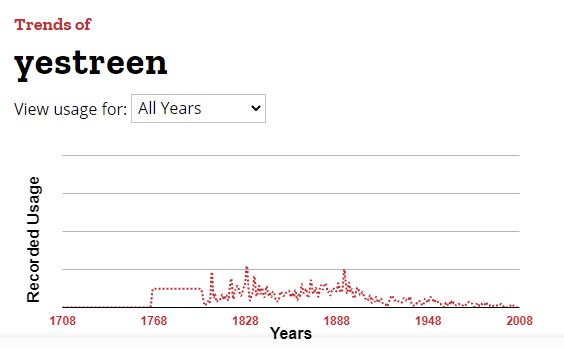
I'm trying to get this charming abbreviation for "yesterday evening" re-adopted.


According to Collins it's Scottish and pretty rare But their "usage trends" graph shows that (back in the nineteenth century) it was all the rage.
</gloss>
... my choir sang this:
Manuscript from Reading Abbey, but probably produced in Oxford.
(see David Crystal, The Stories of English [2005], p. 108)

In  The Stories of English David Crystal says
Reading Abbey did not have a scriptorium, so the manuscript was probably copied at Oxford.
This gives the rota or "round" a double relevance to our choir, as a good few of us live in the Reading area, and both our MD and our accompanist studied at Oxford.

But why Sumer? Isn't it the wrong bird? The cuckoo arrives in Britain in April. Crystal gives the answer:
There was no contradiction, because in Middle English sumer was the only word available to describe the period between the vernal and autumnal equinoxes. The word spring to refer to the season is not recorded in English until the mid-sixteenth century.  
The Stories of English
That Crystal book has reminded me of a pipe-dream I discussed here
<digression theme="pipe-dream" likelihood="0">
Penguin missed a trick (or more likely decided that the trick wasn't worth the outlay) with this book. It was written like a coffee-table book, with two or three sorts of text and standalone features, quite like Words: An Illustrated History of Western Language (which I had a small part in publishing – but a bigger part than I wanted [and that's a whole 'nother story] ). But Penguin just squeezed it all together with tiny margins and no kind of visual clues to what sort of text was which. 
<inline_ps date="2020">
"No sort of visual clue" is strictly a bit of an exaggeration. The designer has done what he or she could in the cost-reduced circumstances of what the trade knows (or knew in my day) as a "mass-market paperback". If you know what to look for it makes sense. There's a vertical rule down the margin of the standalone features; but it's easily missed, and the reader only realizes what's happened when the syntax of two unrelated sentence parts makes the inconsistency felt.
</inline_ps> 
The reader's never sure whether the current text is part of the main argument or part of an illustrative aside. It needs changes in line-length or font or shade of paper to make it a smooth reading experience.
<sub_digression>
In fact, the writing so obviously has this sort of treatment in mind that I suspect it was written to order for another publisher but that the contract fell through. The typescript then got bought by another publisher whose needs were at odds with the book as written. Maybe not though – who knows...?
<sub_digression>
My fantasy – though I haven't discussed this with the good Professor – is to win a large amount of money and become a proper publisher. My Rights department would negotiate with Allen Lane to acquire the rights for a properly designed book, and my Design department would make this book CanDo Publishing's lead title.
<digression> 
<tangent>
In researching this post I've come across my latest nomination for a Tezzy ("Time-wasting Site of the Year".  I haven't dabbled yet, but imagine the temptation will get the better of me in the end.  Here it is, the British Library's Medieval Manuscripts Blog
</tangent>
Enough for now.

b
PS An irrelevant quandary:

My attention has been brought to this petition, and I'm in a quandary about signing it. I know I shouldn't be, as it obviously addresses a critical issue.
<parenthesis>
(My first choice of wording in that last sentence was "It clearly addresses", but while it does obviously address the issue, clarity is hardly characteristic of the way it goes about it. The "writer" has had a thought, taken a number of words in the relevant area, and spewed them out onto the page in the hope that the reader will organize them into something meaningful; with any luck, that meaning will match the meaning intended. 
I am reminded of Sheridan (père's) words (used to drum up business for a teacher of how to write)
We write with ease to show our breeding 
But easy writing's curs'd hard reading. 
</parenthesis>
I want to subscribe to the gist without subscribing to the woeful wording. I do wish people would give some thought to what they're writing, rather than scatter-brainedly  conjuring up a bunch of more or less relevant words and leaving it to the reader to arrange them into a thought. How's this for a doozie?
It is important to learn about Black History and unteach this ignorance as some children may not choose to educate themselves and just listen to the people around them and be influenced causing people to hold racist views and pass them down many generations meaning the cycle of racism and systematic oppression will never end.
Fifty-five words with no punctuation. and daisy-chain syntax. The people the petition is addressed to are almost guaranteed to dismiss it as intemperate ravings.

I guess I'll sign, but with a heavy heart.

Update: 2020.06.06.16:20 – Added inline PS.

Thursday, 1 August 2019

On the road (river?)

See the 6 August update for thoughts
about the "upon"
This coming weekend representatives of the Wokingham Choral Society (not quite half) will be taking to the road with Songs of Travel and I thought I'd write a word or two about the places we're going.

In the phrase "Taking to the road" though, perhaps river would be better than road, as both our concert venues have names that, at one time, referred to rivers.

We arrive ...
<DIGRESSION>
(appropriately enough, as the word ARRIVE itself derives from the Vulgar Latin phrase AD-RIPAM [VENIRE] [and RIPA means river-bank])*
</DIGRESSION>
...first in Stratford on† Avon, which the University of Nottingham's Key to English Place-names (awarded a TEZZY here).
<GLOSSARY item="TEZZY>
Time-wasting Site of the Year.
</GLOSSARY>
explains like this:
The Key to Place-names output for Stratford on Avon.
(Ignore the 'Refs' button in the top right-hand corner
which of course is not live in this screen capture.)


The first syllable is related to the Modern English "street", the Italian strada and German Strasse. The second syllable is self-explanatory*. The last word is rather unsatisfactorily explained. OK, the origin may be unknown, but it‘s  not just a "River-name"; it means river – at least, Welsh afon means river. And even if the origin is unknown (as the Key says) I think  it‘s reasonable to imagine afon is related in some way (as a single f written in Welsh represents a /v/ sound [which explains the ff in names like "Ffion" – as a written ff is used to represent an /f/ sound]. )

Our second port of call (to use a suitably watery metaphor) is Warwick, which the .Key to English Place-names explains like this:

The Key to Place-names output for Warwick.
(Ignore the 'Refs' button in the top right-hand corner
which of course is not live in this screen capture.)

There; told you it was a time-waster. But I have words/notes  to learn, so that's all for now.

b

Update:2019.08.01.14:50 – Added footnote on AD-RIPARE

This assertion could do with some support.

In an earlier post I wrote:
Elcock explains:
While VENĪRE remained everywhere the usual verb for 'to come', two new terms conveying a more visual image were  borrowed from maritime language. ... [HD: The first is well worth looking at,  but not here.]  AD-RIPARE, 'to come to shore', was a somewhat later creation which found favour in Gaul (cf Prov. arribá ).... From Provence it spread to Catalonia, and during the Middle Ages was carried thence to Sardinia, as arribare.   
The Romance Language (I've given this source more than once, but make no apology for that: it's very good.)

Update:2019.08.02.10:30 – Clarified numbers going.

Update:2019.08.06.15:40 – Added footnote

†The Key goes for plain "on", but elsewhere it is "upon" or "Upon". I noticed this at the time of first writing, and on Saturday afternoon saw that the embroiderers of the kneelers in Holy Trinity Church (in Stratford) preferred "upon".
<COINCIDENCE>
I didn't know when I saw the embroiderer's "upon", but it turns out that the unnamed embroiderer was the godmother of the choir's chairman; so my inclination is to favour "upon" (but I have no principled objection to the minimalist view, if that's what floats your boat).
</COINCIDENCE>

Monday, 25 September 2017

Fings ain't what vey used to be - they're a lot better

My latest Tezzy nomination (for the meaning of Tezzy see this blog, passim) goes to this paper (and the site that it links to). The paper is called

The short history of global living conditions and why it matters that we know it

– a bit of a misnomer (as to its shortness), if you click on links within the paper, which takes you to more detail. For example, one of the first links is to a paper on Working Hours which itself is liberally spattered with thought-provoking stuff such as this:

Come on, chaps, could do better: 100 years ago, men  did about 10% as much as women did (productively) in the home. The balance is much better now, but still about 1:2. What's more, both the blue and the pink curves (see what they did there?) look pretty assymptotic: the women's "NO LESS" is droned  (sic?) out by the men's "NO MORE". But there is an irony here: are male bloggers more common than female ones?

Sadly, the

...and why it matters that we know it

bit gets short shrift. There are only four short paragraphs, none of which contains a link. Here's a taste:
For our history to be a source of encouragement we have to know our history. The story that we tell ourselves about our history and our time matters. Because our hopes and efforts for building a better future are inextricably linked to our perception of the past it is important to understand and communicate the global development up to now. A positive lookout on the efforts of ourselves and our fellow humans is a vital condition to the fruitfulness of our endeavors. Knowing that we have come a long way in improving living conditions and the notion that our work is worthwhile is to us all what self-respect is to individuals. It is a necessary condition for self-improvement.
(Come to think of it, that was quite a long paragraph. It just should have been shorter. I ran it through the text analysis tool at UsingEnglish, and here are the results:
Not bad on word-length, but not very readable; it almost qualifies for a FOGGY [see this blog, passim {again :-)}  – Average Sentence length a shade under 20, Lexical Density a shade under 60, Fog Index over 14).

So if you want some more palatable auto-back-slapping, try this video from Bill Gates.

But about that productive effort...

b


Friday, 8 September 2017

Eeny, meeny, tekel, upharsin

One of my occasional "State of the Notion" posts, with a suitable mixture of weighing-in-the-balance and counting (in the otherwise totally arbitrary subject line).

In its first twelve months, from October 2012 to September 2013, the Harmless Drudgery blog attracted just over 7000 visits. July 2013 was the only month with more than 1000 visits (1070, to be precise). In the first 5 days of September 2017, the total was just over a thousand (1053 to be precise – another 17 would have supplied a pleasing symmetry, but the gist is clear):

HD visits, courtesy of Blogger
(Of course there are more at time of going to
<whatever> -- almost, already, as many as in August)
Given a following wind, the  total for September should exceed the peaks in April and May of this year, and might approach the December 2016 peak (which I imagine represents teachers catching up with their blog reading over the Christmas break [there's a similar peak at Easter, but attenuated because the lawn has started to need mowing]).

b


PS My  nomination for a TEZZY goes to this site. 
<explanation reference="passim">
The TEZZY awards go (irregularly) to the Time-wasting Site of the Year. The Ur-TEZZY was awarded nearly 3 years ago :
The prestigious Time-wasting Site of the Year Award (familiarly 'Tezzy') goes to the University of Nottingham [2017: a site that explains the origins of place names].
</explanation>
Avoid this one if you have a deadline to meet: it's a guessing game based on sound clips from world languages. I don't know how big the corpus of clips is, but it‘s big enough to keep you "busy" for several kilo-yonks.

b

PPS And a couple of clues:
  • Organic solution is close, but not quite good enough (2,5)
  • Imprisoned the subject of genealogy – jolly angry. (12)
Update: 2017.09.08.15:20 ‐ Added PPPS

PPPS Also, while I think of it, do sign this, although I'm  not sure what good it will do: the meddlesome priest will just have his zealotry heightened. The more signatories to the petition, the greater the Celestial-Jobsworth's self-regarding sense of martyrdom.

Thursday, 5 November 2015

Taking things to ♥

In last night's talk at the Great Hall, Reading, David Crystal mentioned a change on Twitter (a tweak?) that has caused ructions. Not being a daily user of Twitter –  a twenizen or twabitué – I was aware of it but could not date it so precisely; a has become a ♥ ; at my latest visit, I just noticed and thought  Whyever did they do that?
The had a pleasing ambiguity. I have used it in the past for two things:
  1. As a marker for the last tweet  I had read (back in the days when I tried to at least cast an eye over all the tweets in my timeline). This mimics the First Unseen command of my one-time great love VAX Notes – which I may have mentioned before.
  2. As a way of keeping a record of tweets I wanted to remember (typically, pointers to web pages).
Unlicensed screengrab from
https://www.youtube.com/watch?v=w9lmCpIzhFo
So, as I saw it,  the star was a marker for my use. I had not, then, come across the concept of a social media Like. In the world of social media there is a growing trend in favour of expressing approval of things, by awarding a Like (not a precise synonym for 'a like' in the analogue world – which is a habitual preference, as in likes and dislikes). Well, to call it  'a growing trend' is something of an understatement; it's more an outpouring of unEnglish bonhomie, which is gradually seeping into British English among users of social media. A digital Like is a notch in your digital gun (or, for Not The Nine O'clock News fans, a hedgehog symbol on the cab of your lorry). It's something to be proud of, and a public statement of your worth.

I realized the importance of this distinction when posters of tweets that I had marked with my no. 1 sort of 'like' (when the nearest sense to liking was in the implied You [i.e. I –  this is an internal monologue, remember] may LIKE to note that you've seen everything before this one) started thanking me.

A questioner after the talk asked whether Crystal expected the reinstatement of the  alongside the ♥.  Many users of Twitter had complained, Crystal had said – particularly (or at least most vocally) journalists, who didn't want to Like a picture of a beheading,  for example, when they just found it noteworthy. And this called to mind an example from a forum thousands of times smaller than Twitter.
<autobiographical_note> 
When I first started using UsingEnglish.com there was no way of symbolically expressing approval. This was in 2006, when many users still had slow dial-up lines. It was frustrating to spend <however long> (90 seconds?) downloading the latest reply to a note you were subscribed to, only to see the word Thanks (or even just tx or ;) ). So the powers that be introduced a Thanks button. 
But the forum, which used the vBulletin package was, in time, social-ized. You could have Groups and Friends and stuff – all those social impedimenta that we nerds are uncomfortable with. And as part of this social-ization (or in its wake [I'm not sure of the relative dates]) the Thanks button was re-labelled Like
This was not popular. People wanted to be able to give Thanks without the emotional incontinence of spraying Likes around like an over-excited puppy. Some time afterwards  – I don't know how soon after the change to Like, as a job intervened and I took a sabbatical from my moderating duties  – a new Thanks button was introduced alongside Like. This effete contempt for Likes has backfired. The Facebook page for WVGTbook has amassed a pitiful 60-odd Likes in about 2 years. He who lives by the ... umnm, this sentence has lost its way. 
 </autobiographical_note>

So, if I were a betting man, I would put money on Twitter following suit with their symbols. Look out for a  alongside the  ♥.

b

PS My occasional award of a Tezzy (for the Time-Wasting Site of the Year) goes to this site. Unlike previous Tezzy laureates, it's not really the site itself that is the time-waster – but rather the activity that the site invites.

Update 2015.11.09.10.10 – Added this note:
Crystal-watchers will note that this prediction is at odds with the Professor's insistence on  avoiding predictions  about language-change (except the certainty that something will change). I  – no doubt unwisely  –  am less careful.

For example, in a recent reply in the UsingEnglish forum I wrote:

If I were to say 1 is wrong [HD – the question was about a dog 'perking up' or 'pricking up' its ears], I would expect a chorus of disapproval from people who thought I wasn't aware of how language changes. And one of those ways is the ultimate acceptance of something that initially was a mistake. Elsewhere I wrote

The word VESPERTILIONES was glossed in this document [an early list for travellers of equivalent phrases and mistakes] as CHAUVE-SOURIS. Elcock goes on:
.... In fact, bats are not noticeably bald..., and one is tempted to infer that CALVAS SORICES is a product of 'popular etymology', hiding a quite different word. In most French patois bats are called 'flying-mice' or 'bird-mice'; it may well be that CALVAS is in reality *KAWAS [the asterisk is a convention used to mark a supposed, not attested, form], the Germanic word which survives as the root of Fr, chouette 'owl'.
'Owl-mouse' - for chauve-souris - would make much more sense. But what caused the change from *KAWAS to CALVAS? ...
So I would say the use of 'perk up' given in 1 is not entirely acceptable yet, but it's understandable and therefore becoming more widely accepted. If you ask the same question in 50 years, the answer might be 'Yes, it's right', but somebody else would be answering!


Mammon When Vowels Get Together V5.2: Collection of Kindle word-lists grouping different pronunciations of vowel-pairs. Now complete (that is, it covers all vowel pairs – but there's still stuff to be done with it; an index, perhaps...?)

And here it is: Digraphs and Diphthongs . The (partial) index has an entry for each vowel pair that can represent each monophthong phoneme. For example AE, EA and EE are by far the most common pairs of vowels used to represent the /i:/ phoneme, but there are eight other possibilities. The index uses colour to give an idea of how common a spelling is, ranging from bright red to represent the most common to pale olive green to represent the least common.

I'm thinking about doing a native iBook version in due course, but for now Mac users can use Kindle's own (free) simulator.

Also available at Amazon: When Vowels Get Together: The paperback.

And if you have no objection to such promiscuity, Like this

Freebies (Teaching resources:  
Well over 49,800 views  and nearly 9,000 downloads to date**. They're very eclectic - mostly EFL and MFL, but one of the most popular is from KS4 History, dating from my PGCE, with nearly 2,700 views and nearly 1,100 downloads to date. So it's worth having a browse.)

** This figure includes the count of views for a single resource held in an account that I accidentally created many years ago.


Saturday, 30 May 2015

Reformed priest gives account of current doings (6)

Todays TEZZY (for a Time-wasting site) goes to this fascinating interactive effort – full of interest but (if I‘m being brutally honest) hardly of critical importance for the fate of Civilization as we know it. Its based on a corpus of reports by students of their teachers:
This interactive chart lets you explore the words used to describe male and female teachers in about 14 million reviews from RateMyProfessor.com.
And perhaps I do underestimate its importance. Maybe there is an interesting conclusion to be drawn from  the fact that students are slightly more likely to call a female teacher happy, but much more likely to call a male teacher funny. Im not sure what it might be, but its certainly fun toggling between the two and watching the blue dots change places with the pink ones (OK, they‘re not pink really, more like orange) in a sort of birds eye view of a courtly dance. I think itd be more significant if one could compare ratings of the same-sex teacher by different-sex students, and then to compare S>T, S>T, S>T and S>T. (More significant,  but Id still be hard pressed to say exactly  what it signified.)

Tales from the word-face

I'm still trawling through the vowel+l pairs. L was a dispiriting letter to start with. I should have started with R or W – much more interesting. But I am a slave to the alphabet. I am nearing the end of the -el-s. On a hunch, I went back to check on the raw totals (net of any systematic exclusions I choose to observe). And the numbers of hits in the Macdonald English Dictionary (that is the UK site, despite the Mit) turned out to have an alphabetical regularity:


So...
<rant>
And that is a subordinating conjunction (or  something like that – the naming of parts isn't really my schtick). Another bugbear in my admittedly bugbear-ridden life is the growing and unaccountable and mindless and downright lazy  and otherwise lamentable...
<meta_rant topic="*laMENtable">
And there's another one. Get the stress right for Heaven's sake. I know it's easier to match the stress of the verb, but "them's the breaks, kid" as someone (maybe John Wayne) once said.
</meta_rant>
....tendency to use 'So' as an all-purpose linguistic tic that seems to mean something like 'Here comes a sentence, but don't expect it to have a link to anything that's gone before and I don't care about any fruitless efforts you may make to find one – you seem to have mistaken me for someone with a modicum of consideration for the people I talk to'.

</rant>  
...although I haven't finished -el- I've done more than half.

Enough navel-gazing; there's cricket to watch.  

b

Update 2015.05.31.11:35 – Sexed up picture.

Update 2015.06.01.15:15 – Added PS.

Another TEZZY observation: with a few exceptions, a male teacher is more likely than a female one to be assessed as fat. The exceptions are in Computer Science, Philosophy, Psychology, and Sociology. Make of that what you will; of course, in those (and all cases) the review might have said ‘<teacher-name> couldn't be called fat'. (Come to think of it.... Still, it's fun.)

Update 2015.06.06.18:05 – Added PPS.

...

And while we're on the subject of statistical anomalies, how about this (courtesy of Blogger, a record of page views [to Harmless Drudgery] for the past week):

Noted for Update, 2015.06.08


Update 2018.03.22.12:45 – Added PPPS.
Deleted old footer, and removed part of PPS that wasn't displaying properly.

Wednesday, 6 May 2015

Milbix chez les Bretons

What a TERRIBLE idea. What a bunch of jokers. There I was five weeks into the Big Sleep (which the Fixed Term Parliament Act has condemned us to every 5 years – and forget the Phew it's over feeling; it's only just started*) thinking Miliband was a relatively Good Thing (given the ankle-nipping baseline provided by Cameron) when he goes and spoils it all by announcing his brilliant crowd-pleaser, the inverted metaphor. Maybe that's what the 2001 monolith was all about, Please God he doesn't get to inflict it on the Rose Garden at No. 10. (New readers may find it useful to look at this bit of background.)

But why did I just call it an 'inverted metaphor'? If you think about it it's fairly obvious, but assuming that my grandmother didn't know how to suck eggs, I'll spell it out:

Most metaphors take a concrete thing and make it represent an abstract one: grass-roots, where the rubber meets the road, high horse... Very occasionally you get a metaphor that works the other way – abstract to concrete, as with Titanic.  But even with this one, the concrete as a source is never far away (in either direction): in the past, 'of the Titans' (a concrete idea for people who believed in them); in the future (post-iceberg) 'all they're doing is re-arranging the deck-chairs on the Titanic'.

So anyway, most metaphors look back to something concrete. Some nincompoop in Labour Head Office, during the AOB section  at the end of a strategy meeting, said 'Hey guys, I'm just like thinking out loud here and expect to get shot down in flames yeah but I thought I'd  just run this up the flagpole and see if anyone salutes.... You know, like, when someone says 'It's not carved in stone' and they mean things might change. Well why don't we turn that inside out, and say 'What Ed says is carved in stone, and like carve it in stone!!!'

Milibix was tired. He'd been doing his blue-arsed fly impressions like the other party leaders  for the past five weeks,
<digression>
I wonder what the carbon footprint of this campaign is...
</digression>
and wanted a bit of kip, and there's this intern from the University of Dreamland trying to drag the meeting out: 'Yeah, whatever. Can we go', said Ed. And the next he knew they'd only gone and done it. The next day there on the agenda was Item 1: Choice of typeface for Edstone.

Well I've  got two words to say to that:

How do I vote now?

b

Update 2015.05.08.09:55 – Added this note:
* This made sense before David "Axeman" Cameron and his henchman George "Slasher" Osborne were given free rein to bring the country to its knees.

Update 2015.05.08.11:05 – Added this PS:

"And if I laugh 'tis that I  may not weep", as Byron put it (though not, I think, the morning after a General Election). In an  attempt to lighten the mood, here is my latest nomination for a TEZZY ('the prestigious Time-wasting Site of the Year Award', first mentioned here.)

The Submarine Cable Map is a brilliant interactive map (best avoided if you've got an imminent deadline. It explains paradoxes like the one I often meet during an #eltchat: 'Why does a retweet from someone in India reach me BEFORE a tweet originating in Greece?' (This is explained by the enormous bandwidth going West-East across the Mediterranean, when compared with the pitiful bottleneck running South-North across the Ionian Sea.)


Mammon When Vowels Get Together V5.2: Collection of Kindle word-lists grouping different pronunciations of vowel-pairs. Now complete (that is, it covers all vowel pairs –  but there's still stuff to be done with it; an index, perhaps...?) 

And here it is: Digraphs and Diphthongs . The (partial) index has an entry for each vowel pair that can represent each monophthong phoneme. For example AE, EA and EE are by far the most common pairs of vowels used to represent the /i:/ phoneme, but there are eight other possibilities. The index uses colour to give an idea of how common a spelling is, ranging from bright red to represent the most common to pale olive green to represent the least common.

I'm thinking about doing a native iBook version in due course, but for now Mac users can use Kindle's own (free) simulator.

Also available at Amazon: When Vowels Get Together: The paperback.

And if you have no objection to such promiscuity, Like this

Freebies (Teaching resources:  
Nearly 48,000 views  and  7,800 downloads to date**. They're very eclectic - mostly EFL and MFL, but one of the most popular is from KS4 History, dating from my PGCE, with nearly 2,650 views and over 1,050 downloads to date. So it's worth having a browse.)

** This figure includes the count of views for a single resource held in an account that I accidentally created many years ago.


Friday, 31 October 2014

Returning the compliment (food for thought Part the Second)

Lord and lady  are both derived, remotely, from the root of our word loaf, hlaf. I don't fully understand the social organization that ascribes lordship to a '...hlafweard, literally "one who guards the loaves"...' as Etymonline says, but there it is.

Companion – still on the subject of bread, I have written elsewhere at some length about this one. Sorry about the 'some length', but I hope you'll find the journey worth it.
<digression theme="journey">
I was once editing a carpentry book (Barry of all trades, me), and its author held that a 'journeyman carpenter' was so called because he went from place to place. A dictionary I consulted at the time said that the true derivation was from journée: he was paid by the day. And that's what I believed (it still may be true: either he was paid by the day or he had to work a number of days before becoming a master craftsman). This 'travelling' idea was just folk etymology, I assumed.
But a recent radio talk by Neil McGregor has left me wondering; a journeyman craftsman did go from place to place looking for work. One day I'll find out who's right,,,
</digression>
up the duff / in the [pudding] club / a bun in the oven have already been covered (in last week's post).

warm as toast (sometimes 'toasty') is commonly used. If one were 'as warm as Melba toast' I suppose it would mean both warm  and thin and crumbly, and maybe a little singed round the edges.


toast – and, while we're on the subject, a toast is so-called in a reference to spiced toast used to flavour a drink.

tapas – Tapas bars are so common now in the UK that it could almost be treated as an English word. Certainly, there's no attempt at giving a full [a] value to the second vowel. The English pronunciation is /tæpǝs/. The word is related to the verb tapar [='to cover'] and refers originally to the practice of covering a drink (in transit from the local) with a piece of bread, to prevent spillage. The bread then became part of the treat  – not unlike a trencher, though a trencher was under a meal rather than over a drink.

trencherman is someone who likes his food, regardless of what it's served on. 'Trencher', incidentally, is cognate with the French tranche. So when the director of the board (table) of a company releases a tranche of shares, no fewer than three food-based metaphors are in play.

choux  – not only in the expression mon petit choux...
<digression theme=archaisms?">I've never heard this in real life. It may belong with Saperlipopette! among the not-very-useful vocabulary extensions provided by Passe Partout, which my sainted mother was prevailed on to buy to ensure my place among the crême de la crême.
</digression>
...but also, strangely, in the expression 'choux pastry' . What this has to do with cabbage is beyond me – unless... Aha: I suppose it's the texture – imagine a tight globe of cabbage, cut with a knife through several layers.... Compare that with the image of Paul Hollywood  picking through some choux pastry, talking about 'no/good lamination'. All the same, it strikes me as pretty unlikely metaphor.

crême de la crême –  pretty obviously, the best of the best.

cream off –  see cherry-pick

cherry-pick –  see cream off.
Well, not really, but the joke was too inviting. There can  be an overlap (as when a grammar school creams off/cherry-picks the brighter children in an area). But a dodgy scientist who cherry-picks his data is simply choosing the bits that suit his theory. (Not sexist – lots of women are scientists; but they wouldn't be dodgy ones, bless their hearts.)

mutton-chop whiskers –  an obvious visual metaphor. Not so obvious, though, to people born after the trade deal with New Zealand that guaranteed a year-round supply of lamb and so knocked sales of mutton on the head. Perhaps that should be 'that skewered sales...'. Or even kebabbed. Anyway, after that, farmers who relied on trade in mutton were toast.

Lamb dressed as mutton – the 'dressed' has nothing to do with clothes, as is suggested by the common 'dressed up as' (make that very common: the 'dressed as' version has only a few thousand more Google hits than the 'dressed up as' version: 138,000 plays 111,000 ). The 'dressing' in question often does involve clothes, but it's 'dress' as in 'prepare for the table' (cf, 'dress a lobster', 'dressed crab' autc). Getty Images owns the copyright to this example:
See the full thing here
sandwich(v) – the noun could have been included in last week's post, but when it became a verb it contributed to the corpus of food-based metaphors occupying the non-food world. And even the noun does this: I remember my son being involved in a 'Knowles sandwich' between two friends. (I've tidied up this memory a bit, I think the original was 'a Dom sandwich' – but sandwiches are named after their fillings.)

salary –  there's a fairly obvious link here with salt. The same association of salt with value is at work in the expression 'Worth one's salt'.

on the back-burner – not food, but definitely emanating from the kitchen: ='not actively worked on, but kept ready for future activity'.

Must go: I have my work cut out; (and I think there's a French idiom that means roughly  the same – which aptly refers to having 'du pain <quelquepart>' (no time to check exactly  where [sur le plancher?]).

b

Update 2014.10.31.14:50 – Afterthought in red.
Update 2014.10.31.15:40 – Afterthought in maroon.

PS I may have bitten off more than I can chew with this food metaphors idea, but it'd stick in my craw not to record the ideas as they come, rather than save the best for last. 
Update 2014.11.01.10:45 – Added PPS
PPS The layers of metaphor here go on and on. The food is named after the man who invented it. The man was named after a place. The place was named after the sort of ground, and what was done there:
'Trading-centre on sand'. Sandwich is known to have been a trading settlement in the early Anglo-Saxon period.

Elements and their meanings

  • sand (Old English) Sand.
  • wīc (Old English) A dwelling; a building or collection of buildings for special purposes; a farm, a dairy farm; a trading or industrial settlement; or (in the plural) a hamlet, village.
The prestigious Time-wasting Site of the Year Award (familiarly 'Tezzy') goes to the University of Nottingham.

So when you have a picnic on the beach, the sand that gets in your sandwiches is just returning to its roots: Das ewig Krontschliche zieht uns hinan. [Afterthought I'm not sure where it was that I found this word, and I'can't find it now; but it  was  meant to mean CRUNCHINESS.]

Update 2014.11.01.16:45 – Added PPPS
PPPS I was reminded of another this morning in the Post Office. The woman in front of me said to her friend 'I need a crumpet to get me going in the morning'. And I thought What would Kenneth Horne  have done with that? Come to that, where would the Carry On films have been without the expression 'a bit of crumpet'? I can see the script now:
Barbara Windsor:   'I need a crumpet to get me going in the morning'.
Sid James:           '<dirty-laugh> Me too. I just fancy a nice bit of crumpet                                       before  breakfast. <even-dirtier-laugh>'
 Missed my métier: should have been a script-writer. 
Update: 2014.11.02.20:30 – Added P4S
P4S
Finally drinks:

Lacrima Christi and Liebfraumilch have an air of religion about them. The first is obvious, the second less so. But it's not just any 'beloved lady' that it refers to, and harvesting the milk of a random lady would be pretty creepy. It refers to wine originally 'produced from the vineyards of the Liebfrauenkirche' at Worms, says Wikipedia. The production of alcoholic drinks is common at religious centres. Bénédictine was said to have come from  Benedictine Abbey of Fécamp in Normandy, though in a TV-3 documentary the last family owner of the distillery claimed that his ancestor Aléxandre le Grand made this claim as a marketing gimmick. Aléxandre le Grand? I have a feeling that someone's pulling someone's leg. Still, the association of alcohol with monks is common: M. le Grand, if he existed, was pushing at an open door.

There's no doubt about the provenance of Chartreuse, still produced in Voiron close by the Grande Chartreuse. And this introduces the idea of place-names used to name drinks. There must be dozens, if not hundreds: champagne, burgundy, beaujolais... Sometimes a place-name has been well hidden by the vagaries of phonological etymology. The name of of the place Jerez de la Frontera made its way into English as 'sherris'. Falstaff, in 2 Hen. IV, IV. iii. 111 says

The second property of your excellent sherris is, the warming of the blood; which, before cold and settled, left the liver white and pale, which is the badge of pusillanimity and cowardice; but the sherris warms it and makes it course from the inwards to the parts extreme. 
'Sherris' was  subsequently wrongly assumed to be a plural; whence we get Sherry.

Port too, perhaps unsurprisingly, is vinho d'O Porto;
<digression>
And, incidentally, maps that call it 'Oporto' might just as well call the place near Cherbourg  'Lehavre'.
</digression>
and its close-ish relation Madeira also gets its name from a place. But that's not where the layers of metaphor stop. The island of Madeira is so called because it is heavily wooded (Pg. madeira = 'wood').
<doubt>
All the authorities I've looked at confirm this, but I can't say I'm entirely satisfied. Madeira is the substance rather than the silvan entity. I'll have to check whether at any time in its history its meaning has changed. Or perhaps the island of Madeira was (or is) an exporter of wood. Watch for an update.
</doubt>
Update 2014.11.03.09:05 – Added afterthought in purple.
Update 2014.11.05.17:35 – It turned out to be more than an update's worth: See here.
Update 2014.12.10.11:35 – Added a link to explain the Goethe 'quote'. Far be it from me to  de-mythologize my reputation for polyglottery, but I admit I haven't read Faust.


 Mammon When Vowels Get Together V5.2: Collection of Kindle word-lists grouping different pronunciations of vowel-pairs. Now complete (that is, it covers all vowel pairs –  but there's still stuff to be done with it; an index, perhaps...?) 

And here it is: Digraphs and Diphthongs . The (partial) index has an entry for each vowel pair that can represent each monophthong phoneme. For example AE, EA and EE are by far the most common pairs of vowels used to represent the /i:/ phoneme, but there are eight other possibilities. The index uses colour to give an idea of how common a spelling is, ranging from bright red to represent the most common to pale olive green to represent the least common.

I'm thinking about doing a native iBook version in due course, but for now Mac users can use Kindle's own (free) simulator.

Also available at Amazon: When Vowels Get Together: The paperback.

And if you have no objection to such promiscuity, Like this

Freebies (Teaching resources:  over 47,300 views  and well over 6,350 downloads to date**. They're very eclectic - mostly EFL and MFL, but one of the most popular is from KS4 History, dating from my PGCE, with nearly 2,350 views and 1,000 downloads to date. So it's worth having a browse.)

** This figure includes the count of views for a single resource held in an account that I accidentally created many years ago.