Showing posts with label Word history. Show all posts

Saturday, 20 June 2020

Reservio Dogs...

(a tribute to Google, which helpfully suggested that I might have mis-typed, or to  use my own coining, committed a stenoglurch.)

Remember Consignia (a short-lived attempted rebranding for  grouping together all the one-off brands that used to form part of the "GPO")? As  the BBC put it at the time, under the headline Consignia: Nine letters that spelled fiasco :
A duffer. A howling waste of money. 
The most ruinous decision since the biblical scam that saw Esau swap his birthright for a bowl of stew. 
Think "Post Office Group", think trust, honour, gritty postmen braving blizzards to save a child's smile. 
Think "Consignia", the name which replaced it. Think, um, Roman general? Footballer? Tummy bug? 
More

This was not the only company in the early noughties that went in for a fancy foreign-looking ...
<apologia>
(not that I have anything against foreignness  – indeed, whenever someone starts a sentence with "So" and a pause, I experience one blissful moment of hope that they will continue "is  the French for bucket"}
</apologia>
...word that ended with a diphthong. Our local tip (or to give it its more woke name domestic refuse recycling facility) has instituted a system of reservations – called "Reservio". At first I thought this must be a child of the fancy of some Veolia (they're the recyclers) executive with no sense of the ridiculous.

But Reservio, it turns out, is another of those noughties coinings  (or very nearly – the website was registered in   2010, so there must have been a series of meetings in 2009 when the creation of this chimera was mooted.)

Translation News


Meanwhile, back at the Stephen Spender  Prize, which I suppose is nearly an annual tradition (since I entered last year too) I've been thinking about the relative fortunes of complacent and complaisant – apropos of nothing much (except that one of them cropped up in what I was doing). They don't necessarily mean the same (though there's a good deal of potential overlap, and Collins goes so far as to say that they used to be synonymous in British English and still can be in American English.

They differ, when spoken, in only the voicing of the /s/|/z/ phoneme, which (what linguists call "homonymic clash" and ordinary people call "pun") usually in the development of languages leads to the ousting of one (somewhere in this blog I've cited the case of "let" as in the legal  jargon "let or hindrance" and the tennis player's "let" – both meaning something like obstacle).
<rant fierceness="a million suns">
(and the commentator who insists on saying "let-cord", suggesting that it's something to do with the net-cord, rather than just SOMETHING GOT IN THE WAY. As a matter of fact, it usually is the net-cord that gets in the way, but it could be a pregnant albatross or a drone, anything. And not only a thing. It could be a flash of lightning. They'd still play a let. 
When this bloke (I think it's only one) says "let-cord" it  makes  me want to... count to ten and think of my Happy Place, because otherwise I might have a seizure).
</rant>
When the Great Vowel Shift made the impeding sort of "let" and the allowing sort of "let" uncomfortable bedfellows, one of them had to go; so now "let" almost always means "allow" (except for fossils like the ones I've mentioned, on passports, say – even on the red-covered pre-Brexit ones).

Well, Google displays these unattributed graphs:
The demise of "complaisant"
The rise of "complacent"

Call me old-fashioned, but I'm not a fan of unattributed citations, so I went to Collins again (whose trend charts are at least attributable, even though they stop short 2 years shorter, and don't give quite so clear a picture of the reciprocal fortunes (if I was more of a geek I'd overlay these 2 curves; I'll have to leave that to your imagination.)

The Collins charts are:
"Complaisant":( I wonder why the bottom fell out of the market in the 18th century.)

"Complacent": a steady-ish rise in fortunes

Time I continued with the Great Garden Furniture Refurbishment. There's just time for one more item of Translation news. In the John Dryden Translation Competition my entry (mentioned in an autobiographical note in this post) made the Long List (but got no further). Top quartile but no cigar, as they say. Oh well, onwards and upwards.

b

Saturday, 16 May 2020

Weighed in the balance

The other night I caught, on Radio 3, the last 15-20 minutes (enough to send me back to BBC Sounds to hear the rest) of Belshazzar's Feast.  And it was extraordinary how familiar the music was, given that I had sung it over 30 years ago – in December 1987 to be precise.
<pre-history>
Two years before that I had my audition for Wokingham Choral Society with their new MD Paul Daniel. I persuaded him to take me on, despite my limitations when it came to reading music (and at the time I didn't even have a keyboard of any kind at home to help with note-bashing) on the strength of my having "recently" sung Beethoven's Mass in C (WCS's concert piece that term) with MagSoc's choir. That recently was something of an exaggeration, but it sounded more persuasive than the more accurate 'about 12 years ago when I was looking for an unauditioned choir having been kicked out of the chapel choir').
<peccadillo>
After three years with that choir (three years that coincided with Paul Daniel's tenure, before he went on to greater things) I left WCS, to return in the early noughties, under Aidan Oliver. On the strength of being a returning member I escaped without audition. (This may have had something to do with the maestro's attitude to red tape.)
</peccadillo>
</pre-history>
The rehearsals went well until three or four weeks before the concert, when Paul Daniel began to feel a pain in his shoulder. A physiotherapist and member of the choir kept telling him to get it seen to, but he tried to work though the pain.  Finally, on the Friday before the concert he saw a specialist and was told that if he conducted at the concert it might be the last concert he conducted.
<hearsay>
(well anyway, that's what the chairman said  when he told us on the Saturday morning, and it's at least plausible)
</hearsay>
So at incredibly short notice they found a new conductor, Brian Wright whose biography mentions the piece.
<pre-history>
 (although that was with the RPO; he cut his teeth with WCS.)
</pre-history>
Four things struck me about the concert :
  • The venue: it was a sports hall, converted pro tem – not a great success acoustically
  • The conductor, a northerner, didn't like the way we said brass. He didn't try to change it, but said he felt more comfortable with choirs who said /bræs/. I think Walton, a Lancastrian, would probably have agreed.
  • From the horse's mouth (that is, Walton's) he corrected the printed score with respect to the triplet when the choir sings 'weighed in the balance'. (I'm afraid the details escape me.)
  • Also on the programme was Paco Peña, whose performances I had enjoyed twice in the late '60s.
    <autobiographical-note>
    One of these was at the Guildford Festival. My oldest sister was a student at the University of Surrey, which was linked in some way with Battersea Technical College. Linking the two sites was a shuttle minibus, on which I stowed away disguised as a student (I was in the fifth year – or "Year 11" in new money).
    The concert was called something like "Three aspects of the guitar", and was divided between John Williams (classical),  Paco Peña, (flamenco) , and Chris Spedding (a late replacement for a jazz guitarist, though "jazz" is not a very apt description of his one hit, "Motor bikin'"). 
    At the end, John Williams announced that, having met for the first time that afternoon, they were going to play together. With his three-finger (classical) tremolo his Repertoire included Tárrega's Recuerdos de la Alhambra (that clip demonstrates both the technique and the piece). Paco Peña, with his four-finger (flamenco) tremolo (how VERY DARE they use the little finger?) knew the tune well enough to improvise an accompaniment. And Chris Spedding would do his thing. Hmm? (His solo contribution to the concert proper didn't inspire confidence.) 
    The two acoustic guitars started, confirming Fernando Sor's opinion:...
    <no-source>
    Sorry, can't place it. I believe I saw it on the sleeve notes to John Williams and Julian Bream's first Together album.
    <no-source>
    ,...(something about the only sound more beautiful than a guitar being the sound of two). So we eyed Chris Spedding's VOX AC30 with dread. 
    In the event his contribution was far from intrusive; and when the music finished – after a moment when we hoped (vainly) for more – there was the sort of ovation that I had never been part of before (and have never been part of since). It was not a matter of a few people standing up and others joining them. It was unanimous (in a way that does justice to the roots of the word: one mind). 
    <second-concert>
    To describe my other late ‘60s Paco Peña concert would be even more self-indulgent than usual. 
    </second-concert> >

     </autobiographical-note>

You've got to draw a line somewhere.. Life's just one AOB after another

b

Saturday, 9 May 2020

Sauntering

John Muir, "Father of the National Parks"
My ears pricked up – as they often do when exposed to (often unwitting) crimes against etymology – when I was listening to Radio 3 just now. They were playing a repeat of a 2017 broadcast based on an almost-real-time walk along Offa's Dyke. The commentary didn't quite assert that the word "saunter" derived  from pilgrims to the Holy Land (la Sainte Terre, geddit?).

But it did assert something in that area – that la Sainte Terre was among the many disputed suggested etymologies of "saunter"; and I don't feel it was sufficiently deprecatory of this particular bunch of hooey.

Etymonline provides a link to thoughts on this topic, which is a good read. They take the history of supposed etymologies of saunter from Dr Johnson (a believer in this bit of hokum), via other believers, including Henry David Thoreau...
<autobiographical-note>
(who wrote "I have often traveled in Concord". "Travelling in Concorde" had an amusing secondary meaning in 1979, when I was working on the ODQ [details here]. Oh how we larfed.)
</autobiographical-note>
...and John Muir (in a conversation recounted in The Mountain Trail and its Message by its author Albert Wentworth Palmer).
<aside>
It's a strangely appropriate coincidence that the etymology of the name Palmer is not in doubt:
"pilgrim; itinerant monk going from shrine to shrine under a perpetual vow of poverty;" originally "pilgrim who has returned from the Holy Land," c. 1300, palmere (mid-12c. as a surname), from Anglo-French palmer (Old French palmier), from Medieval Latin palmarius, from Latin palma "palm tree" (see palm (n.2)). So called because they wore palm branches in commemoration of the journey. "

Source
</aside>
I liked this summary of the Muir/Palmer quote:
I'm willing to allow the gist of the quip to be true, and that Muir really did say something like that on some occasion. Perhaps Palmer had the sort of memory attributed to Coleridge that could recall a casual conversation completely.

But that doesn't mean the etymology is correct.
Etymonline
This often happens  in discussions of etymology; a quotation is cited as a knock-down argument, but  the seeker of truth gets up again and shrugs off the standing count of 8. I mentioned an example with reference to Kemp's Nine Days Wonder, here.

Returning to that Offa's Dyke program, my ears pricked up again at mention of Cader Idris. Like Arthur's Seat (a similar landmark, though not the same size), a Cader is something you sit on – a big chair (the Castilian cadera means "hip" but the Catalan cadira means "chair"; I discussed these two, and how they relate to cathedrals and ex cathedra pronouncements [made with that authority that comes from sitting in a big chair], here.)
<AOB>
Other body parts used to name land forms (e.g. the Paps of Jura) come to mind, and other metaphors for land forms (like "canyon", from cannon) will have to wait.
</AOB>
That's all (for today) folks.

b


Update:2020.05.10.12:40 – Deleted this working note, which once served to remind me where I was going:

Also Cader Idris, cf Arthur's Seat and see cathedra stuff.

Saturday, 14 March 2020

Soothing the savage beast

...a misquote of course. What Congreve [not Shakespeare, the usual suspected source of most iambic pentameter] actually wrote in The Mourning Bride was

Musick has Charms to sooth a savage Breast, 
To soften Rocks, or bend a knotted Oak.
<digression title="factoid du jour">
The Latin for oak, robur, gave English the word robust. (Further info). Strictly, it was no English wordsmith that came up with a word based on robur. as Latin already had the adjective robustus, but the link is still worth knowing about (and I only recently had the "Of course it means that – DOH" moment).
</digression"> 
A recent Classic FM page reported (if report is not too strong  word in this case –  there was a disappointing dearth of hard facts about the paper in question):
New research from the British Academy of Sound Therapy (BAST) has shown there is a common dosage for music and revealed how long an individual needs to listen to it for a therapeutic effect to be experienced.
Clicking on that inviting link in the first line leads not to an authoritative source but to another equally unauthoritative  Classic FM page (which at least gives some detail):
To carry out the trial, students divided 157 adult participants into two groups. The first received ultrasound-guided injections of a benzodiazepine known as midazolam, while those in the second group were given noise-cancelling headphones delivering ‘music medicine’.

For three minutes – the length of time it takes for midazolam to reach optimum effectiveness – patients in the second group listened to a musical recording specially designed to lower their heart rate, blood pressure and levels of the stress hormone cortisol. 
To ensure accuracy of results, researchers used an approved anxiety scale with patients before and after treatment, scoring them from 1-4 on six simple statements, while doctors also rated them on a 10-point scale
.
.
.
And it certainly had the desired effect, with the abstract of the study describing music medicine as a ‘non-pharmacologic intervention that is virtually harm-free, relatively inexpensive and has been shown to significantly decrease preoperative anxiety’ 
Source
There may be some way of getting out of this labyrinth of self-reference, but I don't have the time to find it. If you have, have at it. But it reminds me of a reference I made here to 
...the madrigal All Creatures Now, written during the reign of Good Queen Bess ('See where she comes, see where she comes with flow'ry garlands crownéd...'). I have sung this madrigal before, and [not] given this phrase a second thought: 'Music the time beguileth'.  It doesn't seem to belong semantically (or musically) with either what comes before or after it. So previously I have dismissed this line as just an Elizabethan filler that doesn't mean very much.

But having so recently written That's 'wile', as in 'beguile'... [HD – in that same post] I realized that Bennet (the composer) was referring to the way music has a beguiling effect on the listener's awareness of the passage of time; it wiles time away.
 (And if you'd like an H in that wiles, read that post: I've highlighted in red my reasons for going H-less; but you do whichever you prefer.)

The BAST article used this infographic, which I found quite interesting (although I think the RDA message (the Recommended Daily Amount) is rather lost. It would have been more persuasive (about the music versus drugs issue) if they had used the term RDA:
 Music as Medicine infographic, from The British Academy of Sound Therapy. 

That's all for now. I must get on my HazMat gear before this evening's TCB concert.

b

Update 2020.03.17.16.45 – Added PS

PS
I wronged the Classic FM report. Because the first two links in it pointed to more fairly vapid editorial I assumed that the whole site would be like that. But there is a link to the original paper if you persist.
<apologia>
But I'm afraid that the more web masters' budgets are splurged on the generation of "content", the more editorialisers churn out verbiage by the yard, garnering the vain clicks of us seekers of wisdom and truth. Classic FM weren't (egregiously) guilty in this case though –  I was just a bit quick to write them off.
</apologia>

Tuesday, 18 February 2020

Quarantine and epicentre

People who know a bit about the formation of languages learn  that they must beware of the Etymological Fallacy, which this Oxford Reference page defines as
The belief that an earlier or the earliest meaning of a word is necessarily the right one. That it is fallacious is illustrated by the fact that orchard once meant a treeless garden, treacle a wild beast, and villain a farm labourer.
The creeping Wikipedi-ization of the modern world has exposed us more and more to this tendency to hold that words must mean what they used to mean, which implies that meanings must never change. Still, a knowledge of where words come from can be fascinating.

The word "quarantine" has had a long history, originally referring to a period of isolation at the time of The Plague (well  one of the waves of  one of them – it was all a bit muddled back them, TBH).

This page dates it (with annoying vagueness – the site is, after all, designed to drum up business for English Language summer schools, so it would be unreasonable to expect much in the way off academic rigour) to "a document from 1377"  though in an  earlier form that set the safeness-from-plague period to thirty days – una trentina. In an earlier post I briefly referred to "quarantine"‘s ship-of-possible-carriers origin, but I didn't place the first use as coined by Venetians trying to keep the plague out of Dubrovnik (as this page does if you care to read it through):
The word “quarantine” has its origins in the devastating plague, the so-called Black Death, which swept across Europe in the 14th century, wiping out around 30% of Europe’s population. It comes from the Venetian dialect form of the Italian words “quaranta giorni”, or “forty days”, in reference to the fact that, in an effort to halt the spread of the plague, ships were put into isolation on nearby islands for a forty-day period before those on board were allowed ashore.  
Source
My ingrained cynicism about the temptations of the Etymological Fallacy doesn't,  however,  prevent me from experiencing a frisson of "innocent merriment" ...
<PC_defence degree="set phasers to stun">
(at the risk of seeming to make light of a notably unfunny situation)
</PC_defence>
... when the Diamond Princess quarantine forced the word back to its roots (with people not  being allowed to leave a ship).

My other concern at the moment is the snowballing over-use of epicentre. Again, I'm not trying to argue that the word can only be used between consenting vulcanologists ...
<spelling_for_dummies>
(and the infernal machine wants me to write "volcanologists", but quod scripsi scripsi)
</spelling_for_dummies>
... but I just feel my lip curling whenever people use a big word just to make them sound serious. What's wrong with centre? What's wrong with focus?...
<digression>
There's that innocent merriment again. Focus, being derived from the word for fire, seems particularly apt when talking about an infection that causes, among other things, fever.
</digression>
...hub..., source ... There are many ways of avoiding epicentre; but it continues on its juggernaut way. This view of its growth in popularity (sadly out of date – the  latest data they've got is from 2008, and in the last twelve years its use can only have grown) comes from Collins:

 Anyway, it's time I got back to note-bashing for  our next concert:

<incidental_observation>
A fellow choir member has asked about "Jesu chare"  in the Pergolesi Buxtehude  – not having found chare in a latin dictionary.  There are two problems with this search. The first is that the phrase is vocative – addressing Jesus. "Dear Jesus" would be, in the nominative (just naming him), Jesus carus. The spelling of that second word points to the second problem. This recalls my "epicentre" rant; one of the mechanisms of language change is hypercorrection (trying to sound important by a misplaced display of "learning"). The introduction of h after c ...
<inline_ps>
I'm not referring to a /h/ sound following the /k/. The hypercorrect change is from /k/ to /χ/ (like the sound at the end of Bach). Trimalchio – that* character in the Satyricon – is (unwittingly) referring to the influence of Greek sounds on Latin. Greek slaves were common in the Roman world,  and there were Greek-speaking enclaves in what we now know as Italy.
</inline_ps> 
...is usually hypercorrect; this is satirized as early as the first century AD in the Satyricon; which has a social-climbing character who is mocked for saying chommodus rather than commodus; Oops, TMI.
</incidental_observation>

Anyway, it's lovely music. Don't miss it.

b

Update: 2020.02.18.15:45 – Added inline PS.

Update: 2020.02.19.12:15 – Added footnote

* Oh what a tangled web we weave
   When first practice to update with an inline PS

That character is mentioned later on. Sorry.

Update: 2020.02.21.10:20 – Corrected the composer; it was Buxtehude


Friday, 31 January 2020

Hunting and pecking

There are things about smartphones that bother me when I see them in use. (I'm not a user myself, you understand: Ask not for whom the bell tolls, it tolls for islands of self-absorption who avoid eye-contact and court Repetitive Strain Injuries. The temptation would be too great.

Chief among these, apart from the standing invitation to be anti-social, is what happens to users' thumbs. Cradling the phone in the fingers of both hands and typing with two thumbs can lead to stenosing tenosynovitis, or ‘Trigger Thumb‘ (or even – less cryptically...
<aside subject="Trigger Thumb">
Trigger Thumb gets its name from the typical physical jerk and popping sound as the joint moves into/out of place.
<philological_observation>
When only specialists (in this case, specialists in orthopædics) have need of a term, they use what suits their needs – often leaving lay people wondering what they're on about. 
When an idea gets a wider use, as the needs of the users have changed, the term changes to reflect a new focus. "Trigger" Thumb referred to a characteristic sign of the pathology – what a diagnostician should look for; in medical terms, a sign (what an observer sees) rather than a symptom (what a patient feels). So when the same thing started being felt by a wider range of users, a more specific term was needed.
<autobiographical_note>

When my mother (whom saints preserve, [and they better had]) was working at Metal Box in the late '60s, when ring-pull cans were in development, they were called –  in the language of Metal Box technicians 'easy-open ends'. What mattered to those technicians was only the end of the can: specifically, that it was easy to open. 
Obviously that clunky name had to change, and the marketing people came up (in the UK) with 'ring-pull can'. 
<shared_language>
In the US the cans had 'pull-tabs' I gather from Wikipedia.
</shared_language> 
The new expression reflected what was important for the users
</autobiographical_note>
</philological_observation>
</aside>
...– "Texting Thumb").

Winged Words

I've been asked about the derivation of lurgy. A Google search for etymology lurgy leads to confusing results:
1950s (originally spelled lurgi ): used in the British radio series The Goon Show and probably invented by its writers, though possibly from an English dialect term.

So...? What's confusing about that? Well, click on the arrow for further information and you get this:

A 1950s coining with recorded usage going back to the beginning of the 19th century.

The word strikes me as owing something to India (look at the menu of an Indian restaurant; 'urg' is the sort of word-bit (that's morpheme, if you want the $10 word) you'd expect; murgh is Hindi for chicken, so it is not uncommon in that context. But my questioner said that the word cropped up in the context of an Indian asking what the word lurgy meant.

Lurgy/i was a dialect word that referred to laziness. Oxford's Lexico says this:

This was the word that Spike Milligan adopted for the Goon Show.

Spike Milligan was born in India, and in any case may have been exposed to *urg* words during his army service (and in a lifetime of Indian restaurants).  It doesn't seem to me impossible that these Indian influences led him to adopt an existing word that sounded somehow Indian (and looked it, in its lurgi guise).

That's what I think anyway; it's time to go though.

b

Update: 2020.02.01.12.30 – Added PS

PS Apropos of nothing, I've just heard on the radio yet another mis-stressing of Così fan tutte and I've thought that rather than just wincing (after all, the accent is there, and you don't need to be a professor of Italian to realize that it must do something) I should publicize this mnemonic: così means "like that" and it is stressed like that ("like that" – co). OK, as you were, it's now safe to go back to Classic FM.

Update: 2020.05.18.12.30 – Added missing bit of sentence in blue. Sorry.

Tuesday, 14 January 2020

That's one way of looking at it

I've been thinking about – among other things (hence my failure to add to the Harmless Drudgery mountain (slag heap?) for the best part of  two weeks) – obsession. In particular I've been thinking about what obsession, gunwale, and titanic have in  common.

People with an etymological bent (sic – I‘m reminded of Joni  Mitchell‘s ‘That  girl is twisted‘) – will be familiar with the random arising of questions such as "What‘s obsession got to do with sitting?‘
<grandmothers_egg_sucking>
(And I know it should be grandmothers', but the compiler wouldn't be able to handle apostrophes; I know the compiler is a figment of my imagination, but if a conceit‘s worth pursuing it‘s worth pursuing to the last syllabub of recorded time.) 
Words built from some variant of "session" (not -cession, which is a whole 'nother kettle of worms) include somewhere along the line the idea of sitting. At its simplest, for example, a court that  is  ‘in session‘  is sitting.  Session musicians "sit in". And the Holy See involves sitting on a particular sort of chair (whence the building that houses it, a cathedral, gets its name). 
<RC_note>
Ex cathedra pronouncements are reserved for when the Pope Really Really Means It.
<RC_note> 
Etymonline‘s entry for "obsess" explains further:
</grandmothers_egg_sucking>
So besieging – the now obsolete meaning of obsession – involves an army encircling a town and just sitting it out. (I discussed words to do with sitting a while ago, here.) If you think of the poor besieged  townsfolk,  who can‘t get anywhere, by any path, without coming up against the besieging force, you can see where the modern sense comes from: any thought leads to the same place  – the obsession (the besieging enemy).

So ob and sedere got together to concoct the military  meaning, and psychotherapy took the ball and ran with it – so successfully that the ‘besieging‘ idea withered on the vine: obsession isn't just a metaphor; it‘s a metaphor that turned into another metaphor with a totally different meaning.

Which brings me to  gunwale, commonly reduced to gunnel. Most  native speakers of English have met the expression "laden to the gunnels" (OK make that ‘about a third of us, with the other two thirds saying "packed to the gunnels"). The gunnel is a wide plank at the edge of the deck, and if a ship is laden to the gunnels its load is so heavy that the ship  is low in the water.

But if you peel back the superficial metaphor (and when I said "plank" I was giving the game away, as today wood need not  be involved and often isn't) you find out what the gun is doing. On a sailing ship intended for battle the edge of the deck was reinforced with an especially sturdy plank, which supported the cannon – the gun wale.
<further_reading>
Pick the bones out of this if you're interested in the wale bit.
</further_reading>
Like obsession, gunnel (in expressions such as "laden/full to the gunnels") started life as a metaphor, and was pressed into use as another totally different metaphor.

You can probably see where I‘m going with this; the story with titanic is similar. I‘ll just sketch out the bare bones:

Titans (powerful gods) 👉 titanic (=big and powerful) 👉 Titanic: big/powerful ship

Along comes an iceberg and one metaphor gets flipped on its head to make another: something that‘s titanic can either be big/strong/influential ("a titanic struggle") or it can have a capital T and be over-confident and doomed to failure.

There must be more such metaphors  that have been given a new lease of life as newly formed metaphors, but this has gone on long enough...
<autobiographical_note>
(as has this accursed backup)
</autobiographical_note>
.. and I  must return to the land  of the living.

b


Friday, 11 October 2019

Assassins and Dutch courage

The starting point for today's ramblings is the word assassin. Followers of The Old Man of the Mountains (shaik-al-jibal) were known for (in the words of Etymonline "murdering opposing leaders after intoxicating themselves by eating hashish." It goes on:

1530s (in Anglo-Latin from mid-13c.), via medieval French and Italian Assissini, Assassini, from Arabic hashīshīn "hashish-users," an Arabic nickname for the Nizari Ismaili sect in the Middle East during the Crusades, plural of hashishiyy, from the source of hashish (q.v.).

The Etymonline entry for hashish reads
hashish (n.) 
also hasheesh, 1590s, from Arabic hashīsh "powdered hemp, hemp," extended from sense "herbage, dry herb, rough grass, hay."
and quotes English Words of Arabic Ancestry:


Its earliest record as a nickname for cannabis drug is in 13th century Arabic. Its earliest in English is in a traveller's report from Egypt in 1598. It is rare in English until the 19th century. The word form in English today dates from the early 19th century. The word entered all the bigger Western European languages in the early to mid 19th century if you don't count occasional mentions in travellers' reports before then.  

That mention of cannabis invites the reflection that the English word canvas is related. Unstressed vowels between consonants (like the second a in cannabis) are, as students of language change over time say, unstable: they tend to disappear.

Here , relatively early in the life of this blog, I was writing about a spiral ring found in Pompeii,  with an inscription that included the word domnus (sic, no i).
... no-one could presumably suggest that there was not room, in a 10-15 cm spiral ring, for one little I, or that this one-stroke character was too complex for an otherwise impeccable craftsman! No, people were dropping the unstressed I in speech; and this accounts for words like the Italian Donna and Spanish Doña when the  Latin was Domina . (I changed the sex of the lordly person, because in the masculine the attrition of an unstressed vowel has gone one step further in Spanish – Don [which dropped its unstressed vowel {HD 2019: that is, after dropping the unstressed i it dropped the unstressed u}].)

It would have been less contentious to cite the Portuguese donna, as in current Spanish the change has gone further, with the introduction of the ñ.

Anyway, the same happened to the unstressed a in cannabis (though in a different context, of course – not, as linguists are wont to say diachronic) to produce the word "canvas" – woven from that "herbage, dry herb, rough grass, hay.".

The -in of assassin is, incidentally,  a false  plural, like "a criteria", "a panini", "a cherubim".
<THE_USUAL_PROVISO prescriptivism="0">
(I hasten to add that that "false" is an indication of how the word was formed, not a value judgement. Some of these mistakes are becoming standardized.  I won't say "a panini" but at some stage that sort of finger-in-the-dikery will become misplaced  A mistake is at the root of many words. My favourite, and oft-cited, example is the French  word for bat – discussed at length here. [I recommend that piece, but if you don't have time the short version is this: a chauve-souris is not a bald-mouse but an owl-mouse.])
</THE_USUAL_PROVISO>

If the notion of a fighting force getting high before spilling blood seems odd, try your preferred search engine with the string US Army Vietnam drug-taking. I get nearly 22 million hits.

But Vietnam was by no means the first theatre of war that encouraged....
 <QUOD_SCRIPSI_SCRIPSI translation="Youi'd better believe it">
 "Substance abuse in the Vietnam War wasn’t just limited to the marijuana and heroin enlistees could buy on the black market. Military commanders also heavily prescribed pills to help improve soldiers' performance."

History.com
</QUOD_SCRIPSI_SCRIPSI>
 .... drug-taking. The Phrase Finder writes
'Dutch courage' derives from the English derision of the Dutch which came about during the Anglo-Dutch wars. 
Strictly, the Phrase Finder is at pains to point out that the use of alcohol to "stiffen the sinews" wasn't the chief aim of the original users of the expression. Rather, the Anglo-Dutch wars encouraged the use of 'Dutch as a pejorative:

  • Dutch bargain - a contract made when one is drunk.
  • Dutch concert - where several tunes are played at the same time.
  • Dutch feast - where the host gets drunk before the guests.
  • Dutch treat - a 'treat' at which one has to pay one's own share.
  • Double Dutch - nonsense.

I'm not sure I buy the pejorative idea. After all, a "Dutch auction" isn't a substandard or risible auction, it's just a different sort of auction  So I am not so quick to dismiss the idea that Dutch fighters had a nip of the hard stuff before an engagement. They wouldn't have been the first to do it, and gin was cheap and plentiful

Time to return to real life.

b


Friday, 4 October 2019

Where have I heard that before?

Listening to BBC Radio 3 the other day I had an aha moment like the one I discussed here  – when I thought I had detected a link between Delius' On hearing the First Cuckoo in Spring and an American folk song. I had initially thought Delius must have been influenced by the cowboy song  Goodbye old paint while he was in Florida, but in the end (having heard a Tales from the stave programme on the Delius piece) I realized there was another reason for the similarity:
The influence I mistakenly suspected was from an American folk song to Delius. Many years ago, when my ability to read music was even more hesitant than it is now, I found the score of Goodbye old paint in a collection  of American folk songs. It wasn't a melody I knew, but the book provided chord symbols and I eventually worked out A tune that fitted the harmonies. But my grasp of the actual notes petered out after the first phrase

When I later heard the Delius piece I thought  AHA. While Delius was living in Florida he must have been exposed to Goodbye Old Paint.

But the BBC has now disabused me of this. The Delius piece was not an original idea (although I've never been a stickler for originality – as I've said often enough in this blog,  here for example); he got it from Edvard Grieg who he was with in Leipzig in 1887...

Grieg's source was the Norwegian folk song In Ola valley, which he included in a collection of piano transcriptions in 1896. But as that radio programme made clear, the atmosphere of the piece was very different. The story behind In Ola Valley is rather Scandi Noir:

More here
The Scandi Noir bit  is  a lugubrious tale about a lost (and ultimately dead) boy. The falling third of Delius' cuckoo represents, in Grieg's piece, a bell tolling. So On Hearing the First Cuckoo in Spring turns out to be not the direct descendant of Goodbye Old Paint, but the first cousin once removed (the Delius piece via Grieg's transcription, the cowboy song being a direct descendant of the Norwegian folk song).

My more recent aha moment happened 55'35" into an Early Music Show Special: Al-Andalus!
<AUTOBIOGRAPHICAL_NOTE>
I'm not a card-carrying early music nerd, but in the early 1980s I was working in OUP‘s office in  London, formerly the General Division‘s home, but then the home of a few General Division stragglers working on the Oxford Dictionary of Quotations (3rd edn – the one with the pretty green  cover [and you must not forget the quincentenary colophon on the spine, Best Beloved]). The main body of the General Division (an internal admin  thing that is probably irrelevant to the present structure of OUP and  is of no great import) had moved to Oxford. 
The Early Music Department, working on another quincentenary  book The Oxford Book of Madrigals, were also left in London, and I joined a group of singers who sang from it at the launch party. One of the madrigals we sang was The Silver Swan, which became a favourite of  mine and – as the bass line is so  melodious  as a solo  – my usual audition piece (in the days when I did that  sort of thing).
</AUTOBIOGRAPHICAL_NOTE> 
I  haven't listened to the whole thing, so this little observation may not be news to everyone, but the fact  that the programme was called Al-Andalus is indicative of a quirk of Spanish/Portuguese borrowings from Arabic.

The Berbers who occupied various parts of the Iberian peninsula between 711 and 1492 had Arabic as a second language, and they automatically tacked on the definite article to nouns; this accounts for borrowings that start with al- (algebra etc) or a- {Sp. azucar/Pg açúcar...
<PER_CONTRA>
[meanwhile the Italian for sugar – as their borrowing came from mother-tongue Arabs – is zucchero. Similarly Sp alcotón/Pg. algodão  but It. cotone, the root (via France) of  our "cotton"]
</PER_CONTRA>
...) or sometimes just l- (the word lute is derived from words that mean the-oud, the oud being a stringed instrument.
<GUESS likelihood="minimal, but who cares?">
I suspect that Spanish láud may have been influenced by an imagined etymological association with the Latin laus (=praise) as in "praise Him with... stringed instruments", but don't quote me on that; it‘s just supposed folk-etymology. )
</GUESS>
In this case the Portuguese preserved the whole al- –  alaude.

Where was I?... Got it, 55'35". I didn't catch the title of that Hebrew song, 'Adonai <something>', but it's strongly reminiscent of the cor anglais tune at the beginning of the second movement of the Concierto de Aranjuez...
<AUTOBIOGRAPHICAL_NOTE>
I've been there (Aranjuez)... no. Irrelevant self-indulgence.
</AUTOBIOGRAPHICAL_NOTE>
... and some of the ornaments before the voice comes in are just like the later guitar reprise of the tune.

Time I was doing stuff  outside before it starts to rai.. Bugrit.

b

Thursday, 1 August 2019

On the road (river?)

See the 6 August update for thoughts
about the "upon"
This coming weekend representatives of the Wokingham Choral Society (not quite half) will be taking to the road with Songs of Travel and I thought I'd write a word or two about the places we're going.

In the phrase "Taking to the road" though, perhaps river would be better than road, as both our concert venues have names that, at one time, referred to rivers.

We arrive ...
<DIGRESSION>
(appropriately enough, as the word ARRIVE itself derives from the Vulgar Latin phrase AD-RIPAM [VENIRE] [and RIPA means river-bank])*
</DIGRESSION>
...first in Stratford on† Avon, which the University of Nottingham's Key to English Place-names (awarded a TEZZY here).
<GLOSSARY item="TEZZY>
Time-wasting Site of the Year.
</GLOSSARY>
explains like this:
The Key to Place-names output for Stratford on Avon.
(Ignore the 'Refs' button in the top right-hand corner
which of course is not live in this screen capture.)


The first syllable is related to the Modern English "street", the Italian strada and German Strasse. The second syllable is self-explanatory*. The last word is rather unsatisfactorily explained. OK, the origin may be unknown, but it‘s  not just a "River-name"; it means river – at least, Welsh afon means river. And even if the origin is unknown (as the Key says) I think  it‘s reasonable to imagine afon is related in some way (as a single f written in Welsh represents a /v/ sound [which explains the ff in names like "Ffion" – as a written ff is used to represent an /f/ sound]. )

Our second port of call (to use a suitably watery metaphor) is Warwick, which the .Key to English Place-names explains like this:

The Key to Place-names output for Warwick.
(Ignore the 'Refs' button in the top right-hand corner
which of course is not live in this screen capture.)

There; told you it was a time-waster. But I have words/notes  to learn, so that's all for now.

b

Update:2019.08.01.14:50 – Added footnote on AD-RIPARE

This assertion could do with some support.

In an earlier post I wrote:
Elcock explains:
While VENĪRE remained everywhere the usual verb for 'to come', two new terms conveying a more visual image were  borrowed from maritime language. ... [HD: The first is well worth looking at,  but not here.]  AD-RIPARE, 'to come to shore', was a somewhat later creation which found favour in Gaul (cf Prov. arribá ).... From Provence it spread to Catalonia, and during the Middle Ages was carried thence to Sardinia, as arribare.   
The Romance Language (I've given this source more than once, but make no apology for that: it's very good.)

Update:2019.08.02.10:30 – Clarified numbers going.

Update:2019.08.06.15:40 – Added footnote

†The Key goes for plain "on", but elsewhere it is "upon" or "Upon". I noticed this at the time of first writing, and on Saturday afternoon saw that the embroiderers of the kneelers in Holy Trinity Church (in Stratford) preferred "upon".
<COINCIDENCE>
I didn't know when I saw the embroiderer's "upon", but it turns out that the unnamed embroiderer was the godmother of the choir's chairman; so my inclination is to favour "upon" (but I have no principled objection to the minimalist view, if that's what floats your boat).
</COINCIDENCE>

Monday, 17 June 2019

Let the lave go by me

On Saturday my choir will be singing in All Saints, Wokingham (and it's not too late to get a ticket, from the places listed here:
).

The title of the concert is also the title of a Vaughan Williams setting of poems written by Robert Louis Stevenson.  RVW (as we say in the trade :-)) set it for baritone solo; but our Musical Director has arranged it for SATB choir. "Let the lave go by me" is the request made in the first line of the first (and best-known ) song in  the collection, The Vagabond.

And in view of the efforts the choir has put into articulation, it would be a shame if the word lave passed meaninglessly by.


<glossary subject="lave">
Lave is a word set elsewhere by Vaughan Williams (in the Sea Symphony ?), but there it is a verb, deriving ultimately from the Latin lavare. But in "Let the lave go by me" it is obviously not a verb.  Stevenson's lave is a noun, with this meaning (taken from dictionary.com): 
So "let the lave go by me" means something like "I don't care about anything else".
</glossary>
But his arrangement of this collection is not our MD's only contribution to Saturday's programme. He also wrote the collection of haikus set here:
(Not quite Tintern Abbey, but hey...)

For details of the background to this work, I recommend the programme notes. The haikus were set by Paul Burke, and Saturday's performance will be the premiere of a revised version. Again, the programme for the concert has the details. The composer will be in the audience,  adding to the experience for the choir.

The theme of travel will be common to the rest of the programme. These two more substantial pieces will be accompanied by a number of smaller-scale pieces. I'm particularly looking forward to The Ride of the Valkyries  (arranged for piano duet).

But I'm neglecting the cricket.

b

Update: 2019.07.28.10:20 – Tweaked Tintern Abbey link and added PS:

PS
Having done the Romantic Poets for A-level (British poets only of course, what do you take  me for?), the idea of Tintern Abbey as a place whose genius loci might be contrasted with Didcot Parkway struck me as needing no explanation. But I've now tweaked the Tintern Abbey link so that it takes you straight to the bit about literary associations.

STOP PRESS
Next weekend a substantial fraction (not quite half) of the choir will  be reprising parts of this concert (excluding the Didcot Haikus, and with the addition of – inter alia – a charming Rutter piece) on a brief  ...sally? ...foray?...tourette? ... of the Midlands. If you're in either place, or both, you'd be very welcome: 


Sunday, 9 June 2019

Alexa: What is alexia?

People of my vintage, hearing the prompt: "5½ yards?" will unhesitatingly respond "1 rod, pole, or perch" (well, maybe not all of them) , remembering those glossy red exercise books with tables on the back (I never did find out what "Troy weight" was, though I'm pretty sure the number 20 came into it somewhere; ounces in a pound, maybe.) Anyway, this information was hardly crucial to anything very much, and I don't think any less of people who don't have it at their fingertips.
<digression theme="5½ yards">
Although this measurement is not in wide use today, it may be of interest to those of an etymological bent. Another of those numbers on the back cover of 1960s exercise books was "22 yards = 1 chain".

That quantity crops up all over the place: in measurements (10 square chains = 1 acre); in the phrase chain boy (mentioned in a previous post...
But staying with the subject of measurements (the grit at the centre of this ... erm, whatever) someone on  that programme mentioned how memorable measures (resisting metrication) tended to be monosyllabic – foot, inch, yard, and so on. Which brought to mind another such monosyllable –  chain – which was mentioned too. But what wasn't mentioned, on the subject of persistent obsolete technology metaphors, was the surveyor's assistant: chain boy. (The term was current when my brother was one in the 1970s, and a quick Google search confirms that it's still in use [though sometimes, in a diverse workforce, with PC tweezers]).
...); (oh yes, this sentence is still going; it started back at "That quantity..."); in arbitrary measures, such as the length of a cricket pitch...
<sporting_aside>
On a Rugby Union pitch, early in my rugby-playing career, this arbitrary 22 yards thing was avoided. The line about a quarter of the way down the pitch was 25 yards away from the goal line. But the numerological gods were not satisfied: the number 22 ought to crop up arbitrarily in sports fields. Along came metrication to save the day; the "25 yard line", commonly referred to as "the 25", became "the 22 metre line". In fact, 25 yards is very much closer to 23 metres (22.86), but truncation rather than rounding was chosen; I suspect the numerological gods may have been involved.
</sporting_aside>
...(Phew, NOW the sentence is ended.) 

But this digression started out on the subject of 5½. Probably – I haven't checked – the idea of a quarter of 22 yards is the root of the naming of a quarterstaff.
<Hmm>
I have checked now [couldn't resist], and Wikipedia says it's "probably" derived from something else. I'm not convinced.

Per contra
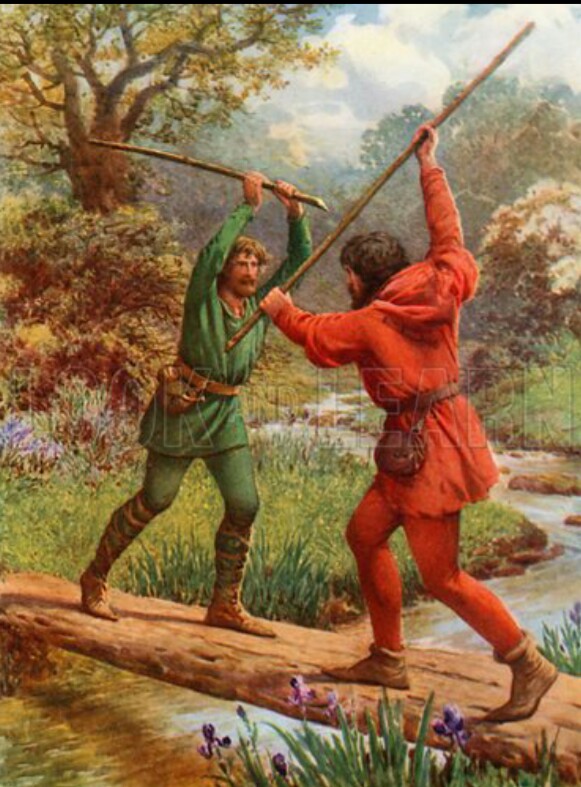
,  a fighting implement 5½ yards long  would be pretty unwieldy even for Little John (who was wielding the first quarterstaff I ever met [in a picturebook, about sixty years ago]).
</Hmm>
</digression>
But a recent survey for Mashable (I say "recent" because the Mashable report is recent; the video itself has no datestamp). But the issue of telling the time on an analogue clock has been around for some time. The late lamented Dave Allen had a routine about it which is worth 6'03" of anyone's time. And many other commentators have said that telling the time from an analogue clock is not a crucial skill for a 21st-century child. (It's just struck me that the ability to read an analogue clock is as irrelevant today as, when analogue clocks were invented, the ability to read a sun-dial became – it can be an impressive trick, but that's all.)

It's not crucial; but losing any skill is a shame. And a risk inherent in any new  technology is that it fosters dependence on it. In case of power cuts it's wise  to keep a few candles handy; and a box of matches. (Luckily, when friction matches replaced tinder boxes, power cuts were a thing of the future.)  But how many new boxes of tricks erode our abilities? Since agreeing (reluctantly...
<comparative_linguistics>
I feel the word doesn't have the force of the Spanish a regañadientes, with its implication of gritted teeth.
</comparative_linguistics>
...) to the use of SatNav,  I've noticed a reduction  in the accuracy of my sense of direction (never great).

Which brings us to alexia (see the subject line). It's related (etymologically, at least, though I have no idea whether the two disorders share any part of the same cognitive mechanism) to dyslexia. but a- instead of dys- – so not-at-all rather than mistakenly).  I wonder what Alexa would make of that. And I wonder whether 22nd-century people (provided that homo sapiens's sapience extends to the avoidance of self-annihilation for that long) will have their ability to read – while probably not entirely eradicated – at least attenuated.

Anyway, cricket calls.

b

Tuesday, 28 May 2019

Schwarzkopf and the harpsichord

Quirks of a translator's life – sitrep

In the course of my translation work (towards the Stephen Spender Prize for Poetry in Translation mentioned before in some recent posts to this blog), I've come across a word with a fascinating cluster of meanings. I've also started to use a new function of Google Sheets – a function that provides a Google Translate version (one word) on the fly.

The syntax of the new function is

=GOOGLETRANSLATE(<cell-to-translate>"<source->","<target>")

for example

 =GOOGLETRANSLATE(A4,"pt","en")

(This function call tells Google Translate to look at the Portuguese word in cell A4 and translate it into English.).

As anyone involved with language knows, meanings of words depend almost entirely on context. So the disembodied words thrown up by Google Translate in its Google Sheets incarnation  can be a bit off-the-wall.

I rather forced that incarnation into the last sentence, as it provides a link to one of the meanings of the keyword, the Portuguese cravo. This can mean "carnation", a meaning that possibly has a more than accidental link with "incarnation", if the derivation for that word (Etymonline lists several possibilities) is the Latin for flesh:

...Or it might be called for its pinkness and derive from Middle French carnation "person's color or complexion" (15c.), which probably is from Italian dialectal carnagione "flesh color," from Late Latin carnationem (nominative carnatio) "fleshiness," from Latin caro "flesh" (originally "a piece of flesh," from PIE root *sker- (1) "to cut"). OED points out that not all the flowers are this color. 
More here
Another possible meaning of cravo is (my source here is the Collins Portuguese Dictionary) "harpsichord". But these language1-to-language2 dictionaries often raise more questions than answers in a translator's mind; I suspect that the equivalent instrument might rather be a clavichord which doesn't sound or behave the same.
<example>
A strangely neglected album has Oscar Peterson playing with Joe Pass in an arrangement of excerpts from Porgy and Bess for clavichord and guitar, exploiting this unique quality of the clavichord: that the thing that strikes the string also defines its length. 
<aside subject="defines">
A deliciously apposite word. The word "determines the length" would be similarly appropriate for those of an etymological bent, as the tangent (that's what the doofer inside a clavichord is called) provides the terminus ad quem the string vibrates.
</aside>
This lets the keyboard  player bend a note, as does a blues guitarist.
</example>
In a harpsichord, on the other hand,  the strings are plucked.
<maybe_though>
(On the other hand, the clavi- bit of the word just means key [as in clef, clavicle, or the French clé] so any keyboard instrument might have been called a "clavi<something>". The makers of the Clavinova were the second (after whoever named the clavichord)  to exploit this neologizing open goal.)
</maybe_though>
Yet another possible meaning of cravo is "nail" or "stud", which – if you think of a nail driven home so that only its head is visible – accounts for the metaphorical use which for reasons best known to Google is the meaning fixed on by Google Translate (try putting that function call 

=GOOGLETRANSLATE(A4,"pt","en")

into a Google Sheets spreadsheet and you'll see what I mean: hint – Schwarzkopf.)

b

Update: 2019.05.28.08:55 – Added PS

PS In my rush to hit the <Publish> button yesterday I left out the one meaning of cravo that applied to the passage I'm translating. Again, it's metaphorical, but unlike blackhead (aha – THAT was it, Schwarzkopf, geddit?) which is animal, this meaning is vegetable: clove.