Showing posts with label Choral singing. Show all posts

Tuesday, 30 March 2021

Quicken - the backstory

When I wrote a piece on faux amis recently – "false friends"...

<inline-pps>
(words that seem, to a language learner, like an easily memorable translation word, but which don't mean the same as the presumed "equivalent")
</inline-pps>

 – the context (unstated at the time) was a virtual recording. Back then it wasn't clear that the finished product would be presentable, let alone something to be proud of:


(I'm not sure if this attempt at embedding works. If not, go to this YouTube link.) The use of quicken (and of languish, which I also comment on, occurs in the passage starting with the tenors at 0'56" ...
<rumblers-parenthesis comment="_I_ know about the apostrophe, but the virtual compiler wouldn't like it.">
(an entry I'm  glad not to have  been involved in :-) )
</rumblers-parenthesis>

.... The process of producing the virtual recording lasted several weeks.  I'd heard about the tribulations involved for the compiler/sound mixer.  (This is a Cambridge Alumni Festival event that took place last autumn [Northern hemisphere, Fall if you must] being a sort "brains' trust" of people in the university involved in  music...

<in line-ps>
(one of whom discussed at some length the problems she had had with this sort of venture)
<in line-ps>
...), but that work was all done with impressive efficiency by our MD. All the singers had to do was record the sound and the video (separate recordings, sync'd...

<parenthesis>
(I understand this is not the only way these recordings can be done [which accounts for all the other virtual recordings you see that show singers wearing headphones; this, for example: {spot the family resemblance, in almost the same position on the screen, 2nd row}
])
</parenthesis>

...). The synchronization involved a clap (doing the same job as a clapper-board in a film studio). My first two takes of the video were false starts, as it was so fiddly balancing a mobile phone on a music stand and getting myself in the frame. On Take 1 I missed the clap on the guide video (showing the conductor), and on Take 2 I clapped all right but realized that my hands weren't visible at all. I suppose James (our MD) could have watched for my shoulders to twitch; maybe not.

Recording the audio was easier, although the (few)  days I spent in recording studios as a would-be troubadour in the 1970s were enough to  tell me that it was bound to take an hour or two. The main problem was that I had a mental block over the word quicken; It took me until Take 6 to avoid singing

Should'st thou walking in grief languish
He will cripple thee

Another singer found, when she listened back to what she thought would be the final take, she had been singing
He walking over Israel slumbers not nor sleeps 

I imagine we weren't the only ones to stumble in this way.

But the bulk of the work was done after we'd submitted our recordings...

<unexpected-network-error>
(which – the submission itself – was a whole 'nother kettle of worms: I brought the network to its knees at one stage)
</unexpected-network-error>

All quite satisfying, not to say surprising, in the end. Many thanks to our MD cum sound mixer cum artistic director cum help desk, to our multi-talented accompanist, to the ad hoc socially distanced vocal quartet that sang on the guide video, and to all the backroom choir members who made our first recording possible. What's next?


b

Update 2021.03.31.12:30 – Added inline PS, and fixed some typos.

Update 2021.04.01.14:45 – Added inline PPS.


Friday, 13 November 2020

Joys Seven

In a Zoom rehearsal last night we were introduced to a new setting by our MD of the carol Joys Seven.

In less pestilential times, before singing a more traditional (or less fiendishly difficult, perhaps) version of this carol I wrote:

We will be singing several pieces new to the choir, among them Joys Seven – which is, in jazz terms, a paraphrase of The Lincolnshire poacher.

<digression>
That's something they don't seem  to do in  Primary Schools any more  – communal singing of  what were known as "Folk Songs" before the Revival of  the late '50s–early '60s. I remember at St Gregory's RC Primary School singing with gusto
When me and my companions Were setting of a snare
'Twas then we spied a
    gamekeeper

For him we did not care
For we can wrestle and fight,
    me boys,

And jump o'er anywhere...
A one-time colleague of mine, who already played the piano and the violin, during her teacher-training was required to learn the guitar so that she could maintain eye-contact with her pupils. As a consequence of this sort of thinking, today's schoolchildren can sing Kumbaya but not Sweet Lass of Richmond Hill.
</digression>
The interjection "me boys" in that extract are significant in a mistake I am always tempted to make in Joys Seven, because the two-word interjection at the equivalent place is "good man" – and I find it hard to avoid the less devout version.

Words, though; they won't learn themselves.

And, in a update to the same post I added this oft-picked nit:

And while we're on the subject of the words to Joys Seven, the sixth verse (which needs a rhyme for six) evokes in me another conditioned reflex from my old  St Gregory's days, provoked by the words "To see her own son Jesus Christ upon the crucifix".

A cross is a cross; an image of someone on one (there have been thousands of people tortured to death that way, if not  millions, but Christ is usually the one depicted) is a crucifix. I thought I'd better confirm this bit of pedantry, and it seems that dictionaries tend to agree:

Cambridge

Macmillan

Cobuild

Still, they needed a rhyme for six, and there aren't too many. Besides, the Collins English Dictonary is more forgiving:

On re-reading this I didn't see at first what justified my word "forgiving"; but there is a reading of this (which would be clarified by a comma after the second word) that makes the last phrase apply exclusively to "image of a cross". (And I wouldn't put such low standards of punctuation past the editors. :-) )

But time's wingėd chariot is doing its usual thing; Phoebus's jolly old cart...

b

Tuesday, 25 August 2020

Who's who in that setting?

Among the many things that a composer needs to think about when setting a text is the internal clues about who's singing what. If they get it wrong it may involve the audience and/or performers in some unnecessary mental gymnastics.

One example is That Lovely Weekend, which once  was a regular part of the repertoire for BYC's male-voice sub-choir. It starts "I haven't said Thanks for that lovely weekend" and the song recounts the two young lovers' doings on the weekend in question, followed by a tearful parting: "I'm sorry I cried, I just felt that way".

This was a song made popular by Vera Lynn in 1942 . It was a wartime song. The lovely weekend in question was – to use the British English – leave (short for 'leave of absence'); the American English equivalent would be furlough...

<parenthesis>
(a word that has a less recreational sense in British English in 2020...
<amuse-cervelle>
What English word is spelt with these consonants in this  order: CRNVRS and includes these vowels (in another order): OOAIU, but has nothing to do with respiratory infection?
</amuse-cervelle>

...If the usage trends graph provided by Collins extended beyond 2008 it might show an upturn starting in March 2020 rather than this faintly embarrassing ... 

<IknowIknow> 

(not that any document can ever be up to date – I just feel that with data at least 12 years out of date [and counting], they ought to 'fess up)

</IknowIknow> 

...slow dwindling:

</parenthesis>


.... But in the setting that used to be in the repertoire of the Berkshire Youth Choir in the early noughties it featured a baritone and only male voices. Of course, the tearful man might have been a conscientious objector being visited by a Wren whose "kit to be packed" (lyrics courtesy of genius.com) included an evening dress, but – expecting (at the sound of galloping hooves) horses rather than zebras – I found it rather odd.

Similarly, but with the full forces of an SATB choir, I felt the version of "Goodnight Sweetheart" performed two or three times by Wokingham Choral Society under our one-time MD Alex Chaplin (and more often by the WCS Chamber Choir...
<plug>
(available at reasonable rates for weddings and bar mitzvahs)
</plug>

...) was inappropriately set. The socio-historic (rather than musical) setting was an American Graffiti sort of thing: an adolescent couple in a borrowed car outside the young lady's home at the end of a date:


sings the young ma... but no; it's the sopranos. I always felt confused at this stage (not that anyone in the audience would have shared my feeling.

That's all for today; things to do (even if it rains at Southampton :-)).

b


Update: 2020.08.26.12:25 – A few typo-fixes and other corrections


Thursday, 20 August 2020

What goes around...

In the early weeks of the present little local difficulty ("Nice and damp treatment [and catching] (8)") I wrote here

[Ed: In September 1985] I had my audition for Wokingham Choral Society with their new MD Paul Daniel. I persuaded him to take me on, despite my limitations when it came to reading music (and at the time I didn't even have a keyboard of any kind at home to help with note-bashing) on the strength of my having "recently" sung Beethoven's Mass in C (WCS's concert piece that term) with MagSoc's choir. That recently was something of an exaggeration, but it sounded more persuasive than the more accurate 'about 12 years ago when I was looking for an unauditioned choir having been kicked out of the chapel choir').
<peccadillo>
After three years with that choir (three years that coincided with Paul Daniel's tenure, before he went on to greater things) I left WCS, to return in the early noughties, under Aidan Oliver. On the strength of being a returning member I escaped without audition. (This may have had something to with the maestro's attitude to red tape.)
</peccadillo>

The post the other morning brought the music for next term's offering ...

<parenthesis>
(if that's the mot juste – as there is no offeree, "so shaken as we are, so wan with care" as wossname put it). We'll be having virtual rehearsals. So individual choir members will hear themselves, but there won't be an audience. 
</parenthesis> 

And the main piece for our Zoom rehearsals was the same mass. So my introduction to SATB choral singing...

<autobiographical_note>
There had been "the sixth form choir", but that was just a (transparent?) ruse to flesh out our UCCA forms ("UCCA" being the fore-runner of UCAS) in the Lower VIth. Our repertoire extended to "Jesu, Joy of Man's Desiring" set for two parts, in Latin  (it was a Catholic school after all) For years this was a party piece for me and my brother.

Before that there had been a primary school choir (back before the philistines rewrote the curriculum), and a Gang Show (from which I can still see the Banda'd ...

<parenthesis>
A Banda was a sort of pre-Xerox duplicating system (Wikipedia calls it a spirit duplicator), involving smudges and a strong whiff of meths. It's a wonder to me that there was not a rash of Banda-sniffing among school children (perhaps there was though; we had a very sheltered childhood)
</parenthesis>

... copies, complete with a baffling typo at the end of "Steamboat Bill". The widow's words addressed to her children should have been "bless each honey lamb"; but our copies said "bless each honey bole" a mistake that my memory can't shake whenever I think of the tune. (We had no idea what a "bole" was at the time, but much of the socio-historic environment was foreign to us anyway: What was a steamboat?, what did "Crêpe on every steamboat" signify? What was a "honey lamb" and did it differ in any meaningful way from a "honey bole"?

</autobiographical_note>

... was Beethoven's Mass in C. And I can't wait to hear what our MD makes of the first movement's less than decisive tempo marking. But what do I know? Far from indecisive it might just be extremely persnickety (and if I was feeling stronger I'd've stuck to my guns when the Autocorrect monster told me to break that last word up with an S). 

"Andante, but moving on a bit, in fact fairly vivace, come to think of it almost Allegretto. But don't overdo it."

The other piece is Brahms' Schicksalslied – a piece that's new to me. But one critic is quoted ...

<dodgy_reference>
Wikipedia gives only a secondary source, so I'm not naming either the quoter or the quotee. More'n my job's worth.
</dodgy_reference>

...as saying "Had Brahms never written anything but this one work, it would alone have sufficed to rank him with the best masters." 

That's all for now.


b

Saturday, 25 July 2020

At the end of the tunnel

Two years ago I wrote about a Voices Now  survey of choral singing in the UK.
The census estimates (conservatively) that over 2 million people sing regularly across the UK. This is similar to the number of Britons who go swimming on a weekly basis, and 300,00010 more than those playing amateur football each week.11 However these two sports receive considerable public funding, in part because of the widely recognised benefits of regular12 sports practice for mental and physical well-being and their role in local communities.
  10  2.52M swimming once a week (source: Active People Survey 10)
11 1.84M playing football once a week (source: Active People Survey 10)

12  Football - £30 million per year (source: Full Fact.org).
    Swimming
-  £10 million(source: Sport England)
Aha I interjected but sport has physical and psychological benefits. Doesn't that explain the difference in government support? The Voices Now survey again:
Professor Graham Welch, Chair of Music Education at the Institute of Education, University of London, found that the health benefits of singing are both physical and psychological. “Singing has physical benefits because it is anaerobic activity that increases oxygenation in the blood stream and exercises major muscle groups in the upperbody, even when sitting. Singing has psychological benefits because of its normally positive effect in reducing stress levels.

Psychological benefits are also evident because of the increased sense of community, belonging and shared endeavour. 

6 Heart Research UK, Singing  is Good for You, 2017
That was then and this is now. Choral singing has a new enemy that uses biological warfare, despite the fact that, as a recent study says, "[T]here is no secure, peer-reviewed data on the dangers of singing itself – taken in isolation, that is, from other potential contributors to outbreaks...". It goes on to list examples: "...close contact, shared drinks and snacks, as well as poor ventilation", all of which can be managed – some, admittedly, with more difficulty than others.

The study investigates
...how dangerous singing and playing woodwind and brass instruments are in the spread of Covid-19. Serious outbreaks of the virus were linked to choirs from countries including South Korea and the Netherlands this spring. Most notable was the terrible case of a choir rehearsal in Skagit County, Washington state, on 10 March. Out of 61 attending practice, 52 people fell ill. Two died.
<parenthesis expertise="0">
Part of a test. For the full picture,
see the original article
"...playing woodwind and brass instruments"?  Singing I can understand – despite the lack of peer-reviewed evidence against it.  But it seems to me that a woodwind or brass instrument is as good (as far as the mouth is concerned, and I'm not sure why a player of a wind instrument would want to waste air by breathing out through the nose – which leaves only sneezes...
<meta-parenthesis> 
[and surely, isn't sneezing nature's way of telling you not to go to a rehearsal?]
</meta-parenthesis>
...) as  any cloth mask (if not more effective) in the inhibition of aerosols. For bio-secure rehearsals I imagine there would have to be protocols for  disposing of the condensate (that's a euphemism for "spit"), but the air coming out of the instruments themselves is surely not a possible vector for the virus – not that the air moves that vigorously anyhow (a professional trombonist speaking in a BBC news interview observed that it was next to impossible to blow out a candle placed by  the bell of the instrument).
</parenthesis>
But this is getting dangerously close to gloomy rumination, which – despite evidence to the contrary  – I'm trying to avoid.

The report of the recent research continues:
The study that Costello has set up with Reid and other colleagues – funded by the Department of Digital, Culture, Media and Sport and sponsored by Public Health England – aims to insert some facts into the discussion. The researchers hope to publish their findings in a matter of weeks – incredibly fast by the usual standards of peer-reviewed academic publishing. 
Here's hoping.

b

PS My latest nomination for a FOGGY (recognizing bad writing - see here, and here's a taste):
The idea for the name derives from Robert Gunning's FOG index, although these awards don't restrict themselves only to obstacles to readability measured by that index.
Here it is:

Is this a recall notice? It claims to be, but the text doesn't say anything like 'Take this back for a full refund. You really really ought to do this ASAP". It's more as though some official department or other has said 'Recall this" and B&Q have decided to save money by falling back on bad writing.

The word "advise" works to ways in English (at least two ways, but these two are the relevant ones):
  • advise + to-infinitive [that's ESOL-speak for what many  language learners know  as 'the infinitive"]
    Meaning: It would be wise to do this
    Example: He advised me to forget it
  • advise + that + indicative
    Meaning: Here's some information. Act on it or not – it's up to you
    Example: Transport for London advises passengers that engineering work will...
But B&Q have conflated these two. They are saying 'Here's some information: do with it what you will.' (the second sort of advise), but disguising it as the first sort (with a subtext of "Anyone with any sense would take care with this jerry-built rubbish. The Health and Safety people say we've got to recall it, but we're not going to waste money like that.")

Update: 2020.07.27.09:30 – Added saxophone picture

Saturday, 13 June 2020

Nabucco

My choir's latest virtual rehearsal was based on what is known in England as "The chorus of the Hebrew slaves" (so much better as the Coro di Schiavi Ebrei, as our copy had it...
<TYPO status="dubious" reason="old language?">
I think, though my knowledge of Italian is based on a course I did in 1992. the modern Italian would have degli in place of di. This would be yet another example of archaism in the 19th century text, like those I noted here
In his text for Va pensiero, Verdi (or his librettist if he had one ...? 
<stop-press date="June 2020">
Yes he did – the splendidly named Temistocle Solera
</stop-press >
...) does not use dove, in
Ove olezzano tepide e molli 
L'aure dolci del suolo natal
...

The ove shows that at one stage some Italic dialects followed the French path, without an initial d
<background>
Earlier in the same post I had written:
The word for 'where' has a chequered history in the Romance Languages. Simply put (which is all I'm up to) it is derived from UBI [='where'] or UNDE [='where from'], with or without an initial DE. So French  comes from UBI, Italian dove comes from DE + UBI and Spanish is 'etymologically pleonastic' when it asks 'Where are you from?'; '¿De dónde eres?' starts with DE DE UNDE, meaning 'from[from[from where]]]'.
<stop-press date="2020"> 
Catalan is like Castilian in its preference for derivation from UNDE, but without the pleonastic d: it uses plain on. So, far from adding a d at the beginning of the word, it drops one from the end.)
</stop-press>
And what in modern Italian would be aire is aure (reminiscent, to me, of the two possible forms in Portuguese of the word derived from CAUSA(M): Fr. chose, Italian and Spanish cosa, but Portuguese [modern Continental Portuguese, that is] either coisa or cousa  – to be filed under Interesting but irrelevant I suspect). 
</background>
As Metternich...
<parenthesis>
"needs citation", to use Wikipedia's passive-aggressive  gibe, but my history teacher used to say it, and what's good enough for Mr Crosby is good enough for me
</parenthesis>
...said at the time 'Italy is a geographical expression'. The name VERDI was a coded feature of political graffiti, standing for Vittorio Emanuele Rei D'Italia. (And, now I think of it, the Hebrew Slaves have an allegorical relevance: the people of that geographical expression had been "enslaved" for centuries by various imperial powers.)
</TYPO>

Covid Chronicles 

The rehearsal (like most things these days: I wonder what's happened to the share price) was done over Zoom. For my madrigals group I use a tablet, which can put  nine thumbnails on one screen; it's a small group, so two screens is the most it runs to. But with the choir – with more than forty (60 or 70 on a good day) – I prefer to revert to my desktop PC, which runs to 2/3 screensful.

But it has no integrated camera. I've found a very old webcam, which I can't get to work. The PC itself is old enough (it runs Windows 7, no longer supported by Microsoft [and this old post sums up  my feelings about computer support:
She...[MrsK] asked a passing school-leaver [in PC World] if there were any known support issues with application software (I'm paraphrasing here, you understand) and the answer was, surprisingly enough, that everything was hotsy-totsy with Windows 8. 
Well, twenty years of working with software engineers (actually, 19¾ – HP took the penny-pinching precaution of shafting me 3 months before they would have had to fork out for a 20-year award) has taught me that if anything can go wrong with new software it will. This was true of Windows 95, and with everything since. Working in 'Support', which I did for many years, involved me almost daily in fixes and workarounds and you-just-can't-do-that-any-more when people tried to get existing application software to play nice with a new operating system.
]), but the webcam pre-dates even that – the user guide doesn't mention Windows 7 (only its predecessors Windows 2000 and Windows XP).

So my participation in the rehearsals is haunted by a photo of me (taken, now I think of it, when I was using Windows XP). The picture is in a file called mugshot.bmp, which gives an idea of its lugubriousness.

Tha'sall. Time I showed my face in the Real World.

b

Friday, 5 June 2020

Brother Lawrence / in the scriptorium / with a quill

Medieval Cluedo?

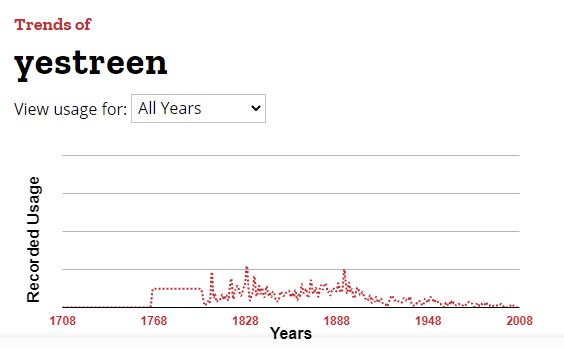
Yestreen...
<gloss>
I'm trying to get this charming abbreviation for "yesterday evening" re-adopted.


According to Collins it's Scottish and pretty rare But their "usage trends" graph shows that (back in the nineteenth century) it was all the rage.
</gloss>
... my choir sang this:
Manuscript from Reading Abbey, but probably produced in Oxford.
(see David Crystal, The Stories of English [2005], p. 108)

In  The Stories of English David Crystal says
Reading Abbey did not have a scriptorium, so the manuscript was probably copied at Oxford.
This gives the rota or "round" a double relevance to our choir, as a good few of us live in the Reading area, and both our MD and our accompanist studied at Oxford.

But why Sumer? Isn't it the wrong bird? The cuckoo arrives in Britain in April. Crystal gives the answer:
There was no contradiction, because in Middle English sumer was the only word available to describe the period between the vernal and autumnal equinoxes. The word spring to refer to the season is not recorded in English until the mid-sixteenth century.  
The Stories of English
That Crystal book has reminded me of a pipe-dream I discussed here
<digression theme="pipe-dream" likelihood="0">
Penguin missed a trick (or more likely decided that the trick wasn't worth the outlay) with this book. It was written like a coffee-table book, with two or three sorts of text and standalone features, quite like Words: An Illustrated History of Western Language (which I had a small part in publishing – but a bigger part than I wanted [and that's a whole 'nother story] ). But Penguin just squeezed it all together with tiny margins and no kind of visual clues to what sort of text was which. 
<inline_ps date="2020">
"No sort of visual clue" is strictly a bit of an exaggeration. The designer has done what he or she could in the cost-reduced circumstances of what the trade knows (or knew in my day) as a "mass-market paperback". If you know what to look for it makes sense. There's a vertical rule down the margin of the standalone features; but it's easily missed, and the reader only realizes what's happened when the syntax of two unrelated sentence parts makes the inconsistency felt.
</inline_ps> 
The reader's never sure whether the current text is part of the main argument or part of an illustrative aside. It needs changes in line-length or font or shade of paper to make it a smooth reading experience.
<sub_digression>
In fact, the writing so obviously has this sort of treatment in mind that I suspect it was written to order for another publisher but that the contract fell through. The typescript then got bought by another publisher whose needs were at odds with the book as written. Maybe not though – who knows...?
<sub_digression>
My fantasy – though I haven't discussed this with the good Professor – is to win a large amount of money and become a proper publisher. My Rights department would negotiate with Allen Lane to acquire the rights for a properly designed book, and my Design department would make this book CanDo Publishing's lead title.
<digression> 
<tangent>
In researching this post I've come across my latest nomination for a Tezzy ("Time-wasting Site of the Year".  I haven't dabbled yet, but imagine the temptation will get the better of me in the end.  Here it is, the British Library's Medieval Manuscripts Blog
</tangent>
Enough for now.

b
PS An irrelevant quandary:

My attention has been brought to this petition, and I'm in a quandary about signing it. I know I shouldn't be, as it obviously addresses a critical issue.
<parenthesis>
(My first choice of wording in that last sentence was "It clearly addresses", but while it does obviously address the issue, clarity is hardly characteristic of the way it goes about it. The "writer" has had a thought, taken a number of words in the relevant area, and spewed them out onto the page in the hope that the reader will organize them into something meaningful; with any luck, that meaning will match the meaning intended. 
I am reminded of Sheridan (père's) words (used to drum up business for a teacher of how to write)
We write with ease to show our breeding 
But easy writing's curs'd hard reading. 
</parenthesis>
I want to subscribe to the gist without subscribing to the woeful wording. I do wish people would give some thought to what they're writing, rather than scatter-brainedly  conjuring up a bunch of more or less relevant words and leaving it to the reader to arrange them into a thought. How's this for a doozie?
It is important to learn about Black History and unteach this ignorance as some children may not choose to educate themselves and just listen to the people around them and be influenced causing people to hold racist views and pass them down many generations meaning the cycle of racism and systematic oppression will never end.
Fifty-five words with no punctuation. and daisy-chain syntax. The people the petition is addressed to are almost guaranteed to dismiss it as intemperate ravings.

I guess I'll sign, but with a heavy heart.

Update: 2020.06.06.16:20 – Added inline PS.

Wednesday, 8 April 2020

/e 'luʧəvæn le 'stele/

These are indeed trying times, and made none the less trying by the mispronunciation called out in my subject. I don't know either why this is so painful or why people do it. Puccini has spelled it out in the first four words of the aria....
<aside type="boogy-woogy">
I mean, it's not like, say, Squeeze's Up the junction, where the name of the song is not mentioned until the last line. (Not sure why that occurred to me.)
</aside>
... with stress obviously, clearly, musically on the second syllable of lucevan. And the orchestration is as sparing as can be; the tenor is as clear as... [ed. can you do something with "bell/bel canto" here?] [You'll be lucky sunshine.]...a very clear thing.

The words are there, spelled out, what possible excuse is there for mangling the Italian? But the DJ on Classic FM (it would be invidious [indeed pointless] to name him, but he's an educated chap) says 'Here it is from Tosca, E loochevan le stele'.  Strange that he doesn't pick up the obvious clues; it doesn't take a great linguistic gift to hear something so simple.

Another frequent trial [while we're on the subject of bees in bonnets] comes for the Classic FM listener (or, more regularly except in these days of isolation, for a choral singer) whenever an r closes a Latin syllable. In English (in RP, that is) an r in this position does something strange to a preceding vowel (a bewildering array of strange things ...
<plug>
In due course ...
<really_though>
[hollow laugh; breath retention is not advised]
</really_though>
... WVGT2bk will list these. But its tortoise like progress has already covered most r words; only UR to go. AR, for example, can represent /ɑ:/ (in par), /eə/ (in pare), /ær/ (in parry), /ᴐ:/ (in war),  /ər/ (in parietal),  /ɒr/ (in quarry)... to list only the obvious cases. The whole grisly story (grisly, that is, for students of ESOL) is covered for AR, ER, IR, and OR words in WVGTbk2 , which will be free to download over the Easter weekend.</plug>
) Anyway, that frequent trial. The life of a choral singer is beset by fellow singers who – when singing Mozart's sublime Ave Verum Corpus, for example – insist on pronouncing the last word as if it were some kind of regimental mascot ("corps puss", geddit? [bou-boum tsh].)

That's all for now; the great outdoors is calling...

b

Update 2020.04.10.17:40 – Added PS

PS A similar mistake  happens with  Che gelida manina. The words are the first thing you hear after an unfussy introduction, and all clearly enunciated on one note. In Lucevan le stelle, the one note statement comes after the clarinet's I left my love in Avalon tune. In Che gelida manina, though, the mangling of the stress is subtly different. Whereas Lucevan is stressed (correctly) on the second syllable, gelida is stressed on the first.
<mnemonic type="approximately homophonic, irreverent">
Think of "jellied eels" – long-short-short.
</mnemonic>
So I ask myself again why the mis-stressed version (gelida) is so common. There's no excuse; the right stress is there, spelled out in the music.


Saturday, 14 March 2020

Soothing the savage beast

...a misquote of course. What Congreve [not Shakespeare, the usual suspected source of most iambic pentameter] actually wrote in The Mourning Bride was

Musick has Charms to sooth a savage Breast, 
To soften Rocks, or bend a knotted Oak.
<digression title="factoid du jour">
The Latin for oak, robur, gave English the word robust. (Further info). Strictly, it was no English wordsmith that came up with a word based on robur. as Latin already had the adjective robustus, but the link is still worth knowing about (and I only recently had the "Of course it means that – DOH" moment).
</digression"> 
A recent Classic FM page reported (if report is not too strong  word in this case –  there was a disappointing dearth of hard facts about the paper in question):
New research from the British Academy of Sound Therapy (BAST) has shown there is a common dosage for music and revealed how long an individual needs to listen to it for a therapeutic effect to be experienced.
Clicking on that inviting link in the first line leads not to an authoritative source but to another equally unauthoritative  Classic FM page (which at least gives some detail):
To carry out the trial, students divided 157 adult participants into two groups. The first received ultrasound-guided injections of a benzodiazepine known as midazolam, while those in the second group were given noise-cancelling headphones delivering ‘music medicine’.

For three minutes – the length of time it takes for midazolam to reach optimum effectiveness – patients in the second group listened to a musical recording specially designed to lower their heart rate, blood pressure and levels of the stress hormone cortisol. 
To ensure accuracy of results, researchers used an approved anxiety scale with patients before and after treatment, scoring them from 1-4 on six simple statements, while doctors also rated them on a 10-point scale
.
.
.
And it certainly had the desired effect, with the abstract of the study describing music medicine as a ‘non-pharmacologic intervention that is virtually harm-free, relatively inexpensive and has been shown to significantly decrease preoperative anxiety’ 
Source
There may be some way of getting out of this labyrinth of self-reference, but I don't have the time to find it. If you have, have at it. But it reminds me of a reference I made here to 
...the madrigal All Creatures Now, written during the reign of Good Queen Bess ('See where she comes, see where she comes with flow'ry garlands crownéd...'). I have sung this madrigal before, and [not] given this phrase a second thought: 'Music the time beguileth'.  It doesn't seem to belong semantically (or musically) with either what comes before or after it. So previously I have dismissed this line as just an Elizabethan filler that doesn't mean very much.

But having so recently written That's 'wile', as in 'beguile'... [HD – in that same post] I realized that Bennet (the composer) was referring to the way music has a beguiling effect on the listener's awareness of the passage of time; it wiles time away.
 (And if you'd like an H in that wiles, read that post: I've highlighted in red my reasons for going H-less; but you do whichever you prefer.)

The BAST article used this infographic, which I found quite interesting (although I think the RDA message (the Recommended Daily Amount) is rather lost. It would have been more persuasive (about the music versus drugs issue) if they had used the term RDA:
 Music as Medicine infographic, from The British Academy of Sound Therapy. 

That's all for now. I must get on my HazMat gear before this evening's TCB concert.

b

Update 2020.03.17.16.45 – Added PS

PS
I wronged the Classic FM report. Because the first two links in it pointed to more fairly vapid editorial I assumed that the whole site would be like that. But there is a link to the original paper if you persist.
<apologia>
But I'm afraid that the more web masters' budgets are splurged on the generation of "content", the more editorialisers churn out verbiage by the yard, garnering the vain clicks of us seekers of wisdom and truth. Classic FM weren't (egregiously) guilty in this case though –  I was just a bit quick to write them off.
</apologia>

Tuesday, 18 February 2020

Quarantine and epicentre

People who know a bit about the formation of languages learn  that they must beware of the Etymological Fallacy, which this Oxford Reference page defines as
The belief that an earlier or the earliest meaning of a word is necessarily the right one. That it is fallacious is illustrated by the fact that orchard once meant a treeless garden, treacle a wild beast, and villain a farm labourer.
The creeping Wikipedi-ization of the modern world has exposed us more and more to this tendency to hold that words must mean what they used to mean, which implies that meanings must never change. Still, a knowledge of where words come from can be fascinating.

The word "quarantine" has had a long history, originally referring to a period of isolation at the time of The Plague (well  one of the waves of  one of them – it was all a bit muddled back them, TBH).

This page dates it (with annoying vagueness – the site is, after all, designed to drum up business for English Language summer schools, so it would be unreasonable to expect much in the way off academic rigour) to "a document from 1377"  though in an  earlier form that set the safeness-from-plague period to thirty days – una trentina. In an earlier post I briefly referred to "quarantine"‘s ship-of-possible-carriers origin, but I didn't place the first use as coined by Venetians trying to keep the plague out of Dubrovnik (as this page does if you care to read it through):
The word “quarantine” has its origins in the devastating plague, the so-called Black Death, which swept across Europe in the 14th century, wiping out around 30% of Europe’s population. It comes from the Venetian dialect form of the Italian words “quaranta giorni”, or “forty days”, in reference to the fact that, in an effort to halt the spread of the plague, ships were put into isolation on nearby islands for a forty-day period before those on board were allowed ashore.  
Source
My ingrained cynicism about the temptations of the Etymological Fallacy doesn't,  however,  prevent me from experiencing a frisson of "innocent merriment" ...
<PC_defence degree="set phasers to stun">
(at the risk of seeming to make light of a notably unfunny situation)
</PC_defence>
... when the Diamond Princess quarantine forced the word back to its roots (with people not  being allowed to leave a ship).

My other concern at the moment is the snowballing over-use of epicentre. Again, I'm not trying to argue that the word can only be used between consenting vulcanologists ...
<spelling_for_dummies>
(and the infernal machine wants me to write "volcanologists", but quod scripsi scripsi)
</spelling_for_dummies>
... but I just feel my lip curling whenever people use a big word just to make them sound serious. What's wrong with centre? What's wrong with focus?...
<digression>
There's that innocent merriment again. Focus, being derived from the word for fire, seems particularly apt when talking about an infection that causes, among other things, fever.
</digression>
...hub..., source ... There are many ways of avoiding epicentre; but it continues on its juggernaut way. This view of its growth in popularity (sadly out of date – the  latest data they've got is from 2008, and in the last twelve years its use can only have grown) comes from Collins:

 Anyway, it's time I got back to note-bashing for  our next concert:

<incidental_observation>
A fellow choir member has asked about "Jesu chare"  in the Pergolesi Buxtehude  – not having found chare in a latin dictionary.  There are two problems with this search. The first is that the phrase is vocative – addressing Jesus. "Dear Jesus" would be, in the nominative (just naming him), Jesus carus. The spelling of that second word points to the second problem. This recalls my "epicentre" rant; one of the mechanisms of language change is hypercorrection (trying to sound important by a misplaced display of "learning"). The introduction of h after c ...
<inline_ps>
I'm not referring to a /h/ sound following the /k/. The hypercorrect change is from /k/ to /χ/ (like the sound at the end of Bach). Trimalchio – that* character in the Satyricon – is (unwittingly) referring to the influence of Greek sounds on Latin. Greek slaves were common in the Roman world,  and there were Greek-speaking enclaves in what we now know as Italy.
</inline_ps> 
...is usually hypercorrect; this is satirized as early as the first century AD in the Satyricon; which has a social-climbing character who is mocked for saying chommodus rather than commodus; Oops, TMI.
</incidental_observation>

Anyway, it's lovely music. Don't miss it.

b

Update: 2020.02.18.15:45 – Added inline PS.

Update: 2020.02.19.12:15 – Added footnote

* Oh what a tangled web we weave
   When first practice to update with an inline PS

That character is mentioned later on. Sorry.

Update: 2020.02.21.10:20 – Corrected the composer; it was Buxtehude


Sunday, 15 September 2019

He saw that it was good|bad|neither good nor bad

I didn't know – until I heard Simon Schama's excellent Schama on Blake on Radio 4 the other day – that Blake was a poet only in his spare time.
<AUTOBIOGRAPHICAL_NOTE type="Introduction">
My introduction to William Blake, the poet, was a whole-class detention (back when teachers could do that sort of thing) during which we were required to learn The Tyger by heart. Ma Griffiths (the teacher, so dubbed because she insisted on being addressed as "Ma'am") can't have tested us very stringently, as only the first 4 lines  stuck – and even then I have to check whether the symmetry is fearless or fearful. And I have vague structural (gist) memories: the second stanza is a series of questions asking what...?;  the last revisits the first (though how accurately I don't know).
<inline_PS>
I underestimated the power of that rote learning. Although this memory was not strong enough to interfere with my singing in the 2019 Christmas concert, it's strong enough to make me expect the words of Rutter's Star Carol 'See the star, shining bright' to continue 'In the forests of the night'.
</inline_PS>
</AUTOBIOGRAPHICAL_NOTE>
The programme was tied to an exhibition at Tate Britain
With over 300 original works, including his watercolours, paintings and prints, this is the largest show of Blake’s work for almost 20 years. It will rediscover him as a visual artist for the 21st century. 

More here
I'm not sure what "rediscover[ing] him as an artist for the 21st century" involves exactly, but I mean to find out.

One of Blake's most famous artistic works  is Europe, a prophecy, which Wikipedia uses to illustrate its entry  on Haydn's Creation (I'm not sure why...

<CHOICE_OF_ILLUSTRATION>
Newton by William Blake -
The William Blake Archive, Public Domain,
 https://commons.wikimedia.org/w/index.php?curid=198284
(in my view his work Newton would have been  more appropriate. Wikipedia, like Schama, describes the implement he is wielding as "compasses", but I'm not so sure. Compasses, as any schoolchild knows, are used in construction. But in this case I think what we can see are dividers (used to measure). A mighty creator would have used compasses.

Europe, a Prophecy - The William Blake Archive, Public Domain
https://commons.wikimedia.org/w/index.php?curid=27197029,
This  puny geometer, though, is just measuring. Blake‘s "Art is the Tree of Life. Science is the Tree of Death." suggests that he wasn't a fan of Newton and his  ilk.) 


I don't see what makes  Europe, a Prophecy relevant to The CreationThe dividers are still there, but the geometer is older.  Did Blake know something we don't?
</CHOICE_OF_ILLUSTRATION>
... though).
<COINCIDENCE> 
On 20 November 2010 at Wellington College Newsome Sports Hall Wokingham Choral Society last sang Haydn's Creation. Reading Chronicle's review called it "this most satisfying evening". The Wokingham Times reported possible misgivings about the venue, but in the end said
While it is true that there was a slight vibration in some of the louder sections, the performance was so well prepared and polished that this did not interfere with the power of the music.
Fortunately,  when the choir sings this marvellous piece again (just under 9 years later, on 16 November 2019) it will be at the University of Reading's Great Hall – with better acoustics and nearer to home. 
And the relevance of this – albeit tenuous and coincidental (hallmark of Harmless Drudgery, the "snapper up of unconsidered trifles") is that the tenor soloist at the concert will be "William Blake". 
<TEXTUAL_INFO type="plug"> 
For further  details on Haydn's  score for The Creation  (particularly the translation), if you're  feeling strong, you could  read this (a 68 page document, though only the first 55 are the  main text). You might prefer, though, to come to James Morley Potter's free introductory talk at 6.30 pm on the day of the performance.
</TEXTUAL_INFO>
</COINCIDENCE>
b

Update: 2019.11.12.15:30 – Added PS

PS

Correction: the tenor at our Creation concert next Saturday will not be "William Blake" (as originally announced). The tenor will be the young Dutch soloist Stefan Kennedy.

Update: 2020.01.02.15:00 – Added inline PPS.


Tuesday, 13 August 2019

Magellan not gelling

The starting point for today's rambling is the quincentennial celebrations of the circumnavigation of the globe, in a voyage that took nearly three years – from 20 September 1519 to 6 September 1522.

The course of the Magellan/Elcano circumnavigation
as depicted in https://en.wikipedia.org/wiki/File:Magellan_Elcano_Circumnavigation-en.svg

The BusinessMirror reported recently on the circumnavigation ...
<REALLY status="query">
People say things like "Magellan circumnavigated the globe". Well, he only made it (alive) for the first half of  the circumnavigation. Maybe his stand-in Juan Sebastián Elcano  who took over captaincy of  the one ship that completed the journey, brought Magellan's corpse with him for the last bit (not unlike Nelson's body on the trip back from Trafalgar) crossing the Indian and Atlantic Oceans, just so he could get the record.
</REALLY>
...of the Earth:
THE arrival of Portuguese navigator Ferdinand Magellan to our shores [the shores of the Philippines] in 1521 was a watershed in Philippine history because, although he was slain by Mactan chieftain Lapu-Lapu, the Spaniards came back decades later to Christianize and unify the country.
I feel there there may be a non sequitur of stupendous proportions here. The arrival wasn't the watershed; the discovery by the Western world of the islands was – or, rather, it represented one.
<OH_YEAH query="appropriateness of water-based metaphor">
Hmm. Interesting metaphor, watershed.  A watershed, for a map-maker, is where water chooses to go either one way or another; if there's a mountain range, and rivers go eastwards on one side and westwards on the other, that's a watershed. The water, in the Philippines' case, is economic development. After the "discovery" it certainly did flow westwards (eventually). (So fast did it flow, in fact, that global-warming threatens the very existence of the Philippines; a mixed blessing.)
Another watery metaphor is bailout. I see in the paper that our tinpot dictator, wished on us by a handful of ...[ no, I must count to ten and keep taking the tablets {as Jahweh said to Moses <boo-boom>}] The "Brexit war cabinet'  is planning a 'bailout fund' for key businesses brought low by a no-deal Brexit.  Two punning meanings of  bail out are involved here. One meaning of "bailing <someone> out" is "getting them released temporarily"; no water there. This meaning has a long history in print, discussed in the Phrase Finder. Shakespeare ( as so often) used it in Titus Andronicus ("Thou shalt not baile them, see thou follow me"). I imagine this idea of temporary financial assistance was in the mind  of the Brexiteers who planned the fund. 
But there are other possible meanings of "bail out". The first that comes to mind is what you do in a sinking ship, deriving from a word for a small bucket. To quote Etymonline:
Both sorts of "bail out" seem to have got mixed together in the parachutist's emergency move (later adopted by anyone in difficulty, from surfers to party-goers) – both a temporary fix for a little local difficulty (standing as guarantor to avoid imprisonment), and a last-ditch attempt to stave off disaster. In the Brexit case, I favour the latter interpretation.
</OH_YEAH>
But this is only the first eyebrow-raiser in an article [HD: keep up: I mean that BusinessMirror article] full of them. the last "sentence" is a masterful demonstration of how not to write:
If Spain and Portugal view these extraordinary feats as their country’s contribution to mankind, it is thereby hoped by mankind that these ‘Circumnavigation’ nations will be in the forefront to foster peace and address the challenges confronting mankind in the 21st century, such as threats to world security and environmental problems, to name a few.
Fifty-five words and only a couple of commas to lighten the cognitive load; oh, and quotation marks to highlight the meaninglessness of "'Circumnavigation' nations". It deserves a FOGGY, (first introduced here).

But, returning to Magellan (or, in the grandiloquent phraseology of  BusinessMirror  "THIS writer referenced Wikipedia"). Wikipedia, in its first line on Magellan, offers two possible pronunciations, citing two dictionaries: "(/məˈɡɛlən/[1] or /məˈɛlən/;[2]" Now, as regular readers will know, I'm not a fan of prescriptions about language use. But a chap's name is his name, and it seems to me that pronouncing it some other way is just plain wrong.

When it comes to foreign names, there's a problem. Often one language's phonemes just don't fit; and there are things like stress that interfere. Ask a French national who /'vɪktə 'hju:gəʊ/ was and they probably won't recognize Victor Hugo (/vik'tɔɹy'gɔ/). And I'm not suggesting that the English should have to grapple with the original pronunciation (I doubt if a modern native speaker  of Portuguese would know how the language sounded 500 years ago). But the Portuguese name Magalhães has (and always has had) a /g/ in it (I've stopped using the term 'hard' for that sort of g since trying to make sense of the requirements of a Musical Director who used it to mean the precise opposite). So my view is that the affricate (/ʤ/) pronunciation (as in "jello") is simply mistaken. Webster's is accurate in reporting its existence (this is one of the few flaws in the makeup of Sir David Attenborough, for example), but that doesn't make it right.

b

Thursday, 1 August 2019

On the road (river?)

See the 6 August update for thoughts
about the "upon"
This coming weekend representatives of the Wokingham Choral Society (not quite half) will be taking to the road with Songs of Travel and I thought I'd write a word or two about the places we're going.

In the phrase "Taking to the road" though, perhaps river would be better than road, as both our concert venues have names that, at one time, referred to rivers.

We arrive ...
<DIGRESSION>
(appropriately enough, as the word ARRIVE itself derives from the Vulgar Latin phrase AD-RIPAM [VENIRE] [and RIPA means river-bank])*
</DIGRESSION>
...first in Stratford on† Avon, which the University of Nottingham's Key to English Place-names (awarded a TEZZY here).
<GLOSSARY item="TEZZY>
Time-wasting Site of the Year.
</GLOSSARY>
explains like this:
The Key to Place-names output for Stratford on Avon.
(Ignore the 'Refs' button in the top right-hand corner
which of course is not live in this screen capture.)


The first syllable is related to the Modern English "street", the Italian strada and German Strasse. The second syllable is self-explanatory*. The last word is rather unsatisfactorily explained. OK, the origin may be unknown, but it‘s  not just a "River-name"; it means river – at least, Welsh afon means river. And even if the origin is unknown (as the Key says) I think  it‘s reasonable to imagine afon is related in some way (as a single f written in Welsh represents a /v/ sound [which explains the ff in names like "Ffion" – as a written ff is used to represent an /f/ sound]. )

Our second port of call (to use a suitably watery metaphor) is Warwick, which the .Key to English Place-names explains like this:

The Key to Place-names output for Warwick.
(Ignore the 'Refs' button in the top right-hand corner
which of course is not live in this screen capture.)

There; told you it was a time-waster. But I have words/notes  to learn, so that's all for now.

b

Update:2019.08.01.14:50 – Added footnote on AD-RIPARE

This assertion could do with some support.

In an earlier post I wrote:
Elcock explains:
While VENĪRE remained everywhere the usual verb for 'to come', two new terms conveying a more visual image were  borrowed from maritime language. ... [HD: The first is well worth looking at,  but not here.]  AD-RIPARE, 'to come to shore', was a somewhat later creation which found favour in Gaul (cf Prov. arribá ).... From Provence it spread to Catalonia, and during the Middle Ages was carried thence to Sardinia, as arribare.   
The Romance Language (I've given this source more than once, but make no apology for that: it's very good.)

Update:2019.08.02.10:30 – Clarified numbers going.

Update:2019.08.06.15:40 – Added footnote

†The Key goes for plain "on", but elsewhere it is "upon" or "Upon". I noticed this at the time of first writing, and on Saturday afternoon saw that the embroiderers of the kneelers in Holy Trinity Church (in Stratford) preferred "upon".
<COINCIDENCE>
I didn't know when I saw the embroiderer's "upon", but it turns out that the unnamed embroiderer was the godmother of the choir's chairman; so my inclination is to favour "upon" (but I have no principled objection to the minimalist view, if that's what floats your boat).
</COINCIDENCE>