Showing posts with label timeline. Show all posts

Thursday, 13 August 2015

Methinks the Dane doth not protest enough


The other morning, in a piece about Benedict Cumberbatch, the presenter said that the role of Hamlet had more lines in it than any other tragic hero. He may have said 'than any other Shakespearean hero', in which case I beg his pardon. But the claim recalled for me my first – and only – appearance on stage in a serious vein. Thereafter, throughout the 1970s, my aim on stage was to make 'em laugh.

<autobiographical_note date_range="1971-1972" theme="Segismundo">
In my first year I was recruited by the Cambridge University Hispanic Society ...
<disclaimer>
That site traces the Society's doings since the year 2000. I haven't been able to track down anything that keeps records for a further 30 years back...
<disclaimer>
... to act in a performance of a play by  Pedro Calderón de la Barca ...
<pronunciation_tip>
Football fans, particularly supporters of Barcelona, should note that the last part of that name has a [k] in it.
</pronunciation_tip>
...who lived from 1600 to 1681, born when Shakespeare was in his teens and outliving him by just over 65 years. 
At the time it was the custom for  the Society to stage a play in Spanish, with a fairly captive audience of A-Level students on school trips  (the play selected was always on the current A-level syllabus).
<digression>
I doubt if this would be possible now. There has been a marked decline in Modern Languages places in HE, and it would be reasonable to assume (Stop Press YUP) there was a similar decline in schools (especially since the incredibly short-sighted decision to make Modern Languages optional in Year 10 (or whatever it's called now). In any case, this sort of jaunt (school trips to the theatre) is, I fear, some of the low-hanging fruit likely to be the first to go in the bean-counters' frenzy of belt-tightening.
</digression>
The play, known in English as Life is a dream, deals with ... 
<disclaimer> 
I was cast because of my size (big) rather than my command of Spanish (negligible, at the time), so my memory of plot details  is not great. If anyone would like to check the text, try here
</disclaimer> 
... a prince who was too big as a baby for his mother to survive the birth, so – fearing an ill omen – his father locked him in a tower (as they used to do in those days). Then, for some reason, a sleeping draught comes into it 
Made of opium superadded
To the poppy and the henbane
, and the prince  awakens  in his princely state. He runs amuck, drunk with power,.. ...another dose of sleeping draught... awakes back in durance vile., thinks he's a butterfly or something....yadda  yadda yadda.
<autobiographical_note>

Anyway, the point is, as I remember it (our director may have cut it that way) he is scarcely off the stage for three or four hours – depending on how much  is cut. And I wonder how the size of this part [some of which I can still quote] would compare with Hamlet's.

Later the same day, Mr Cumberbatch was in the news again, "pleading" with fans, to quote the CNN piece, not to film while he‘s on stage. A BBC report said  that this new version of "the Danish Play" {sorry, wrong superstition} was aimed at a new audience – people more used to going to rock concerts where there was a long tradition of bootleg taping.

The word bootleg introduces an air of petty criminality. The word has an interesting background, referring to purveyors of illicit liquor, secreting bottles in  the top of their wide-necked boots – think of a leading boy. As Etymoline says
 ...As an adjective in reference to illegal liquor, 1889, American English slang, from the trick of concealing a flask of liquor down the leg of a high boot...
<potential_digression>
Hmmm. Pantomime... Hamlet.... nope, no time.
</potential_digression>
This idea of illicitness raises the idea of breach of copyright, a hot button for that new audience, brought up with the expectation that whatever‘s online should be free. There are people who can‘t see an Intellectual Property Right without trying to breach it.  The Internet is the Wild West of the 20th and 21st centuries.

But complaining about the legality of it – which I don‘t think Cumberbatch did, though many artistes do – misses the point. In live theatre there is an  unspoken deal between the actor and the audience: You pretend I'm a Danish prince havering about avenging my father's murder, and I'll pretend you‘re not there.

Then along comes a child of the Internet brandishing an iPhone and shatters the illusion. I can't imagine exactly what goes on in an actor's imagination to maintain their side of this delicate contract of mutual willing disbelief, but I'm pretty sure buzzes and clicks and red lights don't help.

On the other hand, one shouldn't be too precious. The groundlings at Shakespeare's Globe  didn't observe the hushed niceties of a well-behaved 21st-century West End theatre audience. They shuffled aboutperambulated,  peeled  and atepartook of applespears, picked pockets, peed... They really were a mobile vulgus (or to use its modern abbreviation "mob") – they MOVED. But those Elizabethan audiences were better at making believe.

This isn't just a case of modern theatre etiquette though. Anyone who tries (pointlessly, in view of the technical shortcomings of the results) to film a live theatre performance makes it harder (I'd say impossible, but actors may be different) to maintain the actors' half of the bargain, diminishing it the experience for everyone:
ASK NOT FOR WHOM THE TWAT TWEETS... 

I just used the word "pointlessly"; but maybe I'm missing the point. The object of posting these things to YouTube or Instagram or Facebook or whatever is not to record the performance but to record  an instant in the poster's timeline (or life, to use a rather old-fashioned word). Such posts are the 21st-century equivalent of graffiti: "Kilroy was here", "I saw Cumberbatch's Hamlet[, cool  or what?]"


ASK NOT WHEREFORE THE TWAT TWEETS,
HE TWEETS FOR'S SELF

b
Update 2015.08.17.16:00 – A few alliterative tweaks in  the antePenultimate para. and clarificatory tweak in the penultimate para.

Update 2026.06.02.19:10 – Deleted old footer.

Tuesday, 12 May 2015

A foghorn conclusion

Tales from the word-face

My trawl through words containing -el- has brought to my attention the words: haveli (an Indian English word that refers to a big/imposing  house/mansion) and "hovel". I wonder whether they are related in any way...

Etymonline, and other dictionaries (eg Collins) say  hovel's origin is unknown, and that it was first found in English written sources in  the 15th century.

..."shed for animals" (mid-15c.), of unknown origin. Meaning "shed for human habitation; rude or miserable cabin" is from 1620s...
          More here

Portugal, says Wikipedia, was the first European power with a presence in India, starting in the early 16th century.

I focused on "a European power" because that's in my comfort zone, and it seemed to me at first that the word favela  might be involved, though there's obviously a century[at least]'s dislocation in the timeline. But here‘s one view about this word:
The word favela is commonly associated with the word slum, shantytown, squatter community or ghetto. Each of these words carries a negative connotation, slum implies squalor, shantytown suggests precarious housing, squatter community hints at illegality and ghetto presupposes violence. None of these definitions do justice to the richness of favela culture or acknowledge the historical place of the favela in Brazilian history.
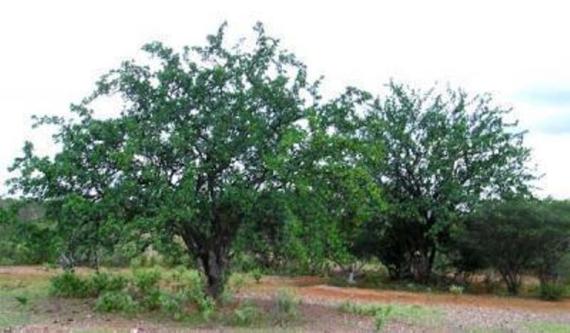
...The term favela is first found in 19th century Portuguese dictionaries, referring to the favela tree commonly found in Bahia.
After the ‘Guerra de Canudos’ (Canudos War) in Bahia (1895-1896) government soldiers, who had lived amongst the favela trees, marched to Rio de Janeiro to await their payment. They settled on what is one of Rio’s hills and renamed the hill ‘Morro da Favela’ after the shrubby tree that thrived at the location of their victory against the rebels of Canudos. 
favela trees

favela / hovel...? The alternation between initials f and h is not uncommon in Romance Philology, especially in the languages spoken in the Iberian Peninsula: for example, Latin filiu(m) gives Portuguese filho but Castilian hijo; and then the h can lose its sound, and be dropped altogether.

But the dates are all wrong. Besides, why bring Portugal into it just because I'm more at home with European sources? Hovel could have left India in the 14th century on the back of Timur's conquests leaving behind haveli. After that, its route into English is anyone's guess. Maybe Arabic [or something Oriental] was involved: whenever a dictionary says 'origin unknown' it's a fairly safe bet that a non-Roman writing system was involved. In fact, 'origin unknown' is a bit like the geographer's terra incognita and 'Here be dragons'; it's a euphemism for 'outwith the scope of traditional scholarship'; and it's not a final sentence.

But why should one word have diverged into two opposite meanings? Well, that's quite common – as is the reverse (flammable vs inflammable, pace the Health and Safety Executive); I just used one such word (quite as in "quite reasonable interesting" and "quite extraordinary".  And after two words diverge, with different meanings, they are subjected to different phonological pressures (elsewhere I have discussed the strange case of grammar and glamour). Elsewhere (again!) I have written:
...in Portuguese there is formoso -a and in Spanish hermoso -a. (And that f/h thing, incidentally, is at the root of Ferdinand and Isabella's royal emblem - the fennel plant: Aragonese had a word starting with f and Castilian had an for the initial letter of the word for 'fennel'. But that's a whole nother kettle of red herring.) 
So the case for a link between haveli and "hovel" is [at best]  not proven. But a man can dream. [What he can't do though, is put off any longer the resumption of that trawl {in preparation of that book of word-lists}!].

b
Update 2015.05.14.09:20 – Correction of example, in the colour of shame.

Update 2018.08.12.15:55 –Added clarification in last line, which made more sense unexplained three years ago.

Friday, 11 July 2014

The sportscaster's present, pt II

This page addresses a use of the present that is peculiar to sports commentators:

<explanatory_note>
Like newspaper headlines and personal anecdotes ("So I'm walking down the street yesterday, and this guy comes up to me and he says ..."), sportscasting has a special affinity for the present tense. But unlike other uses of the historical present—which typically refer to past events, thus "historical" present—the sports announcer is calling a game that is playing out before our very eyes. If ever there were an appropriate time to use the present, surely this is it. So what's so strange about it?
...
Both "Louise kicks the ball" and "Louise is kicking the ball" are present tense, of course. But what makes the sportscaster present remarkable isn't tense. It's a distinction known as aspect, which refers to the period over which an action takes place. The "is kicking" construction has progressive aspect, because it refers to an event that unfolds over time, whereas "kicks" is the older, simpler form that is used for a variety of purposes, including habits ("Be careful—that horse kicks" does not mean the horse is necessarily kicking right now) and verbs of thought or emotion ("I think I'll kick the ball").
</explanatory_note> 
I would like to consider another, also peculiar to sports commentators, but using an analogue of a device that has long been used by language teachers (both MFL [Modern Foreign Languages] and ESOL [English for Speakers of Other Languages]).

This device is the timeline diagram. It lets students in one timeframe (the now of the lesson) think about language that deals with events that happen at different times. Timelines have been used in language teaching for many years. I remember my own French master, the sainted Cedric Baring-Gould who I’ve mentioned several times before, drawing something like this to investigate the difference between habitual action in the past and an event:

Passé                                 Présent                                            Futur

           Passé imparfait
         L M M J V etc
      > .  .  .  .  . >
         J’allais tous les jours…


>----------------------------------------------------|-------------------------------------------------->

        Passé composé
      
     Un jour, pendant que  j’allais …,
                   J’ai trouvé qqc

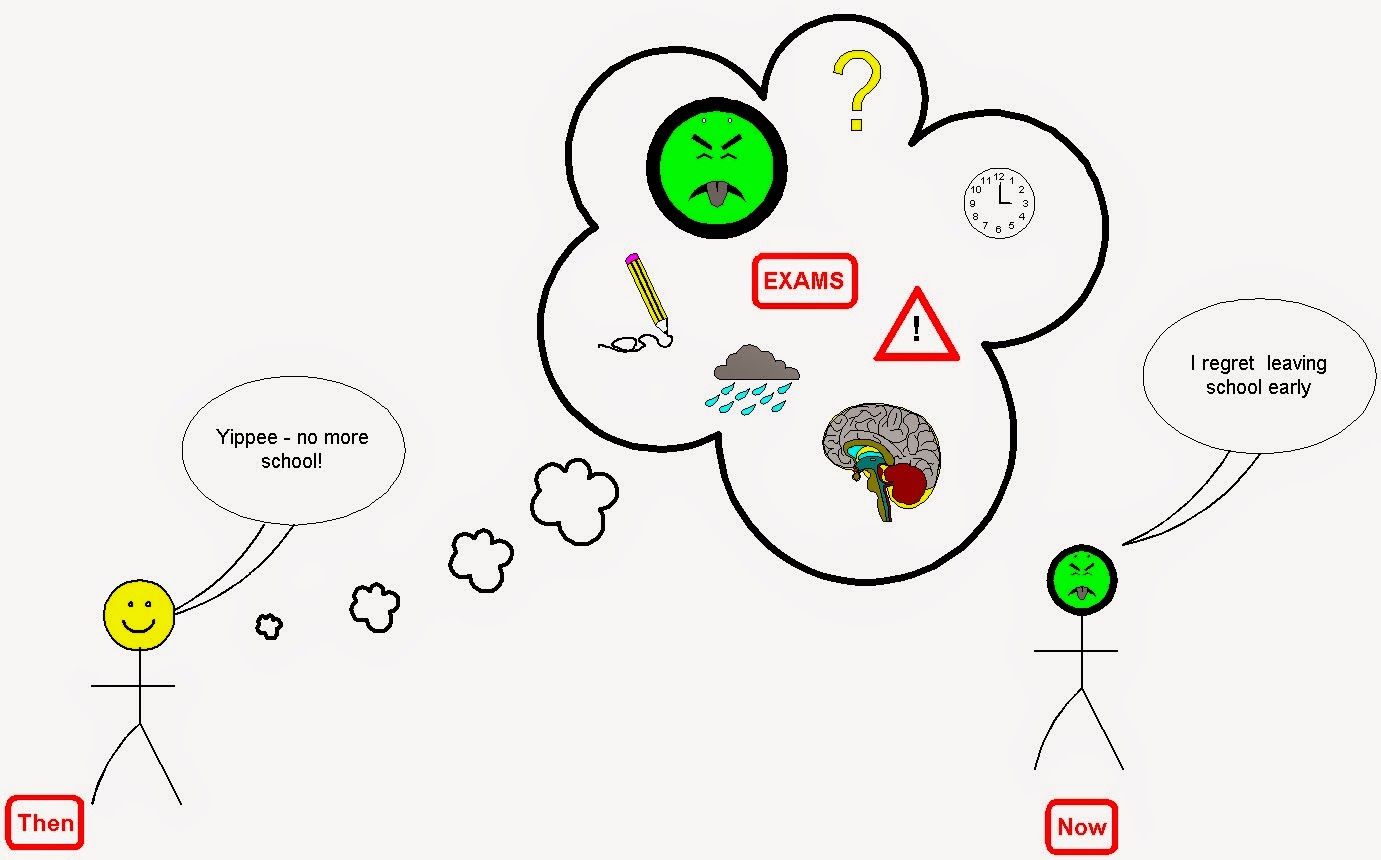
With a bit more time and artistic inspiration, a diagram like this can become quite impressive. Here’s one  I did for an ESOL class a few years ago, where the diagrammatic paraphernalia has been reduced to Then and Now boxes, but the same principle is at work – time progresses from left to right, and the language used at any point refers to that time:


‘Regret leaving’
Versus
‘Regret having left’

Instead of such diagrams, which can freeze time while we look more closely at what’s going on, sports commentators have video playbacks. So they can say things like:

[technical aside: ‘Can we freeze it there?’]
‘Now if he crosses it there, it’s a certain goal.’

The simple present to express a conditional! This is one in the eye for the zeroth/first/second-type† merchants. Given the right visual context, the simple present can be used to frame a perfectly clear conditional. And supposing there’s a Pedant among the Pundits:

[technical aside: ‘Is it possible to stop the action  there?’]
‘If he had crossed it at that stage, it would have been a certain goal.’

What has this achieved? It requires the audience to tune out of a video-context and start parsing formal syntax. In what way is this better?

b

[Time off for bad behaviour. Back soon.]

Update 2014.07.10.15.30 – Added this note:


This, I realize on second reading, may need some explanation. It is a reference to a system of classification of conditionals, widely used in the ESOL world (and possibly also now in the MFL world, which I have not been involved in as a teacher for 10 years). Some people find it useful. Have a look here. It seems to me to lead to unnecessary ratiocination (or, to use a computer internals metaphor, 'thrashing' – when the computer spends all its time trying to decide what to do).

Update 2014.07.21.10.30 – Added this note:
For the purposes of the argument, it's not essential that you agree with the distinction (between 'regret leaving' and 'regret having left'). In fact, I'm not sure I do any more (it's about 8 years old). If I redid it now, I would at least redraw it. What matters, in this context, is just the principle of using a graphic to freeze time while a student considers appropriate language at different times.

 Update 2014.07.31.09.30 – Added explanatory note in maroon, which explains the 'part II' in the title.

Update 2017.09.26.15.40 – deleted old footer.

Update 2018.03.06.14.40 –  typo and format tweak.