Showing posts with label hypercorrection. Show all posts

Friday, 23 December 2016

.. and then TWO come along at the same time

In Wednesday's Book of the Week, Love of Country, a word leapt out from Madeleine Bunting's reading and stirred a – you guessed it – memory, tinged with regret.
<autobiographical_note date_range="1981–1983">
In the early '80s I worked for Macdonald and Co. (Publishers) Ltd. When the firm was swallowed up by BPPC, owned by Robert Maxwell, we moved to a large office building (a hastily converted factory, to be honest) renamed, with sublime lack of  social awareness, Maxwell House.

One of my favourite authors was the old (nay auld) Scot Finlay J Mcdonald (no relation), and the first of the three autobiographical reminiscences of his childhood on Harris was called Crowdie & Cream. I handled the photographs used in this book, one of which was very valuable (he had borrowed it from someone who ... I'm not sure, but anyway it was important to the owner)..

When I was let go (as discussed, or at least referred to, before) I had a few minutes to clear my desk, and the converted factory had no space for storage. The photo went missing, and the people left behind, failing to find the photo, did the natural thing and blamed the absentee. Although I had visited him and his wife at Twechar (then on the outskirts of Glasgow, since no doubt englouti enGlasgowed?) and we had been on friendly terms (I remember amusing him by observing that when I telephoned the key-tones in his 10-digit number played
There was a wee cooper wha lived in Fife
) I never heard from him again. He was a fairly spry old man at the time, but is almost certainly no longer with us*. His much younger wife (a singer of Gaelic songs, [Catriona possibly]), though,  may well still be with us, and I hope she doesn't bear a grudge.
 </autobiographical_note>
The word that brought this to mind was machair, a sea-side strip of rough grass typical of the Hebrides. I had met the word in the typescript of Crowdie & Cream, and checked the spelling of course, but had never heard it spoken – /ˈmæxər/, says Collins   (though Ah hae ma doots about that first vowel).

Next on the morning's schedule was Woman's Hour, in an edition called Seven at 70. One of the seven was Liz Lochhead. Jane Garvey ( for it was she) didn't use the word, I think, in introducing the poet. but she is (or was – Wikipedia would know)  holder/occupant of the Scottish equivalent (a word that may well raise some hackles: what sort of worth are we talking about?) of  the UK's Poet Laureate. This position's name is transcribed in the many ways typical of a borrowing, one transcription (a hotly disputed, hypercorrect one) is machair. I think makar is more politically correct (some would say just CORRECT), bur this coincidence, thrown up by the aleatoric whimsy of the radio schedule, tickled my fancy.


Ho hum... yuletide ballast to be collected... In the immortal words of Tom Lehrer

Deck the hall with hunks of holly
Brother  here we go again.

b
PS And here's a clue:
  • Dr Spooner's instruction to Capt. Kirk, jumper in line-out? (9)
Update: 2016.12.23.13:30 – added PPS

PPS A festive clue:
  • Drumstick? Stocking-filler? (3)

Update: 2016.12.31.14:55 – Added footnote.

* This morning, by chance, I heard on the radio a programme that incorporated an interview with Finlay,  which made me wonder whether there was yet time to make my peace in person. But I soon realized that as it was on Radio 4 Extra it might well not  have been live. I've just checked: Old Year's Night was indeed recorded some 20 years after I knew him, but still 13/14 years ago.

Monday, 6 June 2016

stress on fo'reign words

Some time ago (a little over two years ago, in this post) I wrote this:
In my youth I spent a few months selling magazine subscriptions, as mentioned in a previous post. ... 
One of the English titles that I had for sale was Motor Sport. So  into my fairly competent spiel (I had learned the necessary Spanish off pat) I dropped these three totally unrecognizable syllables: /məʊtəspɔ:t/. The Spanish for 'Motor Sport' included an /r/ sounded before the epenthetic vowel that precedes the outlandish consonant cluster /sp/. 
‡  Outlandish, that is, at the beginning of a word.
In my transcription I overlooked what may be a crucial point: in English, stress is on the first syllable; the Spanish is /mɔ`tɔr.es`pɔrt/.

Of late I've been noticing cases of mistaken stress, sometimes occasioning further phonological mistakes. In no particular order they are
  • Boris
  • Karel
  • Roland Garros

Boris
There's a problem here. In Russian an o in an unstressed syllable is reduced to something a lot more central; I know no  Russian, but I think of this sound like the Portuguese /ɐ/ (and don't get me started on people who  overpronounce Portuguese as though it were Castilian Spanish: that's OK for Brazilian Portuguese, but in Continental Portuguese it's a sure sign of foreignness). So English speakers are stuffed either way. Putting the stress on the first syllable is wrong; but if you do put the stress on the second syllable then the o has to change – resulting in a noise that is going to be simply unintelligible to other speakers (either of English or of Russian).

Karel
This is a related problem. My taiji teacher's husband, Czech by birth, has this name. Many English speakers (myself included) pronounce this as we would say Carol (which at one time was optionally male...

<autobiographical_note>
... which reminds me of a Carroll Gibbons 78rpm record in my father's collection  – on the Brunswick label, I seem to remember. On the air is the one tune I remember from it. The balding pianist on the jacket was obviously a man. (Aha – faulty memory, it must have been an LP, with a jacket like that; and come to think  of it the Brunswick 78 may have been The Little Fiddle
Oh what a tangled web we... trawl(?)
When first we practice to recall
as wossname so nearly said).
</autobiographical_note>
...).

But stress is on the second syllable of Karel. Some students, noticing this, adopt that stress (as in some way "better") . However , they can't keep themselves from enforcing the English phonological rule that requires unstressed syllables (with a few exceptions, notably /ɪ/PPS) to be reduced to /ə/. So they say /kə`rel/ which is wrong in spite of their assiduous striving towards linguistic purity.

Roland Garros

PS: Aha, that was it
The BBC, like most English speakers, uses the anglicized /`gærɒs/. But MrsK often prefers the Eurosport coverage – which exposes the viewer to advertisements aimed at a wider audience. The sponsor of the French Open (whose name, the marketing department will be disappointed to hear, escapes me) regularly announced "Longines,  proud sponsor of Roland Garros".

But here's the thing: they assigned the correct stress to Garros, but at the expense, ...
<digression type="sophomoric"> 
as with "Karel" [vs, as they used to say in Latin (vide supra="see above")
at the risk of sending musicians into a frenzy of page turning (volta subito). #BouBoumTsh ]
</digression>
 ... of reducing the /a/ to /ə/.  And, to compound the injury, they didn't change the stress on "Roland", indeed they made no attempt at all to disguise their obvious feeling that this was an Anglo-Saxon name: /`rəʊlənd/ – "demmed Frenchies", as the Scarlet Pimpernel might have said.

Is that the time? I'll wrap this up another day.

b

Update:2016.06.06.17:00 – Added picture

Update:2016.06.07.12:05 – Added PS

PS re Boris
Another bit of autobiog: I first became aware of this when I was rehearsing with a balalaika player who wanted me to adopt the name 'Boris', and as it happens one of the tunes we played was Korobeiniki (neither of whose os makes an o-like sound). I was reminded of this by a recent radio programme that used the soundtrack of the GAME BOY game Tetris (which, I'm obviously not the first to discover, is the same tune).

Update:2016.06.07.16:30 – Added PPS

PPS
I just remembered that I wrote this snippet about five years ago – for the forerunner of When Vowels Get Together, but at a time when my vaulting ambition extended to all  vowels everywhere. I've brushed it up a bit (but left the period detail – notably the reference to ol' red eyes):
Unstressed i is regularly – in Received British English (RBP) – pronounced /ɪ/. But in many variants, particularly ones with Estuarine tendencies, /ə/ is used –(especially in words that already have a stressed /ɪ/). For many speakers, for example, Tony Blair was the /praɪm 'mɪnəstə/, with the second i of minister reduced to /ə/. 
Also, even in people who think of themselves as speakers of RBP,  this reduction may occur: demonstrations may, for example, be accompanied by acts of /'sɪvəl dɪsə'bi:djəns/, although those speakers, if asked 'How do you pronounce C-I-V-I-L?' would say /'sɪvɪl/ (possibly adding /əv kɔ:s/).

Tuesday, 15 March 2016

Asking questions


Addenda agenda corrigenda memoranda propaganda pudenda...

The time has come, unfortunately, for the pointless, annoying, never-ending discussion about the plural of THE R WORD.

Let's take as our starting point  The Speech of Cicero for Aulus Cluentius Habitus:

This referendum ad populum ["the putting of a question to the people"] was soon abridged to plain referendum; but the phrase shows that the word was, in Latin, a gerund. Now I'm not going to argue that English has to follow the rules of Latin. That ridiculous notion has long plagued studies of English. But to quote one distance learning site:
Forming the gerund: The gerund is formed much the same way... . All gerunds are considered neuter nouns and there is NO nominative case and NO plural form.
OK, there is no plural of referendum  in Latin; so how do we form it in English? There is little doubt about how plurals are formed in English. In most cases (and I wonder how to quantify that mosthmmm) the rule is simple: add an s. Phonologically it's not quite that simple: dependent on what's being pluralized, you add either /s/ or/z/ or /i:z/ or /ɪz/. But there are quite a few exceptions: sheep/sheep, man/men, ox/oxen, basis/bases...

Then there are foreign borrowings: Latin – medium/media, Greek  – criterion/criteria, Hebrew seraph/seraphim... as many as the language has borrowed, and as many as will be borrowed....This gives many opportunities for linguistic snobbery:

My dear, did you hear that? 
"Criterions" – Where did HE go to school?

Naturally, in the face of this, hypercorrect forms such as criteriaare common. People think they should use the foreign pluralizer, but  the native one interferes. And sometimes a foreignified version becomes so commonly used that it becomes standardized. This seems to be what has happened to referendum. It wasn't until I started researching for this post that I came across this:


Well as long as I live I'll keep saying referendums. But I'm afraid the feeling that "formal" contexts call for a parade of ignorance is gathering momentum.

b

PS
Here's a crossword clue:

Exaggerated merits of left-hand page in old wrapper – (8)

Update 2016.10.11.16:50 – Time's up: OVERSOLD

Update 2017.05.15.11:55 –  Added PPS

PPS 

I saw a programme in the Les Hommes de l'Ombre series last night, and it reconfirmed my belief. I have referred before to Gaston Dorren's Lingo . It's still on my Guilt Pile, but some day I'll finish it; and I have read the chapter on French, unfortunately called Mummy Dearest. Dorren's point is that the French language always has an eye on its mother, Latin. There are, of course, many Francophones who know no Latin; but his point is about the relation between the spoken and written language. When a French person says, for example, ils aiment, the -nt has no phonemic value. But in writing it resurfaces. Sometimes, one of these Latinate fossils reappears (resounds?) in speech, because of a phonological rule: il est aimable, for example.

extract from Lingo

Dorren's point could have been more carefully made (that chapter heading, for example). But there is a grain of truth in it:modern pronunciations in many Romance languages hark back to a Latin spelling; elsewhere I have mentioned Italian pronunciations of -ezzo:
...Italian native speakers pronounce mezzo with the voiced affricate /ʣ/ and prezzo with the unvoiced affricate /ʦ/ without – for the most part – knowing the reason: that the one with voicing is derived from MEDIU(M) and the one without voicing from PRETIU(M). Yet I've never heard a mezzo-soprano called (in English) a /meʣəʊ/. Of course I'm not saying the English pronunciation 'should' have the /ʣ/;  it's just interesting that it doesn't.
But French prends la galette, as it were, when it comes to harking back in this way: Latin is never far from the surface of French, and English has no equivalents of Augustan poets like Corneille and Racine. Pope comes close, but his classicism strikes me as more superficial.

Returning to that TV programme, one  of the characters said "Je n'aime pas les référendums". When I heard this I was relieved to learn that French hasn't been infected by the rot of  supposedly formal hypercorrection.

And here are a few more clues:

  • Nips back for a spot of political track-covering, (4)

  • In Cardiff perhaps, initial aspiration for reformed Luddite without it may – in case of emergency – involve these, (6)

  • Hidden talent ripe for development. (7)

Monday, 22 June 2015

I, Robert

<autobiographical_note> 
It was The Legacy that brought this issue to my attention (hemp, canvas, cannabis and related words).
</autobiographical_note>
I started by consulting Etymonline; and all roads lead back to cannabis:
          cannabis (n.) Look up cannabis at Dictionary.com
1798, "common hemp," from Cannabis, Modern Latin plant genus named (1728), from Greek kannabis "hemp" ... and English canvas and possibly hemp
Source: Etymonline

          hemp (n.) Look up hemp at Dictionary.com
Old English hænep "hemp, cannabis sativa," from Proto-Germanic *hanapiz ... probably a very early Germanic borrowing of the same Scythian word that became Greek kannabis (see cannabis). 
Source: Etymonline 

          canvas (n.) Look up canvas at Dictionary.com
"sturdy cloth made from hemp or flax," mid-14c., from Anglo-French canevaz, ..."made of hemp, hempen," noun use of Vulgar Latin adjective *cannapaceus"made of hemp," from Latin cannabis, from Greek kannabis "hemp"... 
Source: Etymonline

All those "..."s hide lots of examples from every language under the sun.

I don't like all those possiblys and probablys though.
<bilingual_pun value="nugatory, sophomoric"> 
(which raises the possibility of Signe demonstrating the versatility of hemp by making a picnic hamper out of hamp  [the Danish for "hemp" being hamp]. And the Swedish for "hemp" is hampa; so if she were Swedish it would be even better.)
         <afterthought viability="stillborn">
Hang on though.... Maybe that's why it's called a "hamper". Etymonline says not though. But there's that probably again....
</afterthought>
</bilingual_pun>

And finally I'll give myself a post-Fathers-Day, non-cannabis-related (except for the first syllable) pat on the head. One of the peripheral baddies in Humans has the name "Capek". Maybe this will be worked into the plot in the fullness of time, but I imagine it's just the writer's hommage (or just chapeau, perhaps)... all right, NOD...to the Czech playwright Karel Čapek (who I thought, before doing a bit of digging, coined the word 'robot' – he didn't: it's just Czech for 'worker'). Presumably the actor who said the name in episode one didn't pick up the reference. They said it with a /k/ instead of the whatever – something palatal, I think.

b

PS: And here's a clue for ... whatever these things are for:

Bishop embraced revised rite before anyone could write about it. (11) *

PPS A little later, the same day:

But the point (without which this post is pretty flimsy) is, what is  the mechanism for the development of *nab* to *mp*? The short answer is apocope – or perhaps syncope, I forget –  and assimilation. The longer and more helpful answer is the dropping of an unstressed vowel between two consonants. and then one of those consonants changing so that it shares some characteristic with the other: /n/ is a labiodental nasal but /p/ (/b/ after voicing's been dropped) is bilabial. So, after the unstressed 'a' has been dropped, the /n/ assimilates to the /p/, becoming the bilabial nasal /m/.
<aside>
In the case of words that use the Greek ɸ, such as 'emphasis', 'symphony', etc. this assimilation is masked. (There are  languages that do use the voiceless bilabial fricative (IPA [ɸ]), but English doesn't.)  The Castilian equivalents show the change: énfasis and sinfonía. Meanwhile, in words such as 'conflagration', the assimilation of the original Latin cum has gone ahead without anyone ticking the NO PUBLICITY box. In 'inefficient/impractical' there is the opposite change  – not from m to n, but from an original n to m.
<aside>
<example>
An interesting example of assimilation turned up on the news last  night – in the report on  a bionic eye. The context was generally optical, so when the reporter referred to a cure for sight loss I thought I heard a cure for Cyclops. I was just thinking this through, and correcting what I thought had been a mis-hearing, when MrsK asked "Did he just say a cure for Cyclops?"
 
Here's why. In forming an /l/ the sides of the tongue touch  approach the sides of the mouth (which is why the $10 word for describing /l/ is lateral there's a central closure, and the air escapes at the sides of the tongue ). Depending on the thickness of the speaker's tongue and the curvature of the palate, this can cause a closure between the body of the tongue and the palate, normally associated with /k/. So the reporter's /ǝ kju:ǝ fǝ saɪt.../ became /ǝ kju:ǝ fǝ saɪk.../ and the listener's expectations supplied the final /ps/.
So this is an example of the sort of  'accidental' assimilation I mentioned many posts ago, here. 
..well, not assimilation to another phoneme. I think it was John Trim (mentioned elsewhere in this blog: let the word-cloud do its thing if you're interested)  who pointed out that a speaker's  simply closing his/her mouth at the end of an utterance could make a final consonant 'assimilate' to the appropriate bilabial phoneme... 
The example he gave at the time was when people say 'Fine' at the end of a conversation it  can often make the sound /faɪm/.
</example>


Update 2015.06.23.14:25 – Added afterthought:

PPPS
When I started writing the PPS I stumbled over the first consonant [in cannabis/hemp], but parked the problem [as they say in some circles]: how does [k] become [h]? It's been simmering away on the back burner, and so far all I've got is an example of hyper-correction in the Satyricon.

In Roman Italy there were many speakers of Greek, and resultant borrowings of Greek words that used both κ and χ[; an educated speaker knew where to make the distinction, and a poseur made similar distinctions when there were none to be made]. One of Trimalchio's guests is a social climber, and like the English social climber adding unnecessary /h/s in words that have no 'h', he adds a χ-like sound in words that have a simple [k]: in Language and Society in the Greek and Roman Worlds James Clackson [sic, not him] writes


I'm not saying this is where 'hemp' got its "h", but is seems to me possible, given the κ as the initial – attentive readers will remember Etymonline's
... from Latin cannabis, from Greek kannabis "hemp" 
Update 2015.06.24.08:55 – Added clarifications in red.

Update 2015.07.21.16:30 – Added answer to crossword clue:
*OK ‐ Time's up. PRELITERATE.

Update 2015.07.22.15:00 – Added inline example in purple and shortly afterwards a correction highlighted like this.


Mammon When Vowels Get Together V5.2: Collection of Kindle word-lists grouping different pronunciations of vowel-pairs. Now complete (that is, it covers all vowel pairs –  but there's still stuff to be done with it; an index, perhaps...?) 

And here it is: Digraphs and Diphthongs . The (partial) index has an entry for each vowel pair that can represent each monophthong phoneme. For example AE, EA and EE are by far the most common pairs of vowels used to represent the /i:/ phoneme, but there are eight other possibilities. The index uses colour to give an idea of how common a spelling is, ranging from bright red to represent the most common to pale olive green to represent the least common.

I'm thinking about doing a native iBook version in due course, but for now Mac users can use Kindle's own (free) simulator.

Also available at Amazon: When Vowels Get Together: The paperback.

And if you have no objection to such promiscuity, Like this

Freebies (Teaching resources:  
Over 49,100 views  and nearly 8,000 downloads to date**. They're very eclectic - mostly EFL and MFL, but one of the most popular is from KS4 History, dating from my PGCE, with nearly 2,700 views and nearly 1,100 downloads to date. So it's worth having a browse.)

** This figure includes the count of views for a single resource held in an account that I accidentally created many years ago.


Thursday, 29 May 2014

If hot all meet in the fridge


See full picture here
The sign in the subject line is from a butcher's window – and is possibly apocryphal (though quite  credible). But earlier this week I came across a delightful instance (detailed in the Language  Log) of machine translation run amok. It's quite a short piece, and well worth a read. But here's the gist:

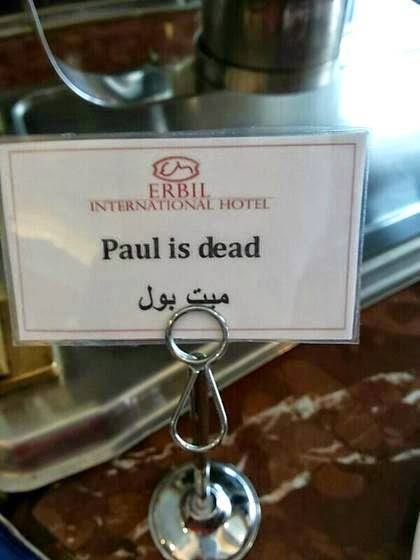
Erbil International Hotel in Erbil, the capital of Iraqi Kurdistan, served a buffet.   One dish in the buffet was meatballs. And this, for reasons explained in that Language Log article, was the sign adorning the dish:

It seems that the word 'meatballs' was first helpfully transliterated; this accounts for the /bɔ:l/ versus /pɔ:l/ confusion (as Arabic has no /p/ phoneme). Then some machine translation software got to work taking no account of the fact that (as Language Log reports):
...Arabic text usually dispenses with the diacritics for short vowels known as ḥarakāt, leaving only long vowels represented. So "ميت" is a fine transliteration for English meat /mi:t/, but it could also represent the Arabic word mayyit 'dead' (derived from the verb māta مات 'die'). 
<etymological_note>
This caught my eye because English sports two words related to this māta:
  1. The word 'matador', borrowed from the Spanish matador  – itself based on the verb matar. The matador is 'the killer'.
  2. The expression 'check mate'. {Think of sheik.} When a chess player says 'check mate', they are saying 'The king is dead' {or, by one account noted in Etymonline, 'The king is stumped'.
</etymological_note>
The Language Log piece adds
...I suspect that Google's statistical approach to automatic translation is being misled by the frequency of the phrase "Paul is dead" in texts involving the persistent urban legend that Paul McCartney actually died in 1966.
On a first reading I dismissed this as fanciful, but now I'm not so sure. Google reports 324,000 hits for "Paul is dead" (and those of you who resist the insidious Wikipedeaization of Internet links may prefer this account of the myth.) So "Paul is dead" is a strong collocation. It even gets into the Corpus of Contemporary American (though not in huge numbers, and not at all in the rather more staid BNC.)

That's all for now. I must start writing my flyer for When Vowels Get Together: The paperback.

b
Update: 2017.07.10.11:30 – Tweaked format and removed old footer.

Update: 2018.03.30.21:30 – Tweaked format,  repaired  old graphic, and added PS.

PS: I've just been watching a TV Programme about York Minster, which is adorned with what I at first (in common with most viewers, I should think – in any case, the presenter foresaw that mis-identification) were gargoyles.

In fact they were grotesques; gargoyles are ornate water-spouts. But the piece led me to reflect on the derivation of gargoyle. As this Etymonline page shows two modern English words are pointers: gurgle and gargle. But a more direct source is the Latin gurgulare and, more proximately, the Middle French gargouiller.

Friday, 16 May 2014

When Kant can

More than a year ago (March 2013 is the date on the draft), I made a note about an Italian interpreter on a news programme – no more specific reference, but probably The World at One or the Nine O'clock News:
/hæz tʊ bi:/ - sounded negative - not vowel, but voicing indicates polarity: /hæs tə/ vs /hæzn tə/
I wonder what this meant... Aha – got it. It follows from a point that I became aware of a while ago.
<autobiographical_note date_range="1979" theme="assimilation">
<digression theme="assimilation">
A few days ago this appeared in the twittersphere:
I suspect (the results aren't out yet, but here comes a spoiler) the process whereby /gri:n/ and /kəʊm/ combine to form /gri:ŋ kəʊm/ is assimilation (well, I know it is, but I don't know whether this will be a good enough answer; they might want me to say whether it's progressive or regressive, and I must have nodded off at that part of the lecture...). Assimilation happens when some feature of a speech item (typically voicing or place of articulation) changes to match that of an adjacent item. Anyway, where was I...?
</digression>
The first proper book that I worked on after moving on from the Oxford Dictionary of Quotations  (when I was just temping to see me through my first winter as a freelance polymath) was Geoffrey Sampson's Liberty and Language. It was either here, or in his next book or in editorial discussions in connection with it (unlikely, as they were pretty one-sided ), that he made the observation that it was almost as if there was a new modal, /tə hæftə/ [to haffto], because the voicing of /hæv/ assimilates to the unvoiced /t/ of the 'to' that always follows it (in this modal use). He had even heard a politician saying 'it's a question of haffing to'.
</autobiographical_note>
When a person is involved in a conversation, many things are going on. Apart from the social and physical things (eye contact and so on) and contextual information surrounding the actual event, the participant's brain is having to process a bewildering amount of information [stay with me here, I'm coming back to that Italian interpreter eventually]. Somewhere – I'm pretty sure it was in Crystal's Cambridge Encyclopedia of Language – I saw an account of a conference that set out to analyse a few hours of recorded language. The proceedings of the conference, in the event, were published under the name The First Five Minutes – which contained a book's worth of analysis; the publisher had decided that analysis of all the data would make the book unpublishably big.

In a live speech event, the hearer has a vast amount to do. Which brings us to the Italian interpreter that started all this. The brain of the hearer starts perceiving speech sounds, and then parsing them, as soon as possible. Making guesses about where a speech event is going is the only way of participating in a conversation. If you wait until all the inputs are in, and then work out what you want to say in response, and then work out how to say it, you'll have missed your turn (experto crede  [that's Latin for 'trust me, I know what I'm talking about'].)

So what the listener does is take in clues and cues about what's going to happen††. In the pair "/hæstə/ ['has to'] versus  /hæznʔtə/ [hasn't to]" the first clue to the negativeness is the voicing of the /z/; the hearer, in the press of efforts to understand what's coming, thinks 'here comes a negative'.

Now, when that interpeter said /hæz tʊ bi:/ I heard the voicing of the /z/ and thought 'Here comes a negative'.
<digression>
The assimilation of the /z/ to the /t/ in the positive involves  voicing rather than place of articulation  – as in the case of /gri:ŋ kəʊm/  (from that #Phonetics quiz) or perhaps (in tribute to my alma mater) I should say /gri:ŋ kɪŋ/ [that's a 'Greene King' reference; if you don't speak fluent IPA don't worry {And I don't mean Greene King IPA, of course}].
</digression>
The inappropriately enunciated /tʊ/ isn't just wrong in an understandable way, it is plain misleading. This (distant, now) speech event underlines something I have often noticed, both as a student of foreign languages and as a teacher of English: one of the features of connected, live, language use is knowing when not to over-pronounce; getting everything right, at the word level, is going to result in getting it wrong at the sentence level.

More recently, the problem of distinguishing between positive and negative arose in the UsingEnglish forum devoted to Pronunciation and Phonetics, but there are things I need to be getting on with; so that will have to wait for an update.

b

Update 2014.05.17.19:00 – Added PS:

PS
That UsingEnglish discussion started with the question What is different between "can" and "can't" when say them.. The question reminded me of my unfinished blog (which, now I think of it, has a title that has made no sense at all until this Update ). The questioner asked:
I am just wondering how English-speekers distinguish these two phases (or words). It seams the only different is the hard-to-heard "t". Then why the language choose this way to indicate total opposite meaning?
As I (eventually) answered, the problem is specific to American English:
Of course, the problem doesn't arise in Br English (though I'm sure many others do ): /kæn/ versus /kɑ:nt/ - and whatever happens to the /t/ the vowel is still distinct..
So I left it to an American contributor to answer before I stuck my oar in.

After correcting 'different', he (I assume he's a he) said
The answer is that to those who know the phonemes of English, the "t" is not at all difficult to hear. When you try to learn a new language, you are forced to begin with the phonemes you are used to, since those are all the phonemes you know. They are all the phonemes that have been relevant to discriminating meaning in the languages you know. But if the foreign language uses other phonemes, your ear is not programmed to hear those other phonemes, because they have never been relevant in your past experience.
I felt this was a bit over-dismissive of the questioner's 'hard to hear[d]', so I leapt to the questioner's defence:
I wouldn't question Newbie's 'hard-to-hear'. I remember in the late '50s being very confused by Perry Como, in 'Magic Moments', singing 'Time can't erase the memory...'. [T]he context (particularly the phrase 'erase the memory') makes it clear this is 'can't'; but I had never met the expression at the time. I suppose this just reinforces the point about  phonemes; I didn't know the phonemes of Am Eng.
But another American English speaker has now added weight to my defence:
It's not uncommon to have to say "I'm sorry - did you say 'can' or 'can't'?" 
I'm not sure what to make of this. Until I read that latest response I thought native speakers could always tell, and that the first answer's 'phonemes of English' just meant 'the phonemes of American English' . Now I'm not so sure.

Update 2014.05.19.11:30 – Added this note:

I can feel the eyebrows jerking up here, particular among readers of an age to remember the old Parse and explain exercise in schools (which makes those readers older even than ME – their English teachers would have insisted on 'older than I'). 
 <autobiographical_note date_range="1963-1968" theme="schoolbooks">
I was just on the cusp, with a mixture of prescriptive and more permissive schoolbooks. As our Latin master was Father Provincial [="Big Cheese"] of the Salvatorians (Society of the Divine Saviour), the school had fingers (tentacles?) in many ...erm...pumice stones?; so we tended to get young besuited trainees among the cassocks, flown in for a term or two here and there. These preferred the more permissive/expressive books and parts of the syllabus.
</autobiographical_note>
But by 'parsing' I don't mean 'third person singular of the pluperfect' sort of parsing; I mean simply taking bits of linguistic input and trying to imagine syntactic structures that they might fit in: 'Who's doing the <verb>-ing?, rather than 'Is that the subject of the main clause?  – which, when you think about it, amounts to more or less the same thing.

Update 2015.10.20.12:40 – Added this note, and a few afterthoughts in maroon:

On re-reading 18 months after the fact, I realize that I was using a semi-technical term here  – semi because although it doesn't really look like one, I was using it to refer to something with technical connotations. I think it was Grice who introduced the notion of a turn in a conversation, although I wouldn't be surprised if it was an idea that he'd been knocking around for many years before Grice propounded his Maxims. (But don't take this as Gospel: my linguistics studies just pre-dated Grices's popularity in linguistics circles [although he was publishing "in my time", and I'm sure I'd have come across him if I'd been a more diligent student]. My acquaintance with Grice [understanding of him would be a bit of an overstatement] is derived from some mugging-up I had to do before teaching an AS set [as described here].)

Update 2015.10.22.09:40 – Added this footnote

††The idea of reacting (as a listener) ahead of hearing the whole message was underlined on the TV news last night. The interviewer asked something like 'Is there any risk to British security in China's involvement in ...<whatever>?' the Chinese spokesman, speaking in English, said 'Absolutely not.'

But the normal intonation for 'Absolutely not' is one rise and fall: ↷. But he said
'↘ Absolutely... ↘ ...not'
and for a split second [until he said the second word] I thought he was making a most undiplomatic admission. (One would think that a speaker of a tone-language might have been aware of this  – but I suppose there's no reason to think that skill with his sort of intonation (where tones affect meanings of single words) implies sensitivity to mine (where intonation patterns affect overall meanings of utterances).

Update 2015.10.22.12:55 – Added this PPS

PPS On reflection (as frequently happens after a Tai Chi lesson)  this expectation (of 'intonational sensitivity') was unreasonable. As an  ESOL student this Chinese-speaker would have met (and possibly drilled) the use of  'Absolutely' as a standalone response. In this case, the intonation is ↷. So he might have thought of this as the canonical intonation pattern for 'Absolutely',  and this might well have been reinforced by the fact that this intonation pattern is a close match to the Chinese rising-and-falling pattern  – 'L1-interference' as we say in the trade, when a feature of a learner's mother-tongue influences their learning of another.

Update 2018.06.17.10:55 –Added clarification in red.


Monday, 7 April 2014

Correcter than thou

A couple of matters arising from a semi-idle hour's worth of Radio 4 listening, one about context and one AOB about hypercorrection – that is, getting something wrong because of trying too hard (and misguidedly) to get it righter than THEM (who didn't go to the right school and probably hold their knife like a pencil my dear would you credit it?)
 <digression theme="hypercorrection" amuse_bouche="hígado">
Hypercorrection is particularly likely to happen when two languages rub up against each other. The earliest example I know of is in the Satyricon, in 'Trimalchio's Feast'. Trimalchio is a social climber who lays on a flamboyant (and tasteless) feast. One of his affectations is to pronounce a Latin c [k] with a fricative à la Grecque χ. The way this is presented in the text (written a while before the foundation of the IPA) was 'instead of commodus he says cHommodus)'.
I know an amuse-bouche should come first, but I've already taken too long over this, so the liver will have to wait.
</digression>
Context:
This week's Book of the Week is about Louis Armstrong (another subject of hypercorrection, now I think of it: he and his family say /lu:ɪs/, but white folks said 'No, it's from the French, silly: LOO-WEE'). One of the events related was when he announced, in a KKK area, that the band wanted to dedicate their next number to the Memphis police force; and they went on to play 'I'll be glad when you're dead, you rascal you'. The narrator explained that this didn't cause a riot because of Louis Armstrong's delivery.

I thought this was ridiculous at first. Yes, he mixes words with skat singing, so that his words can become unclear, but the first line was clear. Why didn't they see that they were the butt of Armstrong's humour?

Then  I thought again. For the last 50+ years...
<digression>
There's scope for an autobiographical note here about my middle brother going to the Crawdaddy in the early sixties. But times's wingéd chariot is breathing down my neck, as is its wont.
</digression>
...I've been listening to Black Americans (and English artistes mimicking them). At the time of Armstrong's jibe the white audience didn't have that familiarity. The nearest they came to hearing Black American speech extended only to the pastiche of  'Yes Massa' and 'Ah'm  comin' home Mammy' familiar from black-face acts.

Hypercorrection:
In 'Start the Week' at least two people said /mə'kɪzməʊ/. The second speaker, the less well educated, may have been following Tom Sutcliffe's lead ('He's saying /k/, and he talks proper; I'd better do the same.') But Mr Sutcliffe should have known better.

When the word first arrived in (American) English in the mid-20th century it would (unquestionably) have had the /ʧ/ of the Spanish machismo (the -ism associated with being  excessively macho – "male (but in an animal sense, without the gentility of being varonil ['like a man']†". Being macho is aping the Alpha-male.

But people with a certain education (they listened to opera music, and so knew that the chi of 'Voi chi sono' [with a /k/, as in chiaroscuro {and English words borrowed  from Italian owe much more to music and art than words borrowed from Spanish} ] wasn't like the ci of  'La ci darem la mano'), seeing machismo  with an o at the end, concluded wrongly that it must be Italian; so they misapplied the rule  
'ch' before 'i' -> [ki]
Hence the horrid '/mə'kɪzməʊ/', or worse still /[mɑ'kismo]/ (with the foreign vowels implying 'I'm nearly bilingual, don'cherno).

The problem is that once a word is naturalized, all bets are off. The l in could was originally hypercorrect (as explained elsewhere) what's hypercorrrect becomes correct. I am a prescriptivist in a descriptivist's clothing. I have to admit that at some stage the cry But it should be pronounced with a /ʧ/ because it's there in the original will become irrelevant to the (at that future time) current state of English. And at the cusp there will be arguments about whether that time has come. For me, in this case, IT HASN'T!

b
Update 2014.04.09.09.35 – Added this PS

† Not to mention hidalguía ["gentlemanliness"], which is another thing entirely. And hidalgo [hijo de algo – 'son of something'] could make for a fascinating aside that I don't have time for now.... 

Update 2014.04.09.12.25 – Fixed square brackets. IPA-nerds may have been quite upset! (But the rest of you needn't worry unduly: it's a phoneme-VS-phone thing.)

Update 2014.04.18.17:40 – Added pointer to new hígado post.

Update 2014.04.21.16:55 – Updated footer


 Mammon When Vowels Get Together V5.2: Collection of Kindle word-lists grouping different pronunciations of vowel-pairs. Now complete (that is, it covers all vowel pairs –  but there's still stuff to be done with it; an index, perhaps...?) 


And here it is: Digraphs and Diphthongs . The (partial) index has an entry for each vowel pair that can represent each monophthong phoneme. For example AE, EA and EE are by far the most common, but there are eight other possibilities. The index uses colour to give an idea of how common a spelling is, ranging from bright red to represent the most common to pale olive green to represent the least common.

Also available at Amazon: When Vowels Get Together: The paperback.

And if you have no objection to such promiscuity, Like this.

reebies (Teaching resources: over 40.000 views  and nearly 5,600 downloads to date**. They're very eclectic - mostly EFL and MFL, but one of the most popular is from KS4 History, dating from my PGCE, with over 2,000 views and nearly 1,000 downloads to date. So it's worth having a browse.)

** This figure includes the count of views for a single resource held in an account that I accidentally created many years ago.