Showing posts with label Alastair Cooke. Show all posts

Saturday, 25 April 2020

From spine-tingling to nerve-jangling

The starting point for today's jaunt...
<note_to_self>
Must check on the etymology of jaunt. Looks a bit Indian to me. like jamboree and jodhpurs and juggernaut.
<cut_to_chase>
Couldn't help myself. 'Unknown origin' says Etymonline. But the trip to that source wasn't entirely wasted, as it's added to my stock of words that have done a somersault and reversed their meaning (as, for example, has backlog, discussed here (and elsewhere, from time to time: you know the drill).

There's not a lot on Etymonline to justify this switch in polarity; well. nothing really:
1670s in modern sense of "short pleasure trip," earlier "tiresome journey" (1590s), from jaunt (v.)
</cut_to_chase>
  <note_to_self>
 ...is a virtual choir recording in which I have a paternal interest. I'm not a fan of most web content (as they say) – most of it a mixture over-sentimentalized verbiage and meretricious clickbait – but this really does live up to its billing as both "spine-tingling" (though the headline wasn't that concerned about hyphenation) and "spellbinding" (a word that recalls to me that Bennet madrigal discussed in an update to this: "music the time beguileth").

In 2016 this Tallis piece displaced Spem in Alium – (House Song of the Van Helsings [no, that's Allium, 'Hope in Garlic'] {This is getting very silly}) – as my favourite (by that composer), as my choir prepared for the tour mentioned, tangentially (you know the drill), here.

On our first night in Newcastle a bunch of us ate at a restaurant on Grey Street, where I noticed this plaque (not a blue plaque, I noticed, perhaps for some reason: Black for foreigners that nobody's heard of? Or maybe it's more subtle than that: grey to match the street.
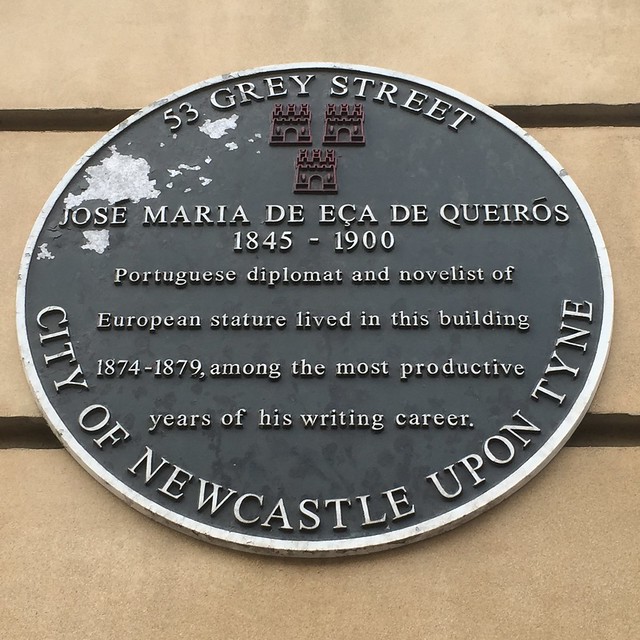


José Maria de Eça de Queirós black plaque | Open Plaques

Well I had (heard of him), and read a good deal of his oeuvre (or obra as we say in the trade).
<autobiographical-note>
and earlier this year (2020, keep up) I entered  a translation of some of his work for 

THE JOHN DRYDEN
TRANSLATION COMPETITION 
(Excuse the shouty typeface; I cut/pasted it from the entry form.). As well as being a novelist and a diplomat he was also a journalist, and a posthumous publication in 1905 assembled much of his work as Cartas de Inglaterra. He was a sort of fore-runner of Alistair Cooke, writing "Letters from England". 
I was first introduced to his work at a summer school at the Universidade de Coimbra, where they had a proprietorial interest in him as an old boy more than a century earlier.
<aside>
The lecturer had a quaint way with pronunciation, joining together two vowels with a... No.  TMI. Vivid memory though.
</aside>
</autobiographical-note> 
Returning to Tallis, I also sang the piece as a visiting Old Member at my Cambridge College in May 2018.
<autobiographical-note>
We visitors were each flanked by members of the present Corpus Christi Chapel Choir, who had mostly been raised as trebles in cathedral schools. So they had a trained reflex to raise a hand when they (rarely)  made a mistake. If I had done the same I would have given myself RSI.
</autobiographical-note>
And more recently we sang it at the WCS choral workshop back when the only place in Corona lockdown was Wuhan; and the (sadly few) basses made such a mess of our E'en the spirit of truth entries that it was not so much "spine-tingling" as nerve-jangling.

But I have secateurs to wield
And sheds to fix before I shield...

<apropos enemy="covid19", first-casualty="language" >
Which reminds me: I'm finding it hard to say 'I'm shielding' (which is the magic word for people especially at risk).  The health chappies (Witty et al.) are obviously not conversant with the Sapir-Whorf hypothesis – which sprang partly from Benjamin Whorf's experience working with insurance claims. He recognized that the way people described situations often contributed to misfortunes; for example, the phrase "empty petrol cans" encouraged people to underestimate their flammability, as "empty" can mean null or void or having no effect – as in "empty threat" "empty promise" and so on. 

Similarly (at last, the point) the verb shield implies strength. A (hero) shields B (vulnerable person) from C (danger). So saying 'I'm shielding' invites the belief that I'm strong. So when I was recently ordering some pills online I asked for them to be delivered to my home address rather than asking MrsK  to queue outside the pharmacy (which I gather we're saying now instead of chemist – I'm tempted to do the full Shakespeare and say apothecary). But I didn't want to say "I'm shielding" in case someone who spoke English misinterpreted it. (On the international stage I reckon this might be more of a problem. People exposed daily to Wittygrams know all about this (ab)usage; but not Johnny Foreigner.)

Just saying. People planning resistance campaigns of all kinds need to think about the language they're using.
</apropos>
...And sheds to fix before I shield. 

That's all for now

b

Update:2021.01.1610.55 – Added PS

PS
You see? Thin end of the wedge. The syntax of the verb 'to shield' was threatened by covid, and now the door's open for further abuse. Emily Maitlis, on yesterday's Americast, used the expression "He was shielding" to mean "He was sheltering" – with no hint of a virological meaning.

PPS
Come to think of it, the verb 'shelter' has precisely the kind of transitive/intransitive flexibility that 'shield' is beginning to have. 

Wednesday, 24 January 2018

But nobody says potahto, Missouri update

In the 2018 Oscar nominations, the presenter (an African-American woman) used the schwa ending (often transcribed as "-uh" by the IPA-challenged). My ears pricked up, because ever since a Letter From America I heard about 30 years ago I had believed Alastair Cooke's shibboleth,
<autobiographical_note>
He said that both were right in different contexts, The state was one (either /ɪ/ or /ə/ in the last syllable) and the river was the other (either /ə/ or /ɪ/). I thought the nominations would clear this up.
</autobiographical_note>
As a 2012 article in the New York Times says:
In 1907, a resolution introduced in the state House to establish the “only true pronunciation as that received by the native Indians” — a third way, Mih-SOO-rih — failed by voice vote[:]
1907 NYT report of failed vote
<hang_on_though>
"S" in the two syllables in which it occurs"...? Two syllables? Did the word syllable mean something different in the American English  of  1907? [Aha, maybe it‘s a matter of syllabification: "Mis/sou/ri". Anyway....]
</hang_on_though>
But my choice of the word shibboleth was intentional. As the Collins Dictionary says

The original shibboleth was a test word, used for separating Them (the chaff) from Us (the wheat). That Gileadite name for wheat was a pre-Christian version of Beg pardon, I'm soiling the doilies. But in this case there is no Them and no Us. Judging from the many discussions found by Google (more than 2 million – I haven't checked every one, but I think I've got the gist), the difference is mainly geographic. As that NYT article says,
Some believe it started as an east-west split, with St. Louis favoring “ee” and Kansas City “uh.” Popular belief holds that the southern half of the state is “Missourah,” with Highway 70 serving as a sort of Mason-Dixon line, and still others contend that “Missouree” is city, “Missouruh” is country.
Given this geographic/cultural split, there's a tendency for one speaker (often in a single speech event) to use both. And, given this alternation, there's a tendency for the chatterati to try to justify both on esoteric grounds of usage (as Alastair Cooke did – angels and pinheads spring to mind).

But next time that nominations presenter spoke, she flipped and used /ɪ/ or maybe even /i:/. Before the change there was some off-mic hilarity between her and her (Caucasian) fellow-presenter. Perhaps, as the schwa pronunciation had been favoured by President Obama, she had decided to use the version preferred by the wh.... no, that doesn't work. Many white folks unashamedly (indeed proudly) use the schwa pronunciation. I suspect that in Trump's America the down-home version is going to enjoy a renaissance. Anyway, having flipped; she reverted to the schwa.

Anyway, I am none the wiser about this pronunciation. The conclusion seems to be Different strokes for different folks, [and quite often for the SAME folks too].

b

PS A couple more clues:
  • Uncle Boris turning somersaults to make TV mogul. (10)
  • In a way, kudos to University Challenge. (6)

Friday, 20 March 2015

Sony and Scott de Martinville

A bit of mail the other day asked if I'd review something I'd bought: the subject line helpfully told me There’s still time to review your recent Argos purchase. Normally I'd've ignored it, but as it reminded me of an impulse buy that I'd regretted I followed the link thinking 'OK Argos, you asked for it' and ranted away.
<rant> 
After a sentence or two I noticed the warning Maximum review-length exceeded by 243 characters. How very dare they,  invite me to vent and then pull the rug out from under my... er... keyboard? So I gave them a couple of dismissive sentences, and stored my words of wisdom for future recycling.
It was hard to set up, because the ON/OFF switch was hidden away at the back. With the radio I was replacing the ON/OFF switch was at the front. This was convenient because switching off with this button was more graceful (in engineering terms); think of a Windows PC – it has to be shut down properly. Switching off my previous  DAB radio directly at the socket made an audible popping sound (increasing wear on the speakers). With a button on the front, switching off properly was easy.
But, as it happened, this radio did not have a graceful way of shutting down; the popping sound was equally loud whether I switched off at the wall or using the inconveniently placed ON/OFF switch. So I ignore the popping sound and switch off at the wall. People who know me personally will know how to interpret the word 'ignore'.
 </rant> 

OK, what's bought is bought; Quod empsi empsi.

But this serves to introduce the theme of sound transmission technology. Recently I caught the end of a TV series that asked How we got to now with Steven Johnson and as his name was part of the title I assumed he was an expert. Perhaps so [definitely, it appears], but not in all things, in particular with respect to phononograms. [Oops – I misheard his accent; he gets it right, but with a confusingly trans-Atlantic twang.]

The phonautograph, a precursor of Edison's Earth-changing invention, is described here (about 9 minutes in). Johnson asks
Why has nobody heard of this guy? Because, unbelievably, Scott's design was missing one crucial feature: playback.
It could record, but not reproduce. This is strangely (inversely, in every way, including commercial success) like the Sony Walkman, which was based on an existing dictation machine, but with the recording facility neutered. (For all I know the technology was still there inside the box, but as it had no User Interface it might as well not have been. This cnet piece may tell you.)
<autobiographical_note>
This reminds me of a project I worked on in the late 1980s, which similarly involved taking an expensive bit of kit and bastardizing it – 'cost-reduced engineering' was the buzzword du jour.
</autobiographical_note>
So whereas Sony made a mint by taking a sound recorder and removing the ability to record sound  – a sound recorder that couldn't record     Édouard-Léon Scott de Martinville made not a sou by inventing a machine that could record but couldn't play back.

Ho hum. I wanted to find a quote from one of  Eça de Queirós's Cartas de Inglaterra. Eça was a sort of 19th-century Alastair Cook, based in England, and writing home not to the UK but to Portugal.

Full details here
When he hears reports of Edison's 1877 invention, he imagines their primary use will  be in making 'living wills' – understandable really as (in the words of that Johnson TV programme)
For the 100,000 years since language developed, every word  ever spoken by anyone was immediately lost to the air.
And one of the video clips used to illustrate these words is a death-bed scene. Letting the dead speak was a major selling point of sound recording technology. But that quote will have to wait until after the concert I'm singing in on Saturday. Don't miss it.


Update: 2018.03.10.17:05 – Removed old footer.

Thursday, 28 August 2014

Bercow in Toyland


One of the BBC news programmes on Monday last featured a gloriously mixed metaphor that conjured up a picture of someobody – I can't remember who (someone involved in the Bercow/Ozgate kerfuffle) – in a pedal-car, knees pumping frantically in an attempt to avoid an accident:
 'he's back-pedalling to avoid a car crash'. 
If this person had done a U-turn as well my cup – as I'm an avid collector of mixed metaphors – would have run over (pausing, of course, for many a slip).

This led me to reflect on the effect of transport on the language.

Starting at the pedestrian end, when you match your actions precisely to those of someone else, you march in lockstep with them (and if you have the same objectives you march to the beat of the same drum. You may follow in the footsteps of somebody, in which case you're walking the same path. The future is further down the road, or (if it's very remote) over the horizon – too far to walk,

Taking a step up from the purely pedestrian, horses figure largely in the language, whether in the humdrum doings of a pack-horse or in the night-time visitation of a nightmare. If you let someone do what he wants, you give him his head. The opposite is keeping them on a tight rein. And if they're keen to get started they are champing at the bit. If you want to see what they can do you put them through their paces (the paces being walk, trot, canter, and gallop). If you don't know what they're likely to do, they're a dark horse. I've said elsewhere that I'm not a believer in the Alastair Cook derivation of cinch – though I'm often a sucker for folk etymology (once I've got the bit between my teeth ).
<digression>
Incidentally, that post's title reminds me of another equine metaphor: back in the saddle; and if someone's had an unfortunate accident that took the wind out of their sails (if you'll excuse a momentary diversion to water-borne craft) they have to get back on the horse.
</digression>
But maybe you ignore the dark horse's unexpected wishes, and ride roughshod over them.

Furniture can sometimes be named after horses as well. Think of a cheval mirror. And if the digression from transport to funiture strikes you as extreme, think of meubles (Fr) muebles (Sp) etc.

<explanatory_note audience="non-linguist">
Those words obviously connote movement to me, but I imagine it's worth noting  that French  meubles are 'moveables', while a building is un immeuble.
<explanatory_note>

In fact, come to think of it, this picture unites furniture and transport and explains the very derivation of the word metaphor:

See full source here

But where was I – got it, cheval  mirror. But for people who don't run to fancy foreign words, the horse is kept below stairs as a clothes horse. In between upstairs and downstairs, artists in Italy use yet another horsey metaphor to hold their paintings while they're working: a cavaletto is an easel (this time derived from a diminutive of the Latin CABALLU(M) – and classicists should see my earlier posts, passim [here, for example], for an explanation of that conventional notation.
<digression>
CABALLU(M) was a lower class of horse than an equus; more of a nag, which makes it ironic that it is the root of chivalry (a less obvious scion than 'cavalry').
</digression>
On life's journey, a lucky man will be accompanied by a helpmeet, a fellow traveller, to share the burden; in Latin, a woman would put a man sub jugum (under the yoke – as in Yugoslavia (and see what came of that yoking). A man didn't put his wife under that kind of trapping; he just led her (astray?): uxorem ducere. But let's return to transport

A procession involving horses is a cavalcade – there's that CABALLU(M) again. But in America they wanted a similar word for a procession of cars. So they knocked the horse part off the word, and substituted motor for it in motorcade.

I have a Crystal reference for that somewhere, I think, but it'll have to wait for an update (which'll have various thoughts about the internal combustion engine as well). But for now I must get on.


b

Update 2013.08.30.18:20 – Added red bit.
Update 2014.08.31.19:10 –  Updated footer
Update  2014.09.02.16:25 – Added this PS

PS
I've found that reference, and it's not in a Crystal book. (I'm pretty sure he's mentioned this somewhere, but I can't find it.)
<autobiographical_note>
It's from a Pelican, which I read in 1970 (no doubt in preparation for Cambridge Entrance exams): Brian Foster's  The Changing English Language. That (if you follow the link) is a later edition. The Pelican edition seems to be Out of Print, or 'OP' as we used to say in my Grant & Cutler days – discussed here. My Pelican, though badly foxed, has survived MrsK's reforming zeal throughout its 35-year shelf-life (that is, 45; but only 35 in the family library!)
</autobiographical_note>
 He writes:
'Cavalcade', etymologically a procession  of horsemen, has given rise in American English to a series of words in which the -cade element denotes the idea of 'spectacular display', e.g. aquacade, musicade and motorcade. Of these only 'motorcade' has penetrated into British use.... It remains to be seen  how productive this ending will be in Britain....
Well, he was writing in 1968 (or before), so I think we can stop holding our breath; -cade's hopes of becoming a productive suffix in British English, can wave forlornly to that slow-moving motorcade, or cortège, that follows many a linguistic speculation like this

But elsewhere automobile-based metaphors pervade the language. A person who is not at their best can be said to be 'not firing on all four [cylinders]'. Rather than rush you can 'put the brakes on' (or, with a nod to former times, you can 'hold your horses'). If you're in a hurry you either 'put the pedal to the metal' (which must come from American English, as the wordplay is better with an American accent) or 'step on it' or 'burn rubber'. The point where, for the walker 'the shoe pinches' is where 'the rubber meets the road'. And while we're on the subject of tyres, assessing the suitability of something in a desultory way, with no clear intention of buying it (either literally or figuratively,) is 'kicking the tyres'. People who need to get moving should 'get their a$$ in gear' and someone who's making progress is 'going through the gears'.

But apart from these metaphors that are 'hard-coded' into the language, cars provide a source of all sorts of figurative references – not fixed metaphors, but one-off metaphorical references.  I had a Musical Director once who, when asking us to make a sudden effort, said 'spin the wheels a bit'. I've never met this in any other context, but we all knew perfect well what he meant.

As another example of our culture referring to motor technology, much software today has a central control module called the 'dashboard'. Of course, it's not just cars that have dashboards. But the software engineers who coined the usage knew dashboards from their cars  and knew that everybody else would too.

On the BBC news recently (or quite possibly The Westminster Hour as it was in the mouth of a politician talking about another politician) I heard a usage that's new to me: Someone (name escapes me, but 'the sword of truth' and Ford Open Prison leap to mind  – got it, Neil Hamilton) was 're-treading himself' as a potential UKIP candidate. A retread  [noun] is a used tyre that has been beefed up so that it looks fairly new but is a bit suspect and is of course cheaper than a new tyre; but I'd never heard the word verbified. And as we've already got the word 're-branding' I doubt if  're-treading' has, as they say, 'much mileage' as the sort of metaphor that future ESOL students will be required to learn by heart. But it was extraordinarily apt in the context.

That must be all for now, but I wouldn't be surprised if more examples spring to mind...

Update  2014.09.03.22:25 – Added this PPS

PPS  That quote was from The Westminster Hour of 31 August. You can still catch it on iPlayer if you're quick and in the right part of the world. It's about 33'30"  into the main programme. But there's a clip here. I didn't get the words quite right; it was
...people like Neil Hamilton are trying to retread  themselves as UKIP candidates...

(note for US readers: 'UKIP' is British English for 'TEA party' (roughly).)

Update  2014.09.29.12:05 – Added afterthoughts in blue.

Update  2015.11.09.14:35 – Added PPPS

A few more horsey ones:

Don‘t look a gift-horse in the mouth and the presumably related long in the toothpresumably related because the length of the teeth was what horse-buyers were looking for when they opened horses‘ mouths. And. on the subject of horse trading, we mustn't forget horse-trading.

<auto-biographical note>
This reminds me of a bit of French used as local colour in the translations I once read of the Three Musketeers books (in Everyman editions kept in that bookcase). Whenever people rode somewhere urgently – as was their wont in those days    – they  rode ventre-à-terre [="belly-to-earth"]. English's preferred metaphor in this case (though referring to more modern transport technology) would be flat-out (or either of two metaphors already mentioned burning rubber or even pedal-to-the-metal).
</auto-biographical note>
  
Everyman Dumas; see source here


 Mammon When Vowels Get Together V5.2: Collection of Kindle word-lists grouping different pronunciations of vowel-pairs. Now complete (that is, it covers all vowel pairs –  but there's still stuff to be done with it; an index, perhaps...?) 

And here it is: Digraphs and Diphthongs . The (partial) index has an entry for each vowel pair that can represent each monophthong phoneme. For example AE, EA and EE are by far the most common pairs of vowels used to represent the /i:/ phoneme, but there are eight other possibilities. The index uses colour to give an idea of how common a spelling is, ranging from bright red to represent the most common to pale olive green to represent the least common.

I'm thinking about doing a native iBook version in due course, but for now Mac users can use Kindle's own (free) simulator.

Also available at Amazon: When Vowels Get Together: The paperback.

And if you have no objection to such promiscuity, Like this

Freebies (Teaching resources:  nearly 45,500 views  and over 6,100 downloads to date**. They're very eclectic - mostly EFL and MFL, but one of the most popular is from KS4 History, dating from my PGCE, with over 2,300 views and nearly 1,000 downloads to date. So it's worth having a browse.)

** This figure includes the count of views for a single resource held in an account that I accidentally created many years ago.


Sunday, 30 March 2014

What do you mean, 'Hard to learn'?

HMM... – it's† all about context. That piece says:
After all, what makes a language easy or hard?  Is it the writing system? Grammar rules like adjective agreement? The arbitrary use of genders for nouns? Don’t even get me started on cases and declension! I would argue that it is none of those things (or perhaps all of those things!) More important than any one facet of a language is the perspective from which you look at the language. What is your native language? How many languages have you learned? How old are you? In what environment are you learning the language? All of these factors play a role in how challenging we may find a specific language.
More here
That is, it all depends on the learner.  Well yes, selbstverstehenlich. {Isn't German great? It 'understands itelf'.} If your language uses tones phonemically, for example, you'll find it easier to acquire another language that does the same  – unlike English, which uses tone only for paralinguistic features. But we are where we are; I speak usually to users of a few Indo-European languages, and for my typical speech community it makes sense to say something like 'Learning Chinese is difficult' (for reasons adumbrated here).

But this has got to be a quickie, and I'll just give an example of the way context influences things. The example may seem a bit of a stretch, but that's context for you: it makes sense for me, because I'm the sort of person it makes sense for – DUH.
<autobiographical_note date_range="early 70s">
This morning I was listening to a recently rediscovered Letter from America.  That context recalled for me the last days of Nixon. I wondered whether it would mention that judge ... what was his name?...

At this moment a totally irrelevant memory cut in. Before Douglas Adams became a confirmed Footlighter he wrote and played in an ensemble called Adams, Smith, Adams. The 'Space, the final frontier .... to boldly split infinitives no man has split before' passage that ultimately appeared in print in The Hitchiker's Guide to the Galaxy first saw the light of day in a monologue that, as I remember, opened an Adams, Smith, Adams revue in 1972[??? Early 70s anyway.]. Another gem from that revue was the line 'the Mercedes-Benz, that Rolls Royce of motor cars'.

But the relevant memory was  sung to the tune of Maria:
Sirica. I've just met a judge called Sirica
...[etc]
The most scrupulous judge I ever heard  – Sirica.
So I got to that name before Alastair Cooke confirmed it.
</autobiographical_note>

I'm not sure how this is relevant to the issue of context , except in that expectations ["'Chinese is hard' versus 'AC will mention Sirica'"] are influenced by everything that one has seen and done to date. Of course.

b

PS Now for another bash at That Door (with my new toy, a proper plane not the Surform thing I've been using [sponsored, presumably, by the makers of Band-Aid]). And then I'll make more than one inroad into that #WVGTbook (V5.<next>) Index.

† Update 2014.03.31.10:15 – Fix typo. (One of these days I'll get that darn apostrophe right. I know the rule, but still....)

Update 2014.05.02.14:15 – Updated footer:


 Mammon When Vowels Get Together V5.2: Collection of Kindle word-lists grouping different pronunciations of vowel-pairs. Now complete (that is, it covers all vowel pairs –  but there's still stuff to be done with it; an index, perhaps...?) 

And here it is: Digraphs and Diphthongs . The (partial) index has an entry for each vowel pair that can represent each monophthong phoneme. For example AE, EA and EE are by far the most common, but there are eight other possibilities. The index uses colour to give an idea of how common a spelling is, ranging from bright red to represent the most common to pale olive green to represent the least common.

Also available at Amazon: When Vowels Get Together: The paperback.

And if you have no objection to such promiscuity, Like this.

Freebies (Teaching resources: over 40.300 views  and well over 5,600 downloads to date**. They're very eclectic - mostly EFL and MFL, but one of the most popular is from KS4 History, dating from my PGCE, with well over 2,000 views and nearly 1,000 downloads to date. So it's worth having a browse.)

** This figure includes the count of views for a single resource held in an account that I accidentally created many years ago.