Showing posts with label Louis Armstrong. Show all posts

Thursday, 29 May 2014

If hot all meet in the fridge


See full picture here
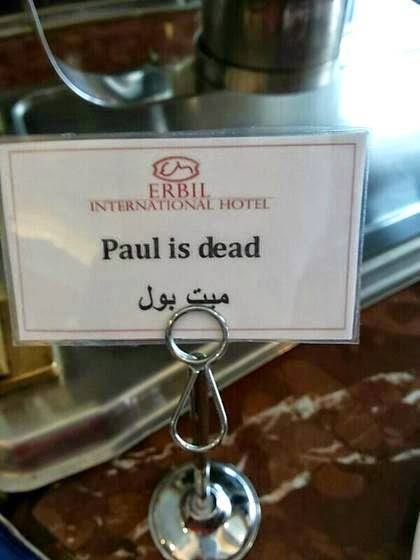
The sign in the subject line is from a butcher's window – and is possibly apocryphal (though quite  credible). But earlier this week I came across a delightful instance (detailed in the Language  Log) of machine translation run amok. It's quite a short piece, and well worth a read. But here's the gist:

Erbil International Hotel in Erbil, the capital of Iraqi Kurdistan, served a buffet.   One dish in the buffet was meatballs. And this, for reasons explained in that Language Log article, was the sign adorning the dish:

It seems that the word 'meatballs' was first helpfully transliterated; this accounts for the /bɔ:l/ versus /pɔ:l/ confusion (as Arabic has no /p/ phoneme). Then some machine translation software got to work taking no account of the fact that (as Language Log reports):
...Arabic text usually dispenses with the diacritics for short vowels known as ḥarakāt, leaving only long vowels represented. So "ميت" is a fine transliteration for English meat /mi:t/, but it could also represent the Arabic word mayyit 'dead' (derived from the verb māta مات 'die'). 
<etymological_note>
This caught my eye because English sports two words related to this māta:
  1. The word 'matador', borrowed from the Spanish matador  – itself based on the verb matar. The matador is 'the killer'.
  2. The expression 'check mate'. {Think of sheik.} When a chess player says 'check mate', they are saying 'The king is dead' {or, by one account noted in Etymonline, 'The king is stumped'.
</etymological_note>
The Language Log piece adds
...I suspect that Google's statistical approach to automatic translation is being misled by the frequency of the phrase "Paul is dead" in texts involving the persistent urban legend that Paul McCartney actually died in 1966.
On a first reading I dismissed this as fanciful, but now I'm not so sure. Google reports 324,000 hits for "Paul is dead" (and those of you who resist the insidious Wikipedeaization of Internet links may prefer this account of the myth.) So "Paul is dead" is a strong collocation. It even gets into the Corpus of Contemporary American (though not in huge numbers, and not at all in the rather more staid BNC.)

That's all for now. I must start writing my flyer for When Vowels Get Together: The paperback.

b
Update: 2017.07.10.11:30 – Tweaked format and removed old footer.

Update: 2018.03.30.21:30 – Tweaked format,  repaired  old graphic, and added PS.

PS: I've just been watching a TV Programme about York Minster, which is adorned with what I at first (in common with most viewers, I should think – in any case, the presenter foresaw that mis-identification) were gargoyles.

In fact they were grotesques; gargoyles are ornate water-spouts. But the piece led me to reflect on the derivation of gargoyle. As this Etymonline page shows two modern English words are pointers: gurgle and gargle. But a more direct source is the Latin gurgulare and, more proximately, the Middle French gargouiller.

Monday, 7 April 2014

Correcter than thou

A couple of matters arising from a semi-idle hour's worth of Radio 4 listening, one about context and one AOB about hypercorrection – that is, getting something wrong because of trying too hard (and misguidedly) to get it righter than THEM (who didn't go to the right school and probably hold their knife like a pencil my dear would you credit it?)
 <digression theme="hypercorrection" amuse_bouche="hígado">
Hypercorrection is particularly likely to happen when two languages rub up against each other. The earliest example I know of is in the Satyricon, in 'Trimalchio's Feast'. Trimalchio is a social climber who lays on a flamboyant (and tasteless) feast. One of his affectations is to pronounce a Latin c [k] with a fricative à la Grecque χ. The way this is presented in the text (written a while before the foundation of the IPA) was 'instead of commodus he says cHommodus)'.
I know an amuse-bouche should come first, but I've already taken too long over this, so the liver will have to wait.
</digression>
Context:
This week's Book of the Week is about Louis Armstrong (another subject of hypercorrection, now I think of it: he and his family say /lu:ɪs/, but white folks said 'No, it's from the French, silly: LOO-WEE'). One of the events related was when he announced, in a KKK area, that the band wanted to dedicate their next number to the Memphis police force; and they went on to play 'I'll be glad when you're dead, you rascal you'. The narrator explained that this didn't cause a riot because of Louis Armstrong's delivery.

I thought this was ridiculous at first. Yes, he mixes words with skat singing, so that his words can become unclear, but the first line was clear. Why didn't they see that they were the butt of Armstrong's humour?

Then  I thought again. For the last 50+ years...
<digression>
There's scope for an autobiographical note here about my middle brother going to the Crawdaddy in the early sixties. But times's wingéd chariot is breathing down my neck, as is its wont.
</digression>
...I've been listening to Black Americans (and English artistes mimicking them). At the time of Armstrong's jibe the white audience didn't have that familiarity. The nearest they came to hearing Black American speech extended only to the pastiche of  'Yes Massa' and 'Ah'm  comin' home Mammy' familiar from black-face acts.

Hypercorrection:
In 'Start the Week' at least two people said /mə'kɪzməʊ/. The second speaker, the less well educated, may have been following Tom Sutcliffe's lead ('He's saying /k/, and he talks proper; I'd better do the same.') But Mr Sutcliffe should have known better.

When the word first arrived in (American) English in the mid-20th century it would (unquestionably) have had the /ʧ/ of the Spanish machismo (the -ism associated with being  excessively macho – "male (but in an animal sense, without the gentility of being varonil ['like a man']†". Being macho is aping the Alpha-male.

But people with a certain education (they listened to opera music, and so knew that the chi of 'Voi chi sono' [with a /k/, as in chiaroscuro {and English words borrowed  from Italian owe much more to music and art than words borrowed from Spanish} ] wasn't like the ci of  'La ci darem la mano'), seeing machismo  with an o at the end, concluded wrongly that it must be Italian; so they misapplied the rule  
'ch' before 'i' -> [ki]
Hence the horrid '/mə'kɪzməʊ/', or worse still /[mɑ'kismo]/ (with the foreign vowels implying 'I'm nearly bilingual, don'cherno).

The problem is that once a word is naturalized, all bets are off. The l in could was originally hypercorrect (as explained elsewhere) what's hypercorrrect becomes correct. I am a prescriptivist in a descriptivist's clothing. I have to admit that at some stage the cry But it should be pronounced with a /ʧ/ because it's there in the original will become irrelevant to the (at that future time) current state of English. And at the cusp there will be arguments about whether that time has come. For me, in this case, IT HASN'T!

b
Update 2014.04.09.09.35 – Added this PS

† Not to mention hidalguía ["gentlemanliness"], which is another thing entirely. And hidalgo [hijo de algo – 'son of something'] could make for a fascinating aside that I don't have time for now.... 

Update 2014.04.09.12.25 – Fixed square brackets. IPA-nerds may have been quite upset! (But the rest of you needn't worry unduly: it's a phoneme-VS-phone thing.)

Update 2014.04.18.17:40 – Added pointer to new hígado post.

Update 2014.04.21.16:55 – Updated footer


 Mammon When Vowels Get Together V5.2: Collection of Kindle word-lists grouping different pronunciations of vowel-pairs. Now complete (that is, it covers all vowel pairs –  but there's still stuff to be done with it; an index, perhaps...?) 


And here it is: Digraphs and Diphthongs . The (partial) index has an entry for each vowel pair that can represent each monophthong phoneme. For example AE, EA and EE are by far the most common, but there are eight other possibilities. The index uses colour to give an idea of how common a spelling is, ranging from bright red to represent the most common to pale olive green to represent the least common.

Also available at Amazon: When Vowels Get Together: The paperback.

And if you have no objection to such promiscuity, Like this.

reebies (Teaching resources: over 40.000 views  and nearly 5,600 downloads to date**. They're very eclectic - mostly EFL and MFL, but one of the most popular is from KS4 History, dating from my PGCE, with over 2,000 views and nearly 1,000 downloads to date. So it's worth having a browse.)

** This figure includes the count of views for a single resource held in an account that I accidentally created many years ago.