Sunday, 22 October 2023

Meaningful versus Nonsensical

My latest podcast discoveries include these two:

The first of these is a compendium of the best bits of long-lived (since November 2009) series The Infinite Monkey Cage, grouped on thematic lines...
<autobiographical-note>
It is, in principle, similar to a (stalled) project that I was worklng on until various software tools I was using were changed and/or canned. Words and Music is a compendium of my favorite bits of this blog. In an ideal world it will be completed, but breath retention is not recommended.
<autobiographical-note>

...And in an early one of these Robin Ince asks 'Why do we say "human being"? We don't say "daffodil being"...

<tangent>
That quote is approximate. I wanted to trace it and transcribe it properly, but BBC Sounds have done their usual trick of APPALING curation.  I've whinged before about the annoying tendency of the BBC to crow about the richness of its back-catalogue while failing miserably to make that catalogue accessible in any intelligent way. The Infinite Monkey's Guide To... exemplifies this in spades. Even the list of "Other Episodes" is opaque: the important bit after the word "To..." is truncated. And when you do find the episode you want, there's no guide to where clips came from. 
<inline-ps>
I wronged them - you can trace the clips if you know where to look. Some hyperlinks would have been useful though,  rather than a series/episode reference; we do have computers nowadays, and you'd think a podcast like this would take advantage of such new-fangled stuff.
</inline-ps>
</tangent>

...The answer was provided by my grandfather: '"Human" is an adjective' he would say (in spite of a mountain of evidence to the contrary). 'It needs "being" to make it into a noun phrase.' 

<autobiographical-note>
(I could hear Archie's voice as soon as Robin Ince spoke.)
</autobiographical-note>

Add To Playlist is a relative newcomer, and it is a joy; not an unalloyed joy – read on. The idea of the programme is simple: two regulars and two musician guests make a daisy-chain of tracks, commenting on structure/melody/rhythm/instrumentation ... etc, and making links between one track and the next. Often one of the recorded artists joins them down the line.

Now we come to the 'not unalloyed' bit. I do wish Cerys Matthews (who is an amazing source of interesting musical insight) wasn't so fond of the expression 'hoNe in on'. When I first heard it, I thought 'Surely not?' And I checked in the British National Corpus:

'That's right' I thought; 'Only one instance. A solitary ignoramus got it wrong.'
<parenthesis>
Oh dear. Me and Cnut...
</parenthesis>
On the other hand there were many of the M-version ('hoMe in on') :


But Ms Matthews has led her co-presenter astray, and now he's doing it too.

The BNC, though, is not very large or very up-to-date. The Corpus of Contemporary American English offers a less parochial view. And there the different commonness of the two forms is much more balanced:


'Home in on' is the commoner of the two, but only by a whisker.

Finally, I used my favourite newly discovered language-related software tool to compare the two.


The expression 'home in on' took off about the same time as computers and related technologies used in guided weaponry, and for twenty years it had the field to itself. Then 'hone in on' appeared, but until the mid-'80s it never represented more than a quarter of its soundalike. Then, from the mid-'80s to the mid-'90s something strange happened: 'home in on' marked time, and 'hone in on' took advantage. It is as if a significant number of M-users tried the N-version as an experiment, and stuck with it; and this infected...
<parenthesis>
(is my prejudice showing?)
</parenthesis>
... the people who had not yet adopted either expression, with the result that for the next two decades the N-version rose in popularity more steeply than the original. Since then, shares have remained roughly stable, with the MEANINGFUL version outnumbering the NONSENSICAL one, but not by much.

That's all for now. There's work to do in the garden, and notes to bash in preparation for this (which I have sung before, but more than 30 years ago – so that although passages are familiar, I don't know it as well as I think):

b

Update: 2023.10.25.14:30 - Added <inline-ps />


Tuesday, 17 October 2023

Gender (again)

My latest discovery in the podcast world...

<parenthesis>
(so many podcasts, so little time😉)
</parenthesis>
... is The Allusionist, which the BBC has recently  (apparently belatedly) adopted.
<confession subject="podcast neophyte, guilty  yer 'Onner">
I'm afraid I still  have a very BBC-centric view of the podiverse. I'm aware that there's a lot more Out There, but podcasts are enough of a time-sink just seen through the BBC's very smoky spectacles, so I rarely let go of Auntie's hand. But the latest I have heard –  No Title –is number 121 on The Allusionist website, while it's only the 4th of the ones  that have the BBC's imprimatur...
<tangent>
(or should that be audiatur? Nobody prints (imprimit)  a podcast. They listen to it.)
</tangent>

...Perhaps the BBC didn't wake up to The Allusionist until Susie Dent got involved (The Allusionist all-time issue number 182, but BBC number 18). 


Most of the whois record for the allusionist.org is redacted, but the first few lines show that it's been around for nearly ten years – not quite as long as some blogs I could mention; but the selection available on BBC Sounds dates from only a few months ago. 

</confession>

Anyway, where was I? –  No Title. She says many illuminating and interesting things abou titles, pronouns, gender... and loads more. Here's a taste:
I've been trying to see if there any particular patterns in the ways that gendered language is ...

<sic-but-AIs-pretty-good> I imagine this should be "languages", with "gender" in the next line being a verb meaning 'assign gender to'. </sic-but-AIs-pretty-good>

...gender things. So at the moment, I've got a spreadsheet and - yes, don't get jealous, you can all have one - I've got columns along the top for different languages: so far, I've got Spanish, German, Hindi, Portuguese, Italian, and Greek. And then in the rows, I've got nouns in different categories. And I've just been trying to see if I can deduce anything from the ways that they gender different words. And so far I have learned that dog is male in all of them. bears are always male except female in Greek, lions are also male except neuter in Greek, and whales are always female except male in German - but in German a baby is neuter. But a spoon is masculine, a fork is feminine, a knife is neuter - which is not how I would have gendered the cutlery, if forced to do so.
But this is a tiny sample of the natural languages still spoken in the world, and all Indo-European – spoken where the founding fathers...
<tangent>
(the founding mothers don't get a look-in, of course)
</tangent>

... had mother-tongues ...

<tangent>
(oh there they are)
</tangent>

...that confused sex (a biological fact) with gender ( a grammatical construct). The early grammarians who first described the Indo-European languages co-opted (dragooned?) the word "gender" so setting in stone their own prejudices. But some languages apply grammatical rules of a gender-like nature without the remotest whiff of sex; the word  "gender" is just a confusing shorthand version of <arbitrary-classification-device>. I wrote here about one such case mentioned in a Guy Deutscher book:

<prescript>

<tangentially-relevant-preamble>
English students of foreign languages that have gender markings have to get used to the fact that the English possessives are marked for the sex of the possessor; many other languages are marked for the gender of the thing possessed. This gender versus sex distinction was one pointed out to me by Joe Cremona (see this blog, passim [that's Latin for 'So often that I can't be bothered to check a reference']). "Concrete things have sex; words have gender." In English, we put a further restriction on the first part of that rule – "Concrete things have sex only if they're animate"; and we don't have the second part (about gender, with a few arguable  exceptions, like ships and old cars; the few words that look as if they are gendered – mostly pronouns and possessives – in fact denote sex... 
<2023-addition> 
A neat example has just come to me. Son stylo and sa plume don't change with the sex of the owner in the way "his/her ballpoint" and "his/her fountain pen" do.
</2023-addition>

...) Isn‘t "only if they're animate" an improbably arbitrary restriction? Hardly. 
</tangentially-relevant-preamble>

In The Unfolding of Language  Guy Deutscher writes of  an Aboriginal language that assigns the gender "edible vegetable" to an aeroplane. He sums up his point:

In linguistic jargon...'gender' has nothing to do with sex  and can refer to any kind of classification that a language imposes on nouns. While sex-based gender is an extremely common type of classification, some languages have special genders not only for 'male' and 'female' but also for classes of nouns such as 'long objects', 'dangerous things', or 'edible parts of plants'.

When there‘s a correspondence between sex and gender (une fille, for example, is both feminine and female, but ein Mädchen is neuter) a phonological rule can interfere; you don't say ma amie because of the initial vowel in amie.

<tangentially-relevant-postlude> 
<harebrained_notion>
Did Bizet make use of this rule in Carmen's claim to be going chez mon ami(e?) Lillas Pastia? Does she toy with Don José's jealousy with doubts about the sex of Lillas Pastia? Lilas is a girl's name; certainly, when I first heard the Seguidilla I assumed Carmen was referring to a woman; I couldn't hear the -ll- that Bizet gave it. Does this make it male, I wonder.... Bizet's only clue (well, I haven‘t read the libretto in detail)  is to write that Lillas is an aubergiste – and I think Mistress Quickly was one of those.
</harebrained_notion> 
</tangentially-relevant-postlude> 

</prescript>

I wouldn't be surprised if I find in due course that this calls for an update (but don't hold your breath) . That's enough for today though.

b

Update: 2023.10.19.14:10 – Added PS

PS

No Title gives some examples of problems thrown up by gendered languages,

[I]n Germany they have Frau and Fräulein - well, they had them. Fräulein was the equivalent to Miss, literally translates to ‘little woman’, but it has been banned from official use since 1972. And in France, their version of Miss - or young woman flirt word - ‘mademoiselle’, has been banned from official documents since 2012, and a female person of any age will be Madame. And this might not sound like much, but in France, the whole language is binary gendered: every noun, every adjective, every pronoun. So if like me you want to get away from a binary-gendered system of everything, France is not going to let you forget it. And also, the language is controlled by the Académie Française, an official body which gets to decide what new grammar is allowed, what new words are allowed in, and when people have campaigned for gender neutral options, the Académie Française has just been like, “Non.”

So this Mademoiselle thing was at least some progress, with that backdrop. But the problem wasn’t so much why do the female titles change whereas the male ones don’t because they just use Monsieur - the male equivalent, Mondamoiseau, fell out of use - it’s so hard to say, that’s probably why. My mouth was exhausted after just one go-through. The problem was actually the etymology of Mademoiselle: it is kind of a diminutive form of ‘Madame’, which breaks down to ‘my lady’, but the problem in particular was this suffix, ‘oiselle’, which means ‘virgin’ or ‘simpleton’.

So this flirt word means ‘my lady virgin simpleton’.

There seems to me to be a whiff of confimation bias here: "The Académie is in charge, so everything sucks". But people in France have  done something about this.

<prescript>
The Académie Française takes a dim view of écriture inclusive – the proposed script reform that attempts to make French gender-neutral in spite of itself. The Times last week [HD 2023: I wrote this almost exactly six years ago: if you want to trace the article, it was published on the Saturday before 17 Oct 2017] referred to a "mid punctuation  point", a glyph that French keyboards are soon to include. And they gave as an example cher⋅es amies [HD: their impoverished fonts presumably don't go as far as an è]. You can sidestep the Infernal Firewall by looking at this Indie article.

Their one English academician, Sir Michael Edwards, calls the result "gibberish"  – missing the point rather  (écriture – the clue's in the name); I don't think the words with the mid punctuation point are supposed to be read aloud – any more than the solidus is supposed to be read aloud in our "his/her". It just lets the reader's mind skip over the gender variation without missing a beat. So when the university of Nancy addressed imminent graduates as Futur⋅es diplômé⋅es it was simply doing them the courtesy of accepting that they might be of either gender, rather than, as heretofore, even in a class of 99 diplôméeand a single diplômé, addressing them all as men....

One sententious self-important windbag, the philosopher Raphaël Enthoven, speaking on Europe 1 Radio, denounced it as "an attack on syntax by egalitarianism". 

<observation>
Generally, I've noticed that people who complain about "an attack on <abstract_noun>" tend to be blowhards.
</observation>
</prescript>

Sunday, 8 October 2023

Plank's inconstant

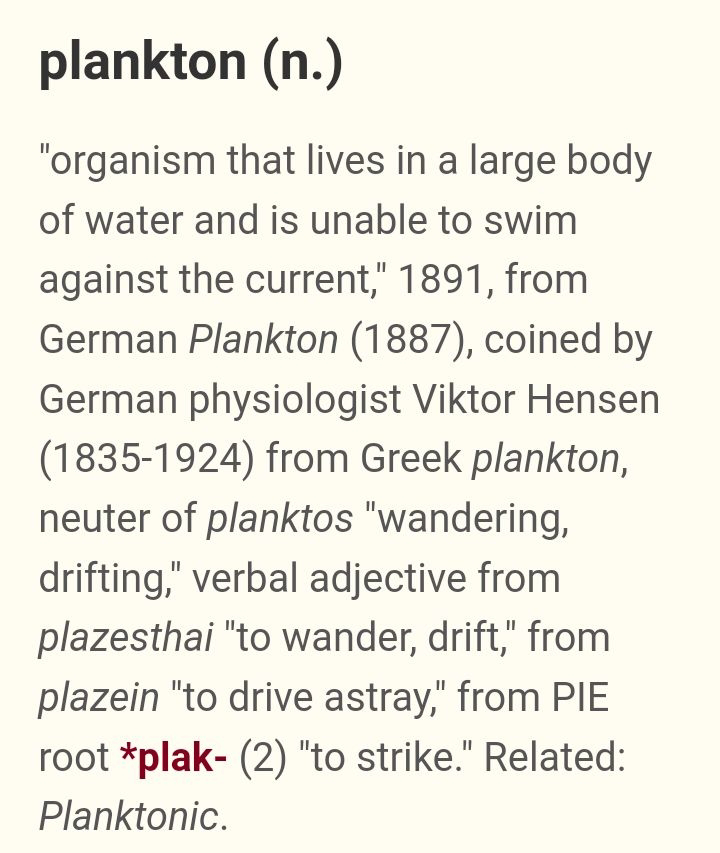
This week's In Our Time was all about plankton, which – like most things when you study them deeply enough – turn out to be crucial to human survival (half the breaths we breathe are down to these little critters, to say nothing of all the food-chains they support).   The programme started with a mention of where they get  their name:

Etymonline

Meanwhile, in the early days of astronomy, seers noticed that whereas some heavenly bodies seemed relatively constant (stars – which we now know move about quite a bit), others seemed to wander about the sky (planets). And these took their name from that characteristic:

Etymonline
I detect a certain shakiness – maybe just a typo – between 'plazesthai' with a definite PIE root and 'planasthai' "of uncertain etymology", but whatever the ins and outs it's clear that the two are related, making a pleasing link between the very small and the fairly big.

Matters arising from my last post

Last week's offering mentioned Gaslight (the 1940 film), which led to a mention on Facebook of the new verb – meaning, roughly, to lead someone (often in an abusive relationship, as in the film) to question their own sanity). @Jim Worm said she didn't remember it being used like that in her youth.

As a more-or-less exact contemporary of that youth I agreed, but thought it'd be interesting to find out more, so I looked at Google Ngrams, which confirmed that this usage really took off in the 21st century:

The ing-form, as I was taught to call it in my CELTA days ...
<parenthesis>
(though I have to admit to a predilection for the old 'gerund/gerundive/present participle' terminology... 
<per-contra>
[but "ing-form" is easier for students, and few if any need to understand the minutiae however much fun it is for nerds like me to appreciate {"knowing the pretium (Latin for 'price', the root of 'appreciate') of everything and the value of nothing?"} the differences]
</per-contra>
...) 
</parenthesis>

 ...is the clincher, as it can only be a verbal usage, But as the two curves are so similar since the turn of the century, and as in the 21st century almost the only use of the noun is in describing the plot of the film it's a safe bet that they both represent the new verb

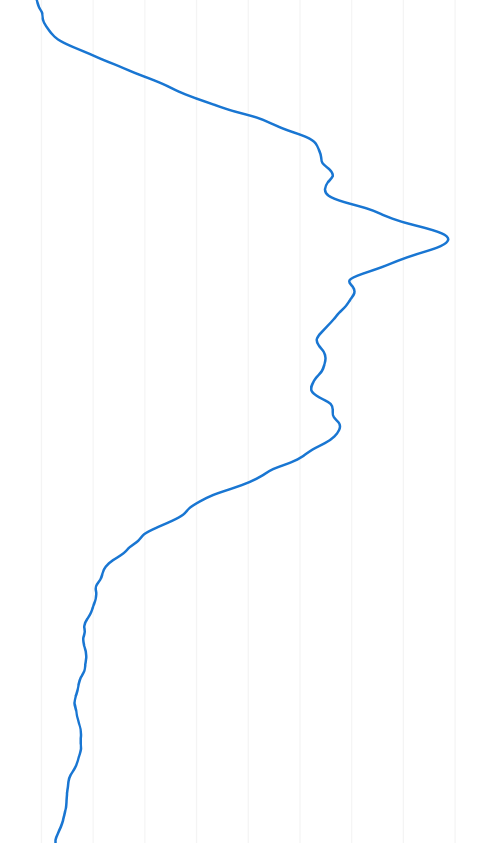
But that isn't the whole story. Long before the film, the word 'gaslight' meant something (the noun, unless there was a verb "to gaslight" in the sense of installing gaslight – I don't know, but it seems possible – and the steep up-tick in recent years is dwarfed by the earlier technological breakthrough:

The ghost in the washing line


Perhaps, though, this curve has a foretaste of the ghostlier sense. If you turn it through 90 degrees. it looks uncannily like someone running into a sheet:


b

PS

Translation news

I've  repeated last year's limited success in the John Dryden Translation Competition (that link doesn't work yet, but it will in the fullness of time): longlisted, but no further. Oh well: back to the ironing board.


Monday, 2 October 2023

What's a girl to think?

I'm often amused/interested/persuaded (if only temporarily) by Dr Michael Moseley's Just One Thing programme/podcast, although features of the formula often grate – especially the introductory words, repeated ever and anon: 'We're  bombarded by often conflicting advice':  too right we are – by the good doctor himself.

<excuse>
The series has been going on for several years, and medical advice changes from time to time. So it's only to be expected that exhortations to do 'Just One Thing',  separated by years, will contain elements of contradiction.

<but-hang-on>
Sometimes, though, contradictions aren't separated by years. In May 2022, there was an edition that dealt with naps that concluded "[I]f you can find time in your day for a nap, it really is worth trying."

Just 5 months later, in a mini-series on sleep  ...

<parenthesis>
This mini-series was a five-parter, which avoided some of the more annoying elements of the standard Just-One-Thing format, particularly the vox-pop bit with the tame guinea pig prepared to 'give it a try'. Per contra, it did involve a flamboyant abuse of the word 'elixir', repeated five times (with each repetition becoming more painful of course).
</parenthesis>

... he was saying "Try to avoid napping".
</but-hang-on>

</excuse>

 And at the end of the recent programme on the benefits of tea, the guinea-pig was so satisfied with her 'challenge' that she had decided to replace her regular coffee with tea. Whereon Moseley recommended the programme on coffee. OK, different strokes for different folks; there's no one recipe for the right balance.

And finally

<autobiographical-note> 
In the film business there is... 
<parenthesis> 
(or at least was; although. the gifts may have become less tangible – after his work on The Prisoner in the mid-sixties [it was broadcast from 1967-8, but probably made earlier] Patrick McGoohan gave my big brother a bottle of whisky. Maybe there's a sliding scale, and a clapperboy [or 'Director of Synchronization', as they used to say  geddit?] didn't qualify for the good stuff.) 
</parenthesis>
...a tradition of leading lights, at the end of a shoot, giving mementoes to the camera crew.

When my father ('Daddy', because the last time I saw him I was nine) was working with Anthony Asquith his end-of-job gift was a pair of gold cufflinks...
<tangent>
incidentally, one of my favourite metaphors in Spanish is the word for twins – gemelos (cufflinks); but I digress (so what's  new?)
</tangent>
... inscribed with CK on one end and AA on the other. A door-to-door spiv conned my recently widowed mother out of them for what I imagined at the time was a pittance. But I realize now that selling them made sense.
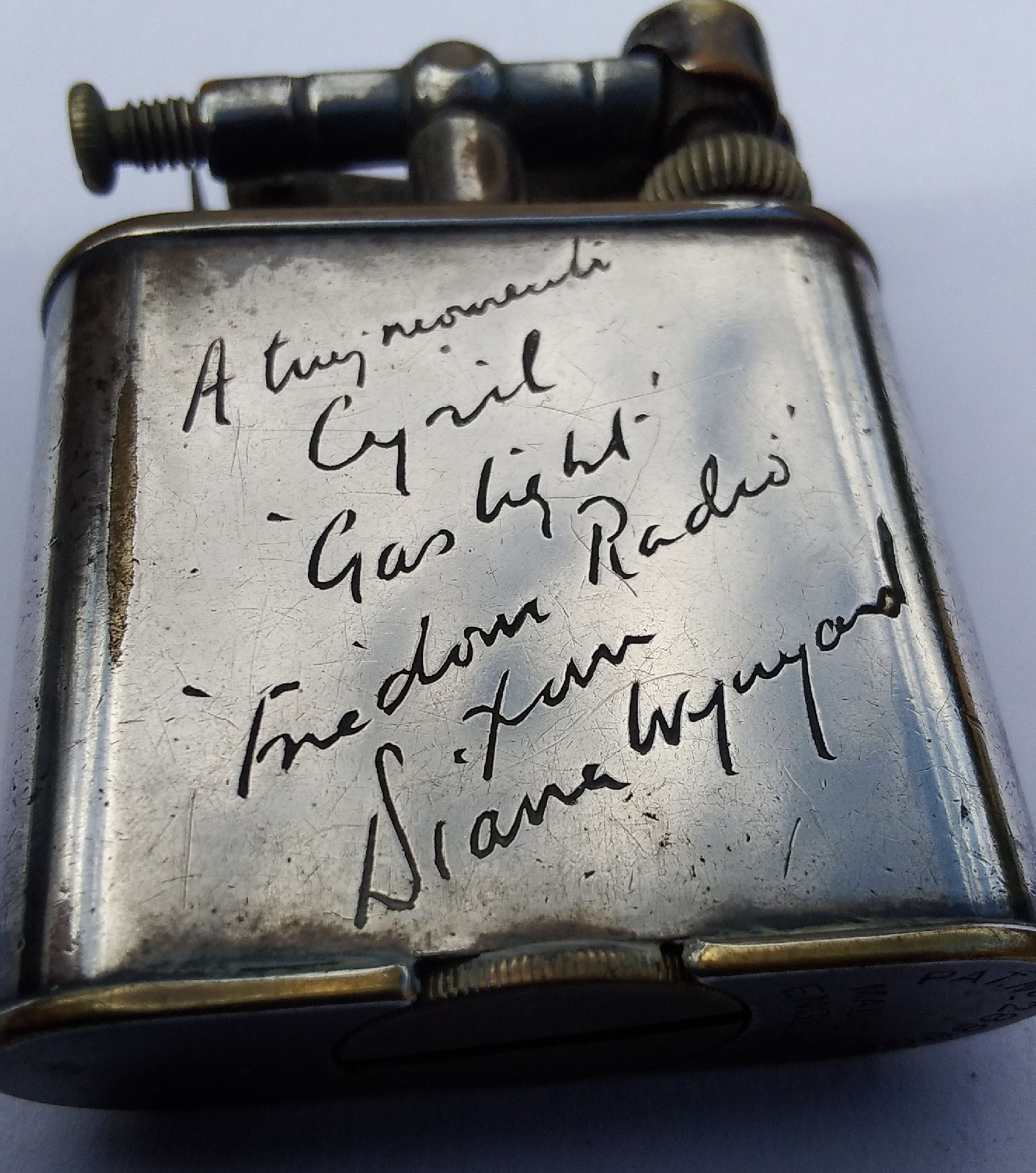
This came to mind this afternoon, as I was queuing to sell another such end-of-job gift, presented to him by Diana Winyard: 

       
<well-I-never> 
I've only just realized that as Asquith directed Freedom Radio, maybe the cigarette lighter and the cufflinks are related. Talk about provenance (oops – too late; they're sold – twice)
</well-I-never> 
</autobiographical-note>


Update: 2023.10.11.14.15 – Added PS


In the process of looking out that lighter, I found a double acrostic that I wrote for the wedding of a house-mate in Cambridge (whence "CB" in the first line). This is a copy:

With apologies to Christina
and renewed thanks
to Penny Thexton (?),
calligrapher extraordinaire

Monday, 25 September 2023

The Returning Soldier Effect

The first episode of Hanna Fry's new mini-series Uncharted ...

<parenthesis>
(occupying  the 15 minute slot that belongs BY RIGHT to The World at One – hankering for the good old days? moi?)
</parenthesis>

 ... dealt with a strange phenomenon whereby the ratio of male babies to female babies increases during and after a war.

<grandparental-note>
(And incidentally, I am of course delighted with my four grandsons, but – while not meaning to put undue pressure on my children – it is possible to have too much of a good thing).
</grandparental-note>

An article with a strange title (Big and tall soldiers are more likely to survive battle: a possible explanation for the ‘returning soldier effect’ on the secondary sex ratio)  provides more background...

<oh-yeah>
This strikes me as a questionable assertion; at the very least, it surely depends on the sort of warfare. Big and tall soldiers had an advantage at Stamford Bridge, but not in Sniper's Alley. Still, life's too short to explore this strange claim.
</oh-yeah>

... with an extensive overview of the more recent research.

MacMahon and Pugh (1954) were among the first to observe the effect. They demonstrate that the sex ratio among whites in the USA rose during World War II, but not during World War I. Others have since documented the phenomenon repeatedly (Lowe and McKeown, 1951van der Broek, 1997Ellis and Bonin, 2004). In one of the most comprehensive demonstrations, Graffelman and Hoekstra (2000) conclusively show that the secondary sex ratio (sex ratio of live births) increased during and immediately after World Wars in all belligerent nations (Austria, Belgium, Denmark, France, Germany, the Netherlands, USA and UK), except for Italy and Spain. In the succinct words of the scientist who has studied sex ratios (of both humans and other animals) more than anybody else, ‘there can be no reasonable doubt that sex ratios (proportions male at birth) have risen during and just after major wars’ (James, 2003, p. 1133).

That 'among the first' does no justice to the seventeenth-century German pastor Johann Peter Sussmilch, who (without reference to twentieth century wars, obvs)   explained everything by reference to Himself:  to repair the loss of young male life in a war, divine providence intervened in the reproductive process to make sure that a majority of boys was born. 

In  Uncharted one of Hanna Fry's main sources is the level-headed David Spiegelhalter, who points out that sex earlier in the mother-to-be's menstrual cycle is more likely to make a male baby, and that – given that if a male baby's already in the works – a female baby isn't going to get a look in. So more sex is going to make more boys. And more sex is going to be on the cards during and after a war. I may have got the wrong end of the stick, but this explanation seems to me more likely than either divine intervention or the size of the father.

<small-print>
The  obvious conclusion (if you want a boy, have more sex) doesn't work though. Professor Fry said that the tendency was so slight that it was impossible to "game the system"...

<tangent>
Interesting word; It seems to me that "game" as a transitive verb (and with the typical object "the system"PS: *
) has only become fashionable in  the last twenty or thirty years. For Further Study (FFS); perhaps it'll make an update – but don't hold your breath.                                         </tangent>

.... That  said, I'm surprised that the obvious research topic "The production of male offspring at the beginning of  a baby-making relationship (when sex is likely to be more frequent)" hasn't been snapped up. Maybe it has. (FFS again).
</small-print>

But this doesn't explain the one big outlier in the data. the biggest spike ever (more than after any war) occurred in 1973. And what about the Falklands War? Was there a spikelet in 1982? Questions, questions.

L'Envoi

Inaction Man has really excelled himself in the last few weeks. Perhaps he's going to put the HS2 question to the party faithful at the conference. You'd think he'd've learnt after his failure against  Liz Truss. Perhaps he's progressing from rolling the pitch on HS2 to polling the rich on how far to row back on his predecessors' green policies.

b

Search for the string game the system

Update 2023.09.29.11:30 – Added footnote    

* My parenthetical surmise was half right. At first I looked in the British National Corpus, and had this unpromising response:

But I couldn't believe I dreamt the usage (or that Professor Fry had been so linguistically innovative), so I looked in the much bigger – and more recently updated – Corpus of Contemporary American English, where the news was much more as I had expected:


Of course, a recent update is necessary to catch a recent language change.

And with a bit of recourse to the Help (as I just searched for game the *) I'm sure I could clarify the (already quite clear) picture of "system"'s supremacy as an object of "game", by wording my search string so as to make "game" a transitive verb; I imagine that in some of the other cases "game" is a noun (in, for example, sentences such as "he wasn't sure he was playing the game the way his teacher would have preferred"). And even if some of those "game the way" do involve a transitive verb, "game the system" is more than twice as common – getting on for three times as common.

Monday, 18 September 2023

It ain't necessarily so

In this post I wrote some time ago about my initial attitude to Ira Gershwin's "home in/abdomen" rhyme.

<pre-script>
...[A]nother song we're singing in our forthcoming concert is It ain't necessarily so – which includes the words "He made his home in that fish's abdomen". The underlay forces stress on the second syllable [HD 2023: of  'abdomen'], which – on a first hearing many years ago – I put down to American English. But many dictionaries give both (though always, in my experience, with abdomen having pride of place). I had previously assumed that the British English stress was the one given unequivocally in the Cambridge Advanced Learner's Dictionary:


No option given there,  whichever side of the Pond you're on.
</pre-script>

In an update, having surmised that speakers with mother tongues other than British English used – when speaking English – the stress-pattern used for the cognate word in their own mother tongue, I added:.

<pre-script>
Come to think  of it, you can bet your life that Moishe and Rose Gershovitz's native language had stress on the -do-, so naturally their son Ira pronounced it that way.
</pre-script>

This week's Pick of the Week (@ 32'36" for about 5 minutes ) reminded me of this. I knew that the words of the song were somewhere on the irreverent/blasphemous spectrum,  but it was news to me that the tune itself was equally (if not more) shocking to a believer – particularly a Jewish  believer. Guy Garvey, on his Radio 6 show, discussed the background of this song, and ended with a Jewish scholar describing the ritual reading of the Torah, using the same melody as that used in the first two lines of Ira Gershwin's song.

<autobiographical-note type="choral">
The words were vaguely familiar to me, from snatches of The Chichester Psalms, set by another immensely talented American Jew: "Baruch", "Adonai", "Elohim"...
</autobiographical-note>

The whole thing (only 5 minutes' worth) is well worth a listen. I particularly enjoyed an  unpublished (unsung?) verse:

Way back in 5,000 BC
Old Adam and Eve had to flee
Sure they did that deed in the Garden of Eden
But why chasterize you and me?

This hasn't made it into the canon. Perhaps the unusual word 'chasterize' is the problem: 'chastize' with a metrical contribution from 'castigate'?

Another thing that ain't necessarily so – the great sensus con

I have nothing to say about the rights and wrongs of the doings of Señores Rubiales and Brand, except to note that they were both very quick to reach for that much-misused word consensual. Think about it: cum + sensus. When an activity is consensual, both parties share a feeling about it. and an understanding of its role in their relationship. It seems to me that when there is a significant difference in power between the parties, consensuality is by definition impossible.
<etymological-fallacy>
But I'm in danger of committing the Etymological Fallacy here – the belief that words can only ever mean what they originally meant (usually in another language). "Consensual" has now become the knee-jerk roué's defence.  I'm not entirely at ease with that – to use the Portuguese, which seems to me particularly appropriate – relaxação
<inline-ps> 
(≅ relaxation [of standards]; it was a word often used by a central character in Eça de Queiroz's novel A Relíquia
</inline-ps>

<etymological-fallacy>
If Señor Rubiales would look at the celebrations at the World Championships in Budapest recently after the success of the Netherlands women's 4x400m team, when the men's team came to congratulate them (about 15  minutes in), he will see how men excitedly but appropriately congratulate women after a sporting success: hint – osculation is not involved.


b

Update 2023.09.21.14:40  – Added <inline-ps />


Sunday, 17 September 2023

Ron of the Glums

The spineless populist

In the recurring bit of intro, played every time after the pre-intro of Americast, Ron de Santis says he will "fight the woke". And whenever he does I think what a lame shadow of Churchill's "fight on the beaches" speech it is. Mr de Santis has obviously read (or perhaps just heard, in a Public Speaking for Dummies course) Churchill's speech:

...we shall fight on the beaches, we shall fight on the landing grounds, we shall fight in the fields and in the streets, we shall fight in the hills; we shall never surrender.

Here is the de Santis version: 

We will fight the woke in education, we will fight the woke in the businesses, we will never ever surrender to the woke mob.

Oh dear. That repeated "ever" does the reverse of what it's designed to do; it doesn't reinforce, it adds banality. This man wouldn't recognize rhetoric if it bit him.

Shame. I had hopes of his sparing us from another helping of Trump, but someone else will have to do that job. He's a washout.

A bugbear (not another?)

<tangent relevance-value="0", reason="Just saying">
There is no n in restaurateur. Far be it from me to suggest that people who use the word must get the French right. If they want to neologize, they're welcome to; if they want to say 'I'm a restauranter" that's a brave choice (although I think most people hearing it would find it rather silly). But if they're using the word that ends -eur then they need to curb their enthusiasm, n-wise. 
<devils-advocacy> 
But ns with no etymological justification do crop up in word families like passage/passenger or message/messenger. The reverse seems to have happened in French with restaurant/ restaurateur, although if you go back to the verb restaurer [≅ feed, give sustenance to], the n is quite predictable (as is its absence): the place where the doing is happening ends -ant ... 
<extra-credit> 
If you go right back to Proto Indo-European, I suspect the n in -ing and the n in -ant are the same. But Etymonline only goes back to Proto-Germanic.
</extra-credit> 

...and the person doing it (Latin -ator... 
<tangent> 
When I wrote this I toyed with the idea of giving an example. There  are so many that  I decided against it. But Philip Hoare, interviewed on this morning's Broadcasting House  provided one. The Romans called killer whales Orca Gladiator (though that would work better for swordfish, as a gladium is a sword [think of the shape of the leaves of the gladiolus].) 
</tangent>
...) has no n. The question in that case is Where did the -at- come from. But given the state of the lawn, that particular item of etymological gristle will have to remain unchewed. 
</devils-advocacy> 

 </tangent>

This has nothing to do with de Santis, apart from the general background of illiteracy. Whoops, is my elitism showing?

And finally

Welcome to the world, grandson no 4, whom I'd name if I hadn't just had a lesson in social engineering (and its usefulness to scammers). Shortly after my birthday last week I received a promising looking email. "Bob", it said, "your friend Louisa has sent you a birthday card. Click here to see it."

Hmm, I thought. Anyone reading this recent post would know it was my birthday around now. Facebook would say exactly when, and would list 'Louisa' as a friend. Mix all that together and you get clickbait.

Rather than click as invited, I sent Louisa a message; and she hadn't sent the 'birthday card', which would presumably have involved a premium rate phone call, a subscription to a service I don't use, or worse.

Shame (and shame on the people who force the rest of us to be less trusting).

b