Wednesday, 21 April 2021

Angels and pinheads...

... and pre-sales marketing? In February 2014, someone asked at ResearchGate

Are there infinitely many possible sentences in a natural language? 

Most authors seem to think so. Frege, one of the few mathematicians who worked on that problem spoke of “unpredictably many” (or uncalculably many; “unabsehbar viele”) - not an infinite number of them. (Frege, Logische Untersuchungen, 3. Teil Gedankengefüge, 1993, p.72 ff (German) /see also Fodor/Lepore „Holism“ 1992,p 242).
Further discussion (much much further) here

 The answer, if you value your sanity, is 'Who cares?' Frege's  unabsehbar viele” is good enough for me.

But not, it seems,  for Max Louwerse Ph.D., whose article in Psychology Today I just came across.  But, not without disingenuousness, he reframed the question to make it less intelligible:

How Many Words and Sentences Do We Know?


Honestly? Did he really ask that? What a stultifying, demeaning, dehumanizing, meaningless question 
<incoherent-rant>
Splutter, splutter. Wha...? No wonder academia gets a bad press sometimes. These people are caricatures of ...[I won't pursue that thought. Don't wrestle a pig. The pig enjoys it and you both get dirty. I shall just count to ten, take a deep breath and... See? Sweetness and light.]
</incoherent-rant>
And, in a way beloved of sub-editors everywhere, the article had a frankly risible corollary:

The number of words and sentences you know
is more impressive than you guessed.

Umm.... no, it's not, as a matter of fact. But, moving on. Dr Louwerse adduces quite a thought-provoking thought experiment
Let’s try to compute the numbers (bear with me). As a thought experiment, let’s first assume that we only have six words we know, rather than those 60,000 words. Let’s assume these six words consist of three nouns  (JohnMary, and Jane) and three verbs (hitsbeats, and hugs). From this rather limited vocabulary of six words and a sentence structure English has (noun verb noun), we can generate 27 different sentences (Mary hugs JaneMary hits JohnJane beats Mary being three of them). Because the sentence structure could also consist of a noun-verb combination (John hugs), the number increases to 36.

But GIGO: garbage in: garbage out. Or, rather, "homely over-simplification in-[to an infinitely creative system (what Pinker called The Language Instinct): hopelessly incalculable number out":

This [I've ellipted loads of ifs, ans and buts here, but we started out with a thought experiment, so we're talking about an infinite number of back-of-an-envelope approximations: sue me]  means that the possible permutations of a 10-word sentence are over 4,741,000,000,000 sentences. If we now add the number of permutations from a three-word sentence to a 20-word sentence, we end up interpreting over 5,000,000,000,000,000,000,000 sentences. But so far we assume that the order of the word classes in a sentence remains constant. This is obviously not the case. Let’s simplify the situation again and assume that there are only two variations of word order in a sentence. If we only take two-word order variations into account, we can safely assume that we know at least 10,000,000,000,000,000,000,000 sentences or 10 sextillion sentences.

Gosh!  That many! Little me! Squillions and squillions! What's that in Terabytes? What a piece of work is man. And, speaking of pieces of work (in the non-Shakespearean 21st-century sense of "He's a piece of work") there's a moment of truth at the end of the article:

Before you object that it is unfair to count the number of words this way, let alone the number of sentences because once you know the rule system behind words and sentences one should not count words and sentences individually, you are right. But that’s not the point. The point here is to marvel at the impressive talent that we have that often goes unnoticed because it comes so naturally to us. 

Louwerse says that the marvellousness (I've done him the courtesy of repairing his syntax: a point has to be a noun...
<inline_PS>
(or a subordinate clause doing the work of a noun, or "NP" as linguists like to say) 
<inline_PS>
...of the system of natural language is 'the point', throwing dust in the eyes of his pursuers by claiming not to have wasted his time on pointless number-crunching, and finally admitting (cherchez le bouquin?...

Getting a sense of how many words and sentences we know, brings us to the question: How do we keep those words in mind. That’s a question I’ll save for a later post (and for a popular science book [HD: My emphasis] that will come out soon).
...) You'll have to forgive me if I don't join the queue at the bookseller's.


b


Update:2021.04.28.15.05 – Added <inline_PS />


Friday, 16 April 2021

Brought to Book

When Roy Plumley devised Desert Island Discs in 1942 I suspect he was influenced by Jules Verne's L'Île mystérieuse, published nearly 70 years earlier in 1875. In that book,published in the same year in an English translation by Mrs. Agnes Kinloch Kingston (and retranslated the following year....

<unanswered-question>
Was it that bad? Maybe naked sexism is to blame, or maybe the original translation was just a rush-job always intended to be improved once the initial novelty had been cashed in on. It'd be interesting to find out (but not, I suspect, interesting enough for me to do it). The Wikipedia article suggests the Kinloch translation was expurgated. If interested, make my day.
</unanswered-question>
...by Stephen W. White).

Jules Verne answers the question What does a castaway need? quite comprehensively with the contents of a fortuitous chest found among the driftwood after a wreck:

[T]his chest contained tools, weapons, instruments, clothes, books; and this is the exact list of them as stated in Gideon Spilett’s note-book: —Tools:—3 knives with several blades, 2 woodmen’s axes, 2 carpenter’s hatchets, 3 planes, 2 adzes, 1 twibil or mattock, 6 chisels, 2 files, 3 hammers, 3 gimlets, 2 augers, 10 bags of nails and screws, 3 saws of different sizes, 2 boxes of needles.
Weapons:—2 flint-lock guns, 2 for percussion caps, 2 breach-loader carbines, 5 boarding cutlasses, 4 sabers, 2 barrels of powder, each containing twenty-five pounds; 12 boxes of percussion caps.
Instruments:—1 sextant, 1 double opera-glass, 1 telescope, 1 box of mathematical instruments, 1 mariner’s compass, 1 Fahrenheit thermometer, 1 aneroid barometer, 1 box containing a photographic apparatus, object-glass, plates, chemicals, etc.
Clothes:—2 dozen shirts of a peculiar material resembling wool, but evidently of a vegetable origin; 3 dozen stockings of the same material.
Utensils:—1 iron pot, 6 copper saucepans, 3 iron dishes, 10 metal plates, 2 kettles, 1 portable stove, 6 table-knives.
Books:—1 Bible, 1 atlas, 1 dictionary of the different Polynesian idioms, 1 dictionary of natural science, in six volumes; 3 reams of white paper, 2 books with blank pages.

I expect the bible was in an appropriate translation, which to Roy Plumley would have been the King James (AV), though Jules Verne probably had something else in mind.

Modern castaways care less for the soul (in a secular sense, that is). One of them, in the Children's  Writers subseries of Desert Island Discs Revisited, was Philip Pullman.

<mini-rant>
And, incidentally, if the BBC are so pleased about the size and range of their archive (they go on about it often enough) they should invest in some kind of usable index. I heard this episode recently on Radio 4Extra, but I'm blowed if I can find it. It's not so much an archive as a gigantic compost heap. But I digress.

The Children' Writers subseries is there OK.., but not Philip Pullman. Perhaps the episode is too new to have been indexed. But I know I didn't dream it, because of the surprising absence that I'm about to recount. Now read on.
<mini-rant>

I've listened to many episodes of this programme, probably 200-300 in all, and I'm accustomed to atheists, when told they're getting the Bible, who say 'Well you can keep that'; to which I always reply (in a polite sotto voce),   

But what about the language? The Bible's a priceless source of the things we say and do: expressions like 'Good Samaritan', 'Lazarus', 'Pearls before swine', 'the powers that be', 'David and Goliath', 'scapegoat', 'Prodigal Son', 'cast your bread upon the waters','the patience of Job'...(there must be hundreds if not thousands of these, part of the texture of the language and underlying much of Western European culture – particularly music and literature)

Pullman, though not a practising Christian, avoided saying 'Well you can keep that.' "Aha," I thought, "At last someone's going to defend the AV on grounds of language and culture." But he didn't say that. The BBC's woeful indexing system prevents me from checking what he did say, but it was something along the lines of 'It's full of good stories and wisdom.' Well yes, but there's more to it than that, and it was disappointing that Pullman didn't say so.

Disappointing and surprising.  Pullman has studied the Bible closely (much more closely than most of us). In a review this time last year in the Guardian Richard Holloway, former bishop of Edinburgh, wrote

Though he wears his scholarship lightly as befits a master storyteller, there is no doubt in my mind that Pullman has a complete grasp of the intricacies of the quest for the historical Jesus. Like Schweitzer, he thinks Jesus was an immeasurably great man who died to bring in a better world, the difference being that Schweitzer believed Jesus died trying to force God's hand, whereas for Pullman Jesus realised in the garden of Gethsemane that there was probably no God, so any bettering of the human condition is now up to us.

This review escaped my notice in April 2020,  but I came across it in connection with a book I'm just reading: The Good Jesus and Christ the Scoundrel. In it, Pullman rewrites the story of Jesus, but in a world where Mary's son was twins – Jesus (the good one) and Christ (who hasn't yet [I'm only halfway through] merited the epithet 'scoundrel'). And the central counterfactual (a world where Jesus and Christ are a sort of first-century Palestinian Jedward) made me think of the two worlds in the Lyra books. At least, I think it did.

<plantedMemory-query>
I say 'I think it did', because the source of "my" idea may be that review:

In Pullman's allegorical retelling of the Christian story, Mary gives birth to twins, the first born called Jesus, the second born  Christ. Christ, a feeble[HD: ??? Granted, he was 'small weak, and sickly' as an infant, which suggests he didn't grow up to be an alpha-male; but was he 'feeble'?], introspective character, is Mary's favourite, while Jesus is strong and quiet and calm. "One for Joseph, and one for me, thought Mary." Pullman has serious fun with the interaction between the brothers. It is Christ, impressed by his brother's oratory and moral passion, who puts the three satanic questions to him during his period in the desert. And in the parable of the prodigal son, Christ knows Jesus is fingering him as the timid, mean-spirited, stay-at-home older brother.

One day a mysterious stranger approaches Christ and recruits him to keep an account of the words and actions of Jesus – from a particular perspective. Whatever agency is behind the mysterious stranger – and it is easy to detect the shadow of the Magisterium from the Dark Materials trilogy – he gives Christ clear instructions on how to keep the record. "There is time, and there is what is beyond time. History belongs to time, but truth belongs to what is beyond time. In writing of things as they should have been, you are letting truth into history. You are the word of God." This is actually a fair summary of one theory as to how the theological tone of the gospel records was gradually heightened.

Maybe this is the source of the idea. 

</plantedMemory-query>

So the idea may not be mine. What is mine Ehem. This is my theory, and it is mine. is this: that Christ is no more a scoundrel than Judas was evil in Borges's Tres Versiones de Judas (one of the Ficciones). He did some things that had an  immediate effect that seemed apparently bad; but he was an essential part of the story (and deployed as such by the master story-teller).

L'Envoi

I'm no longer much of a user of Twitter, but it remains an endless (and serendipitous) source of new vocabulary. Who'd have thought that a castaway might be coincé? There's a world of difference between an island and a coin [=corner].

<trouvaille>

I recently came across this game (for use in a French class):

I'm not so sure about gl[sic]onflable. Maybe you can infate it?

</trouvaille>

But I have things to do – starting with the identification of the Nickelodeon-bird (well that's its working title: its call is just like "Put another nickel in" ).


b


Tuesday, 30 March 2021

Quicken - the backstory

When I wrote a piece on faux amis recently – "false friends"...

<inline-pps>
(words that seem, to a language learner, like an easily memorable translation word, but which don't mean the same as the presumed "equivalent")
</inline-pps>

 – the context (unstated at the time) was a virtual recording. Back then it wasn't clear that the finished product would be presentable, let alone something to be proud of:


(I'm not sure if this attempt at embedding works. If not, go to this YouTube link.) The use of quicken (and of languish, which I also comment on, occurs in the passage starting with the tenors at 0'56" ...
<rumblers-parenthesis comment="_I_ know about the apostrophe, but the virtual compiler wouldn't like it.">
(an entry I'm  glad not to have  been involved in :-) )
</rumblers-parenthesis>

.... The process of producing the virtual recording lasted several weeks.  I'd heard about the tribulations involved for the compiler/sound mixer.  (This is a Cambridge Alumni Festival event that took place last autumn [Northern hemisphere, Fall if you must] being a sort "brains' trust" of people in the university involved in  music...

<in line-ps>
(one of whom discussed at some length the problems she had had with this sort of venture)
<in line-ps>
...), but that work was all done with impressive efficiency by our MD. All the singers had to do was record the sound and the video (separate recordings, sync'd...

<parenthesis>
(I understand this is not the only way these recordings can be done [which accounts for all the other virtual recordings you see that show singers wearing headphones; this, for example: {spot the family resemblance, in almost the same position on the screen, 2nd row}
])
</parenthesis>

...). The synchronization involved a clap (doing the same job as a clapper-board in a film studio). My first two takes of the video were false starts, as it was so fiddly balancing a mobile phone on a music stand and getting myself in the frame. On Take 1 I missed the clap on the guide video (showing the conductor), and on Take 2 I clapped all right but realized that my hands weren't visible at all. I suppose James (our MD) could have watched for my shoulders to twitch; maybe not.

Recording the audio was easier, although the (few)  days I spent in recording studios as a would-be troubadour in the 1970s were enough to  tell me that it was bound to take an hour or two. The main problem was that I had a mental block over the word quicken; It took me until Take 6 to avoid singing

Should'st thou walking in grief languish
He will cripple thee

Another singer found, when she listened back to what she thought would be the final take, she had been singing
He walking over Israel slumbers not nor sleeps 

I imagine we weren't the only ones to stumble in this way.

But the bulk of the work was done after we'd submitted our recordings...

<unexpected-network-error>
(which – the submission itself – was a whole 'nother kettle of worms: I brought the network to its knees at one stage)
</unexpected-network-error>

All quite satisfying, not to say surprising, in the end. Many thanks to our MD cum sound mixer cum artistic director cum help desk, to our multi-talented accompanist, to the ad hoc socially distanced vocal quartet that sang on the guide video, and to all the backroom choir members who made our first recording possible. What's next?


b

Update 2021.03.31.12:30 – Added inline PS, and fixed some typos.

Update 2021.04.01.14:45 – Added inline PPS.


Friday, 19 March 2021

Amalgamations

My attention was recently brought to this:

"Really old days?" I thought. Unigate was a concoction not heard of until 1959...

<autobiographical_note>
(when I was still an altar boy, before the longest cassocks started revealing my bare shins – a while ago, but hardly really old.)
<autobiographical_note>

If the really old days extend back as far as 1915, we find a fore-runner of Unigate – United Dairies. Also sprach  Wikipedia:

During World War I, there were dire shortages of men, horses and vehicles commandeered for the war effort, hampering any business which was reliant on the timely distribution of its products, such as a dairy company. United Dairies was formed in 1915 when Wiltshire United Dairies (established in Melksham in 1897), Metropolitan and Great Western Dairies, and the Dairy Supply Company merged in an attempt to pool their resources and keep their companies operating until the end of the war.

 A  rival to United Dairies was Cow & Gate.  And when the two companies came together in 1959 they did the sensible thing and melded the two names.

<aside,>
In later years in similar circumstances a manager would throw money at the idea and come up with some monstrosity such as the short-lived and ill-starred Consignia (discussed a while ago here)
</aside>

But in 1959 the world was simpler. A few years later, my middle brother had a holiday job at Griffin & George, which as it happens had a long history of mergers that treated the constituent company names like bits of Lego (although in view of the engineering context, Meccano would perhaps be a better metaphor).

The origins of this firm go back to circa 1881, when the company Baird & Tatlock was founded in Glasgow. In 1896, the partnership dissolves, Hugh Harper Baird going to London and John Tatlock staying in Glasgow. In 1903, the London company became Baird & Tatlock (London) Ltd. In 1915, the Glasgow firm also took the name of Baird & Tatlock, Ltd, spurring a big dispute over who had the rights of using that name. The two firms held the same name until 1925, when the Glasgow company merged with John J. Griffin & Sons, Ltd (a London firm of Glasgow origins), and began trading under the name of Griffin & Tatlock Ltd in 1929. In 1954, Griffin & Tatlock merged with W. & J. George & Becker Ltd. and Standley Belcher & Mason Ltd. to form Griffin & George Ltd., which is still in existence today.

Source

 <autobiographical_note>
(I remember a physics lesson that involved chemical beam balances with boxes of accessories marked Griffin & Tatlock and W. & J. George & Becker Ltd.  Even then, I thought aha.
</autobiographical_note>

 Well, time for my constitutional. Got to get in training for the Walk of Light tomorrow week. 


b

Update: 2020.05.05.16:55 – Repaired missing picture.


Saturday, 20 February 2021

False Friends

In the memory of a language teacher and one-time learner of foreign languages the term faux ami looms large (what other way is there to  loom, come to think of it?). I first met it with reference to parent in a French lesson in the mid sixties. In those unenlightened days (this post introduces the idea of écriture inclusive, in case it has passed you by) the right way to say "my parents" was  mes pères (and your mère didn't count); as I remember, mes parents meant "my ancestors". But, language developing the way it does and given the spread of Globish, this is no longer the case;  the "ancestors" meaning survives only in the better dictionaries, but as a literary convention:

Larousse

And the term faux ami, in those days at least, was necessarily French. In my brief introduction to German I did not meet a falsches Freund (not sure about that ending; German best before end Nov 1969). The  German teacher said faux ami too (though she also taught French, so maybe she just didn't bother with code-switching in her meta-language). And in later studies I met neither falsos amigos nor falsi amici (although it wouldn't surprise me if of late such expressions have become current).

When, much later, I was training to teach ESOL (English for Speakers of Other Languages)  the term "false friend" had become all the rage  – even among francophone student teachers. So I've come to use the term. And in my various ramblings about language and translation I mention it here and there; two cases spring to mind:

  • terrible (links to old post, but here's the relevant bit)
    French terrible doesn't mean 'terrible'; the adjective, in English, doesn't work like that. The adverb, though, does: something that is terrible (Fr) is terribly good. (I first became aware of this in a Johnny Halliday song; when I read the song's name on the sleeve [not having started to study French]...

    <2021_autobiographical_addition>
    It was an EP (look it up if age <50) with a big hole where the gramophone spindle went (pretty niche, this detail – the French multi-disk towers must have been different from ours, so we had to get an adaptor [or trust to the eye to get the disk centred, with sometimes cacophonous, not to say damaging results]). My bother had brought it home from an exchange visit; see here for more details of the Regnault-family-exchange-programme).
    </2021_autobiographical_addition>

    ... I assumed that Elle est terrible had negative connotations. When I heard it, it obviously showed approval; the tune was that of one I'd already heard: She's Somethin' Else [I had no clear idea of what it meant exactly, but it was obviously approving].)
  • romanesque  (links to old post, but here's the relevant bit)
    This week's Book of the Week  on Radio 4 [HD 2021 – not THIS week, obv.] is a political biography that deals with Mitterand. In it, I caught the phrase 'the romanesque side of Mitterand's nature' (his tendency to fantasize); and my translator's ears pricked up. I though[2121: sic] it was Sarkozy who had high arches... [Think about it.... Arches....] Mitterand wasn't anything to do with architectural history. I thought the book must have been a translation  whose translator had misunderstood roman-esque – 'like a story (un roman)'. 

But there are probably others. 
<stop-press>
I just heard another case on BBC News coverage of the Grenfell enquiry. A representative of a French company that produced flammable cladding even with an interpreter (who surely knew better) – said he had arranged for the panels "to pass the test". On the face of it, this looks nefarious – if not criminal... Except  that in this context passer doesn't mean "pass". Passer un examen is just sitting it; in order to pass it you have to être reçu (or, in what I would guess is a small majority of cases, être reçue). (The behaviour of Arconic was in many cases atrocious, but this particular atrocity is imaginary.)
</stop-press>
And a false friend that I've become aware of only recently... 
<parenthesis> 
(I say "become aware of" not because  of my natural sesquipedaliophilia [don't bother looking that one up, it's hot off the presses, meaning "predilection for using long words"] but because I've met it several times when my choir has sung Elijah, and only now notice that it's a false friend)
</parenthesis>
...is "quicken". And it's the sort of false friend that is easiest to overlook: the general meaning is right in some contexts, but it's behaviour changes in its precise grammatical context.

The question of whether and to what extent Mendelssohn's text for Elijah is a translation is not uncomplicated. I treated it at some (some would say obsessive) length here. In brief, a German libretto was started by Schübring, a friend of Mendelssohn's, years before the work's first performance ; but that  was an English version, and the "translator", Bartholomew, had sight of Schübring's incomplete version  not that he regarded it as "sacred" (or even competent; he was quite dismissive of it).

The verb "quicken" has a long history. It was much used in the 18th century.. The word had been around since the 13th according to Etymonline, but in the sense of giving life (based on the sense of quick that we see in "the quick and the dead" (Biblical, before the punning film title), "quicksilver" (mercurial, not the metaphorical sense often attached to footballers, for some  reason), and "quicklime". 
<tangent>
This sort of "quick" is the basis for an aperçu that I've recently had about an anomaly I met in the school chemistry lab. Some elements have seemingly random symbols, like K and Sn  and Hg. As a schoolboy I was content to just learn them; some of them, anyway,  had mnemonic value – tin and Sn shared an n; and s is close to t both alphabetically and with regard to where the tongue goes in forming it. But Hg?
 
Well the alchemists (or whoever) who first named mercury chose a different metaphor for its fluid behaviour ; not alive-silver, but watery-silver, not quicksilver but hydrargyrum.
</tangent>
And this was the sort of "quicken" I used to think was used in Bartholomew's English text for Elijah a reasonable assumption, given the biblical associations of that sort of "quick".

Usually, the usage diagrams that Collins gives if you look hard enough (scrolling down three or four pages), doesn't pay attention to changes in meaning; so all the average navel-gazer can do is make suppositions about what changes in meaning were associated with what up-ticks or down-ticks happened. But conveniently, the Collins usage diagram showing the fortunes of "quicken" dates back only to the beginning of the eighteenth century; and as Etymonline says
Meaning "become faster" is from 1805. Related: Quickenedquickening. An earlier verb was simply quick (c. 1200), from Old English gecwician.

A drawback of these usage diagrams is that scale, units, and size of data-set, are all unspecified; but it's fairly clear from this chart that the "make faster" meaning diluted the usability of the word; having spent the eighteenth century flickering up and down quite wildly in the 2nd and 3rd strata (whatever they represent) for the next two centuries it languished (that's a word that may appeal to the Elijah cognoscenti) in the 1st.

Collins

Time I got to the point: Schübring's text in the chorus He watching over Israel is 

Wenn du mitten in Angst wandelt so erquickt er dich

(= something like "If you're walking in the midst of woes, he will speed you up")

Bartholomew, keen to use the new-fangled "quicken" to stand for the German erquickt didn't notice that our "quicken" doesn't work the same way. You quicken a heartbeat or a pulse or a pace, but not a person.  The nearest English comes to quickening a concrete noun is "quicken a heart" – but there "heart" is a metaphor (metonym?) for heartbeat. I mean to do some research* on that point, putting some numbers on my usage instincts, but this post is getting out of hand, so that's all for now.

b
 

Update: 2121.02.23.15:15 – Added footnote giving the promised  numbers.

* After a prolonged bout of DIY (which included a foray into Key Stage 4 Bitesize Physics on the subject of serial and parallel circuits) I've now spent some time in the British National Corpus justifying the breezy and unfounded claims I made last week about possible nouns used in collocation with quicken. If you want to see the BNC at work (fascinating but not appealing to all tastes) run this search. (it takes a while to get through everything, but if you just sit back and resist the temptation to keep prodding Return it gets there in the end). 
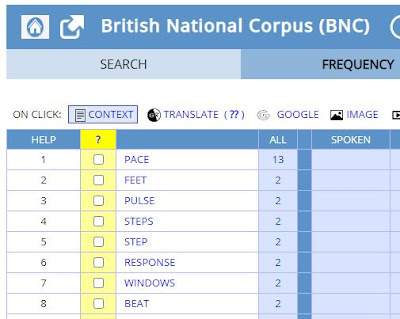
BNC search for quicken +NOUN


For the more faint-hearted I've  captured the most frequently used words – "most frequently" being a relative term, as only a single word (predictably, pace) occurs more than twice, and only seven others appear more than once (in a corpus that contains 100,000,000 words of text; these 27 cases are nearly half of the total [63]). The only one ...


 <parenthesis>
(apart from the initially perplexing WINDOWS, which it turns out refers to Windows, specifically a software product called "Quicken for Windows")
</parenthesis>

 ... that seems at odds with what I wrote last week (broadly, "no concrete nouns") is feet; but that is a metaphor for foot-steps (just as heart is a metaphor for heart-rate as I wrote before).


Update: 2121.02.26.10:15 – Expanded on Bitesize coincidence.

A word or two about my rather gnomic reference to Bitesize and its relevance to the DIY task I was engaged in. This Key Stage 4 Physics case almost exactly describes my kitchen lights. There are three, and after my first few hours fiddling, I uttered a triumphant Fiat lux and flicked the switch; one of them shone brightly, and the other two only got half the requisite voltage. The answer (as eny fule know) was to wire them all in parallel circuits. Duh.

Excerpt from spookily relevant Bitesize lesson


Update: 2121.03.03.13:05 – DIY/KS4 update

As some Frenchman put it (Chateaubriand? Talleyrand?) Le mieux est l'ennemi du bien (often rendered as "Good enough is fine" or some such lame excuse for not doing things right [perhaps that word  gives a hint about a certain problem with my worldview]). I tinkered to make the job neater, and all  hell broke loose (where "hell" suggests the presence of Lucifer [the light-bearer]; whereas the absence of light  –  in two cases out of three  – was the problem).

Mr Montgomery (my old physics master) came to me in a dream; well, during a T'ai Chi session on Zoom to be precise. Cherchez l'homme, he said: V= IR (we were multilingual in my school  – a Latin man [VIR] was the mnemonic for Voltage = Current x Resistance.) My new/improved circuit included a length of flex with higher resistance, which reduced the current. The fix was trivial; but Chateaubriand seems increasingly attractive.:-)


Wednesday, 3 February 2021

And he shall purify

 Good old Liddel & Scott (Ancient Greek dictionary known by its authors' names to all students of Ancient Greek) lists a number of words having to do with purity:


The key prefix is кɑθ- (kath-). The name Katharine in its various forms is a member of a cluster of words in this general vicinity. The Cathars, had this in common with the Puritans, though not in their beliefs (except in that they espoused a particularly purist form of their religion).

Katharine refers to purity ...

<papist_aside>
The innocent-sounding Catherine wheel refers to a particularly gruesome method of torture, which was meted out to St Catherine – though she was by no means its first victim.
<papist_aside>

...and many other girls' names are positive-sounding abstract nouns: Charity, Felicity, Gloria, Grace, Honor, Joy,  Lætitia (Latin for the same thing), Modesty, Patience, Prudence, Ruth, Verity, Victoria...

<parenthesis>
(not so much boys' names, I think – a legacy of the sugar-and-spice-and-all-things-nice school? – Felix and Victor come close, but they means "happy"and "winner" respectively rather than happiness and "the fact of winning", and I suspect "Endeavour" was Colin Dexter's joke: this site calls it a girl's name. 
Maybe, though, there are boys' names that are positive-sounding abstract nouns; they're just less obvious than the girls' ones. Hmmm... 
<initial_thought> 
Is this just a function of an arbitrary (? – really? Maybe  the sugar-and-spice-and-all-things-nice school were involved in the assigning [that word is, of course, totally unrealistic. Language doesn't work like that. But the whole "school of thought"  idea is itself metaphorical – and language-users were involved in linguistic choices that shaped the language] of gender to those words... 
<a_bridge_too_far> 
But this thought is getting a bit more than "initial". Perhaps I'll do an update
<a_bridge_too_far>
...) fact about the Latin words for these abstract nouns – caritas, felicitas, gloria, gratia, honor, lætitia  ... etc. They are chiefly (all?) feminine; it'd be perverse to attach such a word to an unnamed male baby. 
</initial_thought>
</parenthesis>
.... I could (probably - given a bit of research) go on – not that I don't (go on, that is).


But what started me on this line of thinking (in case you've forgotten, kath- words) was
this article in the Observer, particularly this bit:

This is not the first time that a war of words has erupted over Greek.  [HD: The article is about the influx of Covid-related Anglicisms.] 

Arguments over the language, between proponents of change and traditionalists advocating a return to its Attic purity as a means of reviving the golden age, go back to the first century BC. Controversy continued through 400 years of Ottoman rule, becoming especially explosive in the run up to the war of independence in 1821.

The struggle over whether purist Greek, or katharevousa, officially inducted as the language of the state after the revolution, should prevail over demotiki, the commonly spoken vernacular, raged until 1976 when demotic officially replaced it.

 I first met the word katharevousa in 1979...

<autobiographical_note>
(or more probably 1980, having let the brooding presence of the huge scholarly manuscript haunt my guilt-pile for a few months. I say more about this daunting manuscript in an update to a very early post – the fourth, to be specific.) 
Arthur Toynbee's manuscript for The Greeks and their Heritages  
"[now out of print, but whose notes featured correctly inflected Latin abbreviations - not just idem , but eosdemeamdem and so on]" 
early post
had been knocking around the editorial department at OUP's General Division for several years after the great man's death, ignored by less painstaking (or, let's be honest, wiser or at least  less stubborn) predecessors in my "Editorial Assistant" role.
</autobiographical_note>

Time I reappeared in the Real World.

b


Friday, 29 January 2021

Peregrinatio...

 ... or to put it more simply 'walking'. The word peregrinatio suggested itself because one of the earlier sources for Romance philologists is an account of a pilgrimage by a 4th-century woman (a nun? I expect Wikipedia might have a view) , known familiarly as "The peregrinatio", more formally Peregrinatio ad Loca Sancta (or various other formatsand this (the word, not the text) is the root of the word "pilgrimage".

When starting this post I did some research at the Crisis at Christmas site about a "pilgrimage" that I took part in:


<autobiographical-note type="self congratulatory">
I had already worked out the date, by remembering an unsuitable "Remploy"  hold-all I was carrying on the second leg. Had I done the whole walk I'd've had some kind of back-pack (though we didn't call them that in those days, favouring the more Germanic "rucksack"'; according to Etymonline back-pack has been with us since 1904;  but it hadn't reached the Knowles family [or rather, it didn't meet the stringent Presbyterian standards of our live-in grandfather, Archie, whose word on language {though not religion}was final]). But I was playing rugby on the Saturday, so missed the Canterbury to Gravesend leg.

Anyway, one of the seams came adrift, so I wrote to the manufacturer. And at the beginning of the letter I made reference to the fact that I was a "New Adult" – as it was shortly after my 18th birthday and we'd just been given the vote.  It was not a particularly memorable letter, and I don't know what resulted – if anything. The only thing that sticks in my mind is that one phrase  – which provides an autobiographical anchor.

<meta-tangent>
About this time I wrote a guitar instrumental in the style of Gordon Giltrap, (though, anachronistically, it had more the feel of Eric Bibb's Walkin' Home  – nothing like as cool, but similarly plodding and reflective) called Walking Home from Harrow, but the event it commemorated (involving a missed bus – a regular hazard faced by someone whose school, and therefore peers, were more than an hour away from home; and I think it was not the last bus, but the penultimate bus from Stanmore to Harrow) was a small fraction of the 25-mile second leg of The Bishop's March.)|
</meta-tangent>

 </autobiographical-note>

Anyway, that walk was my first and – so far  – only sponsored effort.  That is, the walk as planned had all the paraphernalia of these things: goals and targets and teams and signup sheets and what have you; but I didn't play the game. My contribution, if any, was negative. The organizers did all the admin – even booked a hall for the walkers doing the full 2-day pilgrimage – and I didn't pay my way.

But on 27 March I'll be joining this. (And in case you don't feel like clicking on that, here's an extract:

[W]alk with us as the sun sets, this Spring, from wherever you are. You even get to choose your own route and distance.

Whether you walk in memory of a loved one, to reflect on what has been a challenging time for everyone affected by blood cancer, or because you want to light the way to a brighter future – we’d love for you to join us!

My JustGiving page is here, but as I say there (or maybe not – it's probably too long, in which case you saw it here first):

...I've set the bar really low, and started the ball rolling by covering it myself. I've already met the goal, so there's no pressure. But Blood Cancer UK is a worthwhile cause, so feel free to chip in.

There's no goal either for the distance I shall  cover, though it'll probably be a bit further than my usual daily jaunt - maybe a couple of laps of Langley Mead, water table permitting. The reason (apart from basic temerity) I didn't get any signatures back in 1969 was that I felt that making a donation of <so-much-per-mile> was arbitrary and pusillanimous (not pusillanimous in itself, but inviting pusillanimity: as though a donor might say "Aha, but I've checked in the AA book [no Google Maps in those days] and it's not 25 miles; more like 24 and two-thirds. So I have to pay ...[Let's see, that's 3 times 25, minus  1]  74 75ths [more mental arithmetic in those days too]. Have you got change of a ten bob note  half-a-crown?")

<inline_ps>
This was a while (just over a year) before decimalization, so the original calculation might have gone like this: 25 miles at 6d a mile (that's old pence, or denarii to dress them in their Sunday Best) is  118½d or 9s 10½d  12/6. (In a display of magnanimity, the donor threw in the extra three halfpence. The revised total  would be 12/4.
</inline_ps>

Hell, if a cause is worth giving to, just give. ;-)

Time I showed my nose in The Real World.

b

Update: 2021.01.31.12:45 – Added inline PS.

Update 2021.02.05.14:20 – Updated inline PS to make the calculation more realistic. In fact the 74/75 calculation would be unnecessary as well, since 6d per mile  is 2d per ⅓ mile.

Update: 2121.03.01.14:10 – JustGiving coincidence

I was hugely surprised to get an update from the JustGiving people:

Someone has made a donation to your page

Well quite surprised by the notification itself; hugely surprised by the identity of the donor I learnt when I clicked on 

 He had; and  it was someone I haven't met since 1970. And he was a fellow walker on that first "sponsored" walk.