Saturday, 30 May 2020

Bras dessus bras dessous

In a trail for an Eartha Kitt program  I heard once there was a song that I had never heard in the original (although C'est si bon ...
<parenthesis>
(one of those "translations" that give up the effort of actually translating, and just throw in the odd snatch of the original – Volare is another example)
</parenthesis>
...is a commonplace on the lounge circuit in an English version):
C'est si bon,
De partir n'importe où,
Bras dessus bras dessous,
En chantant chansons
And the phrase bras dessus bras dessous took me back to my French classroom in the early '60s (possibly '63-'64, otherwise '65-'66...
<autobiographical-note>
Not in the intervening year, when we were consigned to the attention of an assistant, who –  much to our annoyance at the time – insisted that we learn and use the symbols of the IPA.  I was later to realize that – unless total immersion in the environment of the target language was possible  – IPA symbols were an almost essential ...
<parenthesis>
(and that "almost" is a craven sop to the sometimes vocal language teachers who are happy to pander to the needs of  students who can't use a decent [that is, mono-lingual] dictionary)
</parenthesis> 
...tool for learning a language.
</autobiographical-note>

...). The particular memory was of Cedric Baring-Gould's mime of walking arm in arm. My reaction was not a simplistic "Aha – bras dessus bras dessous is "the equivalent..."  (whatever that means in the context)  "....of the English" ...
<parenthesis>
(the assistant had introduced us to the less formal la main dans la main [in Françoise Hardy's "Tous les garçons et les filles de mon âge].. or "was to introduce" – all these parentheses are a bit too involved even for me...
</parenthesis>
 ...."arm-in-arm".

My association of that phrase with that mime is an example of the sort of association summed up on the right hand side of this diagram I later (much later) used in a Portuguese lesson:


I've probably uploaded this to TESconnect, but here it is anyway; and if you want to change the target language, you're welcome to the Visio sources (Microsoft-backup-willing)

The question O que é? triggers the name of the object, without recourse to the arduous and time-consuming and unnatural and error-prone left-hand route.

As I wrote in an earlier post:
My memory was of the mime performed by my French master 50-odd years ago. I've mentioned Cedric before, here. I can imagine his shade smiling down with a look of smug satisfaction (like the one he used to show the difference between 'No vacancies' and 'Complet' [HD 2020: arms  folded for the latter, hands upraised for the former]). 
At this time of year [HD 2020: I was writing about the time of the rentrée des classes], teachers of all kinds may need the fillip of this post: if you're good, what you do (probably more than what you say) will let your pupils take away from your lessons much more than you think.
I'll never forget BG's figure hunched over the enormous reel-to-reel Grundig that he always carried from class to class. (The assistant had one of the new cassette players, but BG swore by his magnétophone .)

Time for my walk, if I can get this published before Minusnet ("better than damp string")  crashes again.

b

Sunday, 24 May 2020

...if it wasn't for those pesky prepositions

This morning (that is, yesterday morning at time of going to <whatever>, my attention was caught by a charming birthday wish for Richard Wagner:
...and don't bother clicking on this screenshot, which is as dumb as can be.
Rather, give your ears a treat by going to YouTube.
<autobiographical-note subject="WCS tour, 2016">
If your YouTube experience is anything like mine (which it probably won't be) this Wagner piece is followed by a piece that Ben (the pianist on YouTube and my choir's pianist) played with us on our tour of the North-East in 2016: Abendlied.
</autobiographical-note>
You'll note that Facebook has helpfully supplied a bit of contextual information – leading me to wonder about their choice of preposition. I'm not sure what this sort of note adds.

The first response to Ben's post points to this bit of silliness on Facebook's part ...
<tangent subject="Gresham's Law?">
(not, please, behalf – although see my rant in the first update to this; the abomination has wormed its way into a kosher dictionary (Collins, I think, from memory). This seems to be yet another example of Gresham's Law as it applies to language: not Bad money drives out good, but Bad language-use drives out good).
</tangent subject>
...but, I feel, misses the point:


Facebook's note is not just otiose; it's wrong. By the same token, Oliver Twist is ABOUT Charles Dickens, that is, not.

In Facebook's defence (can I have written that? ) maybe some pictures need a bit of context-setting; and when writing a bit of generic text the right preposition in one case won't work in another. So whoever it was at Facebook who decreed We must generate some context-setting text on the fly was giving  the writer ...
<parenthesis>
(or maybe they make the mistake of leaving this sort of thing to the software engineer rather than spending money on a writer (or even, as with some enlightened and forward-thinking tech companies, a "User-Interface Engineer")
</parenthesis>
...a poisoned chalice.

That's all you're getting; a quickie. I'm thinking of more preposition-related stuff, but there's some serious tail-chasing in progress at the moment (if progress is the right word).

b


Saturday, 16 May 2020

Weighed in the balance

The other night I caught, on Radio 3, the last 15-20 minutes (enough to send me back to BBC Sounds to hear the rest) of Belshazzar's Feast.  And it was extraordinary how familiar the music was, given that I had sung it over 30 years ago – in December 1987 to be precise.
<pre-history>
Two years before that I had my audition for Wokingham Choral Society with their new MD Paul Daniel. I persuaded him to take me on, despite my limitations when it came to reading music (and at the time I didn't even have a keyboard of any kind at home to help with note-bashing) on the strength of my having "recently" sung Beethoven's Mass in C (WCS's concert piece that term) with MagSoc's choir. That recently was something of an exaggeration, but it sounded more persuasive than the more accurate 'about 12 years ago when I was looking for an unauditioned choir having been kicked out of the chapel choir').
<peccadillo>
After three years with that choir (three years that coincided with Paul Daniel's tenure, before he went on to greater things) I left WCS, to return in the early noughties, under Aidan Oliver. On the strength of being a returning member I escaped without audition. (This may have had something to do with the maestro's attitude to red tape.)
</peccadillo>
</pre-history>
The rehearsals went well until three or four weeks before the concert, when Paul Daniel began to feel a pain in his shoulder. A physiotherapist and member of the choir kept telling him to get it seen to, but he tried to work though the pain.  Finally, on the Friday before the concert he saw a specialist and was told that if he conducted at the concert it might be the last concert he conducted.
<hearsay>
(well anyway, that's what the chairman said  when he told us on the Saturday morning, and it's at least plausible)
</hearsay>
So at incredibly short notice they found a new conductor, Brian Wright whose biography mentions the piece.
<pre-history>
 (although that was with the RPO; he cut his teeth with WCS.)
</pre-history>
Four things struck me about the concert :
  • The venue: it was a sports hall, converted pro tem – not a great success acoustically
  • The conductor, a northerner, didn't like the way we said brass. He didn't try to change it, but said he felt more comfortable with choirs who said /bræs/. I think Walton, a Lancastrian, would probably have agreed.
  • From the horse's mouth (that is, Walton's) he corrected the printed score with respect to the triplet when the choir sings 'weighed in the balance'. (I'm afraid the details escape me.)
  • Also on the programme was Paco Peña, whose performances I had enjoyed twice in the late '60s.
    <autobiographical-note>
    One of these was at the Guildford Festival. My oldest sister was a student at the University of Surrey, which was linked in some way with Battersea Technical College. Linking the two sites was a shuttle minibus, on which I stowed away disguised as a student (I was in the fifth year – or "Year 11" in new money).
    The concert was called something like "Three aspects of the guitar", and was divided between John Williams (classical),  Paco Peña, (flamenco) , and Chris Spedding (a late replacement for a jazz guitarist, though "jazz" is not a very apt description of his one hit, "Motor bikin'"). 
    At the end, John Williams announced that, having met for the first time that afternoon, they were going to play together. With his three-finger (classical) tremolo his Repertoire included Tárrega's Recuerdos de la Alhambra (that clip demonstrates both the technique and the piece). Paco Peña, with his four-finger (flamenco) tremolo (how VERY DARE they use the little finger?) knew the tune well enough to improvise an accompaniment. And Chris Spedding would do his thing. Hmm? (His solo contribution to the concert proper didn't inspire confidence.) 
    The two acoustic guitars started, confirming Fernando Sor's opinion:...
    <no-source>
    Sorry, can't place it. I believe I saw it on the sleeve notes to John Williams and Julian Bream's first Together album.
    <no-source>
    ,...(something about the only sound more beautiful than a guitar being the sound of two). So we eyed Chris Spedding's VOX AC30 with dread. 
    In the event his contribution was far from intrusive; and when the music finished – after a moment when we hoped (vainly) for more – there was the sort of ovation that I had never been part of before (and have never been part of since). It was not a matter of a few people standing up and others joining them. It was unanimous (in a way that does justice to the roots of the word: one mind). 
    <second-concert>
    To describe my other late ‘60s Paco Peña concert would be even more self-indulgent than usual. 
    </second-concert> >

     </autobiographical-note>

You've got to draw a line somewhere.. Life's just one AOB after another

b

Saturday, 9 May 2020

Sauntering

John Muir, "Father of the National Parks"
My ears pricked up – as they often do when exposed to (often unwitting) crimes against etymology – when I was listening to Radio 3 just now. They were playing a repeat of a 2017 broadcast based on an almost-real-time walk along Offa's Dyke. The commentary didn't quite assert that the word "saunter" derived  from pilgrims to the Holy Land (la Sainte Terre, geddit?).

But it did assert something in that area – that la Sainte Terre was among the many disputed suggested etymologies of "saunter"; and I don't feel it was sufficiently deprecatory of this particular bunch of hooey.

Etymonline provides a link to thoughts on this topic, which is a good read. They take the history of supposed etymologies of saunter from Dr Johnson (a believer in this bit of hokum), via other believers, including Henry David Thoreau...
<autobiographical-note>
(who wrote "I have often traveled in Concord". "Travelling in Concorde" had an amusing secondary meaning in 1979, when I was working on the ODQ [details here]. Oh how we larfed.)
</autobiographical-note>
...and John Muir (in a conversation recounted in The Mountain Trail and its Message by its author Albert Wentworth Palmer).
<aside>
It's a strangely appropriate coincidence that the etymology of the name Palmer is not in doubt:
"pilgrim; itinerant monk going from shrine to shrine under a perpetual vow of poverty;" originally "pilgrim who has returned from the Holy Land," c. 1300, palmere (mid-12c. as a surname), from Anglo-French palmer (Old French palmier), from Medieval Latin palmarius, from Latin palma "palm tree" (see palm (n.2)). So called because they wore palm branches in commemoration of the journey. "

Source
</aside>
I liked this summary of the Muir/Palmer quote:
I'm willing to allow the gist of the quip to be true, and that Muir really did say something like that on some occasion. Perhaps Palmer had the sort of memory attributed to Coleridge that could recall a casual conversation completely.

But that doesn't mean the etymology is correct.
Etymonline
This often happens  in discussions of etymology; a quotation is cited as a knock-down argument, but  the seeker of truth gets up again and shrugs off the standing count of 8. I mentioned an example with reference to Kemp's Nine Days Wonder, here.

Returning to that Offa's Dyke program, my ears pricked up again at mention of Cader Idris. Like Arthur's Seat (a similar landmark, though not the same size), a Cader is something you sit on – a big chair (the Castilian cadera means "hip" but the Catalan cadira means "chair"; I discussed these two, and how they relate to cathedrals and ex cathedra pronouncements [made with that authority that comes from sitting in a big chair], here.)
<AOB>
Other body parts used to name land forms (e.g. the Paps of Jura) come to mind, and other metaphors for land forms (like "canyon", from cannon) will have to wait.
</AOB>
That's all (for today) folks.

b


Update:2020.05.10.12:40 – Deleted this working note, which once served to remind me where I was going:

Also Cader Idris, cf Arthur's Seat and see cathedra stuff.

Saturday, 2 May 2020

Annie - Mona Lisa of the Seine


The slimmed down Covid-19 version of Radio 4Extra's RadioLab programme (itself a repeat of the original NPR broadcast from the USA) brought to my attention a programme originally broadcast (in the UK) 2 years ago.
<autobiographical_note>
In the mid 1980s, when I was getting my First Aid at Work certificate, we were told that the first thing to do on approaching an unconscious casualty was to call out, as the sense of hearing is the last bit of consciousness to go (I'm not sure about this; maybe some other sense is the very last to go; but an apparently unconscious patient can still hear). So we always addressed the dummy as "Annie", which I assumed was based on the name of the dummy, Resusci-Anne.
</autobiographical_note>

But that RadioLab programme (the relevant section starts about 7'25" in) made me think again about the derivation of that "Anne". The English /æ/ phoneme used in "Anne" is  not a million miles from the first syllable of the French "Inconnue", and the similarity increases in the context of the following nasal. It told...
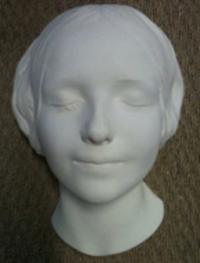
...the story of an innocent young woman from the country who comes to Paris, who's seduced by a rich lover and then abandoned when she falls pregnant. With nobody to turn to, she drowns herself in the waters of the Seine, a modern Ophelia. At the mortuary, her beautiful face, now peaceful in death, is preserved forever with a plaster cast. 
It was another drowning - or near-drowning - that ensured the Inconnue a place in medical history. 
In 1955 Asmund Laerdal saved the life of his young son, Tore, grabbing the boy's lifeless body from the water just in time and clearing his airways. Laerdal at that time was a successful Norwegian toy manufacturer, specialising in making children's dolls and model cars from the new generation of soft plastics. When he was approached to make a training aid for the newly-invented technique of CPR - cardiopulmonary resuscitation, the combination of chest compressions and the kiss of life which can save the life of a patient whose heart has stopped - his son's brush with death a few years earlier made him very receptive.  
He developed a torso or whole-body mannequin which simulates an unconscious patient requiring CPR. Asmund wanted his mannequin to have a natural appearance. He also felt that a female doll would seem less threatening to trainees... 
Source

In Norwegian, the similarity ...
<inline_ps>
between the Norwegian equivalent of  "Anne" and the first syllable of the French Inconnue
</inline_ps>
...may be closer. A fuller treatment than RadioLab's was given in a BBC Magazine article in 2013 (already quoted from above, and given the intriguing headline The Mona Lisa of the Seine;)
Millions of people around the world have learned CPR on a mannequin known as Resusci Anne. The story of the 19th Century beauty behind the model - or at least, one version of it - will be told at a symposium in London to mark European Restart a Heart Day. But does anyone really know anything about her?  
...[!I]f you're one of the 300 million people who's been trained in CPR, you've almost certainly had your lips pressed to the Inconnue's.

5 years later ( or maybe a bit more in the case of the original US broadcast) that figure hadn't changed;...
<old-numbers>
The mask of Inconnue
L'inconnue de la Seine
As CPR has been taught for nearly 70 years, that 2013 figure might have been expected to increase by at least a few hundred thousand since then. The "300 million people who'[ve] been trained in CPR" seems to be a rather sticky one. But still; what matters (to my understanding at least) is that they've all used a version of the same dummy, and that the dummy's based on a death-mask.
</old-numbers>
... but anyway it's a large number.

Bye for now. I'll leave you with a chance Where've-I-heard-that-before? noticed on my daily walk the other day; the radio played the Polka from Smetana's Bartered Bride  and I couldn't help comparing it with that staple of Belfast pub songs I'll Tell My Ma. Not identical by any means but close enough to remind me of the old Clancy Brothers/Tommy Makem version. (I didn't use this in the first sentence of this para. The introduction is a bit wordy. Skip to 0'9" if you just want to hear the music.)
<thinks>
Perhaps I shouldn't always be wired for sound – give the birdsong a chance. This morning they were making such a din that I almost missed the rare passage of an aeroplane.
</thinks>

b

Update 2020.05.06.13:00 – Added inline PS.


Saturday, 25 April 2020

From spine-tingling to nerve-jangling

The starting point for today's jaunt...
<note_to_self>
Must check on the etymology of jaunt. Looks a bit Indian to me. like jamboree and jodhpurs and juggernaut.
<cut_to_chase>
Couldn't help myself. 'Unknown origin' says Etymonline. But the trip to that source wasn't entirely wasted, as it's added to my stock of words that have done a somersault and reversed their meaning (as, for example, has backlog, discussed here (and elsewhere, from time to time: you know the drill).

There's not a lot on Etymonline to justify this switch in polarity; well. nothing really:
1670s in modern sense of "short pleasure trip," earlier "tiresome journey" (1590s), from jaunt (v.)
</cut_to_chase>
  <note_to_self>
 ...is a virtual choir recording in which I have a paternal interest. I'm not a fan of most web content (as they say) – most of it a mixture over-sentimentalized verbiage and meretricious clickbait – but this really does live up to its billing as both "spine-tingling" (though the headline wasn't that concerned about hyphenation) and "spellbinding" (a word that recalls to me that Bennet madrigal discussed in an update to this: "music the time beguileth").

In 2016 this Tallis piece displaced Spem in Alium – (House Song of the Van Helsings [no, that's Allium, 'Hope in Garlic'] {This is getting very silly}) – as my favourite (by that composer), as my choir prepared for the tour mentioned, tangentially (you know the drill), here.

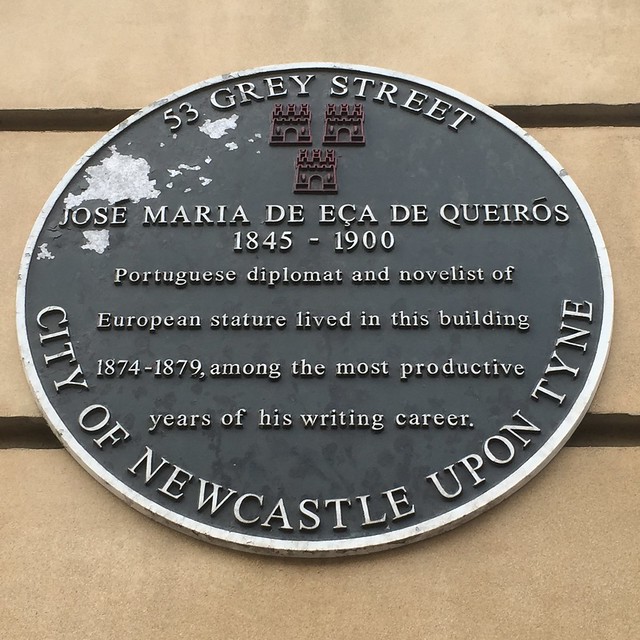
On our first night in Newcastle a bunch of us ate at a restaurant on Grey Street, where I noticed this plaque (not a blue plaque, I noticed, perhaps for some reason: Black for foreigners that nobody's heard of? Or maybe it's more subtle than that: grey to match the street.


José Maria de Eça de Queirós black plaque | Open Plaques

Well I had (heard of him), and read a good deal of his oeuvre (or obra as we say in the trade).
<autobiographical-note>
and earlier this year (2020, keep up) I entered  a translation of some of his work for 

THE JOHN DRYDEN
TRANSLATION COMPETITION 
(Excuse the shouty typeface; I cut/pasted it from the entry form.). As well as being a novelist and a diplomat he was also a journalist, and a posthumous publication in 1905 assembled much of his work as Cartas de Inglaterra. He was a sort of fore-runner of Alistair Cooke, writing "Letters from England". 
I was first introduced to his work at a summer school at the Universidade de Coimbra, where they had a proprietorial interest in him as an old boy more than a century earlier.
<aside>
The lecturer had a quaint way with pronunciation, joining together two vowels with a... No.  TMI. Vivid memory though.
</aside>
</autobiographical-note> 
Returning to Tallis, I also sang the piece as a visiting Old Member at my Cambridge College in May 2018.
<autobiographical-note>
We visitors were each flanked by members of the present Corpus Christi Chapel Choir, who had mostly been raised as trebles in cathedral schools. So they had a trained reflex to raise a hand when they (rarely)  made a mistake. If I had done the same I would have given myself RSI.
</autobiographical-note>
And more recently we sang it at the WCS choral workshop back when the only place in Corona lockdown was Wuhan; and the (sadly few) basses made such a mess of our E'en the spirit of truth entries that it was not so much "spine-tingling" as nerve-jangling.

But I have secateurs to wield
And sheds to fix before I shield...

<apropos enemy="covid19", first-casualty="language" >
Which reminds me: I'm finding it hard to say 'I'm shielding' (which is the magic word for people especially at risk).  The health chappies (Witty et al.) are obviously not conversant with the Sapir-Whorf hypothesis – which sprang partly from Benjamin Whorf's experience working with insurance claims. He recognized that the way people described situations often contributed to misfortunes; for example, the phrase "empty petrol cans" encouraged people to underestimate their flammability, as "empty" can mean null or void or having no effect – as in "empty threat" "empty promise" and so on. 

Similarly (at last, the point) the verb shield implies strength. A (hero) shields B (vulnerable person) from C (danger). So saying 'I'm shielding' invites the belief that I'm strong. So when I was recently ordering some pills online I asked for them to be delivered to my home address rather than asking MrsK  to queue outside the pharmacy (which I gather we're saying now instead of chemist – I'm tempted to do the full Shakespeare and say apothecary). But I didn't want to say "I'm shielding" in case someone who spoke English misinterpreted it. (On the international stage I reckon this might be more of a problem. People exposed daily to Wittygrams know all about this (ab)usage; but not Johnny Foreigner.)

Just saying. People planning resistance campaigns of all kinds need to think about the language they're using.
</apropos>
...And sheds to fix before I shield. 

That's all for now

b

Update:2021.01.1610.55 – Added PS

PS
You see? Thin end of the wedge. The syntax of the verb 'to shield' was threatened by covid, and now the door's open for further abuse. Emily Maitlis, on yesterday's Americast, used the expression "He was shielding" to mean "He was sheltering" – with no hint of a virological meaning.

PPS
Come to think of it, the verb 'shelter' has precisely the kind of transitive/intransitive flexibility that 'shield' is beginning to have. 

Friday, 17 April 2020

And then two come along at once

My mind had spent 68 years untroubled by thoughts of Steller's sea cow. But for Christmas 2019 I was given a copy of Ross Barnett's The Missing Lynx, which introduced me to this loyal and gargantuan extinct manatee. It was rendered extinct, wrote Barnett, because it was so easy to hunt (which is where the loyalty came in – the silly things went back to help fellows who'd been harpooned).
Steller's sea cows were large herbivores that had a seal-like appearance with a tail which resembled that of a whale. The Steller's sea cow was named after George Steller who discovered the animal and who described it: "The animal never comes out on shore, but always lives in the water. Its skin is black and thick, like the bark of an old oak, its head in proportion to the body is small, it has no teeth, but only two flat white bones one above, the other below". 
Source
But then I heard Rob Newman, on The Extinction Tapes. He made it clear that (on this rare occasion) it wasn't only man that was vile. Well, vile, but not because of a direct effect on the sea cow population. The vileness was due to the popularity of sea otter fur, as explained in this article in the Proceedings of the National Academy of Sciences of the USA. It's not a simple story, but in a nutshell the hunting of sea otters for their fur, left sea urchins unchecked – and the sea urchins deprived the sea cows of their main (perhaps sole) source of food, kelp. It was not that  they ate an enormous amount, but they cast the plants adrift by gnawing through their moorings. As the National Ocean Service website says:
Sea urchins will often completely remove kelp plants by eating through their holdfasts. Other invertebrates found in kelp forests are sea stars, anemones, crabs, and jellyfish... 
A wide range of marine mammals inhabit kelp forests for protection and food. Sea lions and seals feed on the fish that live in kelp forests. Grey whales have also been observed in kelp forests, most likely using the forest as a safe haven from the predatory killer whale. The grey whale will eat the abundant invertebrates and crustaceans in kelp forests. One of the most important mammals in a kelp forest is the sea otter, who takes refuge from sharks and storms in these forests. The sea otter eats the red sea urchin that can destroy a kelp forest if left to multiply freely. 
Source
This graph from the PNAS article, where the scale on the left shows population density (of sea otters) as a proportion of the maximum, shows what happened and when. 


Of course post hoc doesn't have to mean propter hoc. And the hoc in question is so remote in time and space that it's impossible to know what caused what. But the author of the PNAS article is pretty convinced and convincing:
Although the exact timing and even the existence of a kelp forest collapse in the Commander Islands can only be surmised, the phase shift probably occurred soon after the onset of the fur trade in 1743. Sea otters in the Commander Islands had been hunted to virtual extinction by 1753. Although the precise timing of the associated kelp forest to urchin barrens phase shift depends on the exact trajectory of decline in sea otter density, those details are of little consequence to our argument. Sea otters were ecologically extinct by 1753, and the kelp forest collapse therefore preceded that date if our data from the western Aleutians are a reasonable proxy for what happened 250 y earlier in the Commander Islands. If the time course of the sea otter decline in the Commander islands was roughly exponential, then the kelp forest collapse probably occurred around 1750, just 7 y after the onset of the fur trade and 16 y before the last record of a living sea cow
b

PS And my the latest nomination for a Tezzy ...
<GLOSSARY item="TEZZY>
Time-wasting Site of the Year.
</GLOSSARY>
...goes to this, where the 14th century meets the 21st. In the 20th, in the year of my birth, the Equatorie was  misattributed to Chaucer; but recent research has placed the writer as a 14th century monk:
The ... possibility that the Equatorie was Chaucer’s own composition is an issue that has occupied the attention of many scholars; however, this has now been resolved. The writer has been identified as John Westwyk, a Benedictine monk of Tynemouth Priory and St Albans Abbey, whose life was one of dramatic contrasts.
The interactive model equatorium based on the Equatorie offers many hours of play. Don't say you weren't warned; this Tezzy looks as though it might be richly deserved. I haven't put it through its paces though, because of...

Self-isolation Chronicles

My tai chi classes are continuing via Zoom. But yesterday normal service was interrupted because my laptop had a nasty turn.

The backup plan was to continue on the desktop. But this has two big drawbacks.
  1. It does not do video, and fixing up a camera for it wouldn't be plain sailing, as it's running Windows 7 (I know...).
  2. It is in the study, where there's not enough room to swing a ca...gerbil.
<stop_press>
The day has been saved by a near-obsolete iPad.
</stop_press>

Meanwhile, my local U3A has gone into hibernation. Ironically, the mail announcing that everything was suspended until further notice claimed to be Guaranteed virus-free