Monday, 29 July 2019

Titanic silliness

In an early post that dealt with Michael Gove and Nevile Gwynne (guilty of, among other things, Gwynne's Grammar...
<HMMM>
[a  helpfully specific title, that makes it clear that this "Grammar" is not that of any language, but a hotch-potch of shibboleths peculiar to one misguided individual]
</HMMM>
...)

I quoted an Oliver Kamm review of Gwynne's book:
And while we're on that subject, I heartily recommend Oliver Kamm's piece in this Saturday's copy of The Times, in which he calls Gove's guidance 'well-intentioned and largely either futile or destructive' and says of Gwynne's Grammar
It is a work of titanic silliness, and it's alarming that the Education Secretary doesn't see this.
And the phrase "titanic silliness" struck me as an apt title for a reflection on Jacob Rees-Mogg's latest folie de grandeur (or should that be grondeur, to suggest the tone of implied reprimand?)

Mr Rees-Mogg, MP, PC, Esq., <whatever-the-hell-else-he-wants>, in common with many people taking over a new empire (Churchill did, as that post said, Gove did at the Department for Education [see Gove's Golden Rules] among many others; as Dr Johnson said, "Hell is paved with roll-your-own style guides" – or something of the sort).

The BBC summarized his rules thus:
(??? I might be wronging him here, the "summary" is so risible; can he really have written it? It is a shining example of lack of parallelism
<EXPLANATION SUBJECT="parallelism">
  • sometimes "What I want" {eg 'Double space after fullstops'}, 
  • sometimes "What you must do" {eg 'CHECK your work' – with its echoes of the school-room}, 
  • sometimes statements of opinion {eg 'Organisations are SINGULAR' – golly, bold and caps}...
</EXPLANATION>


And there is a list of words to avoid:
Here he has taken the lazy teacher's easy way out of identifying a word that tends to provoke unwanted behaviour in some cases (eg "yourself" to mean "you", parenthetical "hopefully" to modify a statement ...
<digression>
(in the terminology of Mr Rees-Mogg's beloved Latin grammar it might be called 'the "hopefully" absolute' [which incidentally has an impeccable pedigree, but OK the dude doesn't like it and I understand his conc... ooo-er])
</digression>
... "got" as an all-purpose verb of acquisition, understanding, becoming...
<digression>
(on the analogy of pronoun, I suppose it might be called a pro-verb, but that'd be silly)
</digression>
...   as I was saying, identifying a word that tends to provoke unwanted behaviour in some cases, and banning it completely. I am sure Mr Rees-Mogg would have no principled objection to the assertion that "it is better to travel hopefully than to arrive" but it does have that word. And what's wrong with investing in schools, anyway?

As is always the way when glass-house-dwellers throw stones, they break their own rules:. That BBC  report goes on
This is something Mr Rees-Mogg discovered for himself on Wednesday as he made his despatch box debut in the House of Commons. 
In one exchange, he said: "Mr Speaker, we have got perambulators and nannies into this session, which I think must be a first for questions to the Leader of the House."
According to the Guardian, the official transcript of parliamentary proceedings, Hansard, recorded more than 700 instances of Mr Rees-Mogg using one or other of the banned words or phrases. 
The man satirizes himself (and he knows it). He is a freakish side-show designed to distract attention from the more insidious chicanery going on in the name of democracy.
<UK_CONTEXT DESTINATION="Hell" CONVEYANCE="Handcart">
In late July the UK suffered what, in the words of the Prime Minister (speaking at the time of Gordon Brown's not dissimilar undemocratic anointment as PM in the unelected wake of Tony Blair), called "a palace coup".

Strictly speaking, there was an election of sorts. Theoretically, the few tens of thousands who voted for a new leader of their party weren't voting for a PM. But they knew what their preference entailed. Less than 1% of the UK population voted for certain economic meltdown.
<JINGLE>
Before the final vote I mused, to the tune of Little Weed's oft-repeated question (see here at 13'08"):

Is it Hunt or is it Boz
Wants to cut of Britain's schnozz
Just to spite its own figgoz [a poetically licensed version of "fizzog"]
Is it Hunt or is it Boz.?

And, as the Little Weed might have said, "It was Boz! – it was Boz!" [I'm sure she'd' approve of the punctuation.]

As in the Bill and Ben case, there was little to choose between  the two; but the eventual winner was the more hell-bent.
</JINGLE>
<CUNNING_PLAN ENGINE="the power of a positive attitude">
If you believe in fairies boys and girls, clap your hands.
</CUNNING_PLAN>
<SCOTTISH_VIEW>
An MP representing the Scottish Nationalist Party (who don't want Brexit, still less the lunatic/cliff-edge/no deal Brexit envisaged by the new PM and his cronies) spoke of him as "the last Prime Minister of the United Kingdom". I knew the nationality of my Scottish grandfather would come in useful.
</SCOTTISH_VIEW>
</UK_CONTEXT>

But the grass won't cut itself. That's all for now.

b


Friday, 19 July 2019

Adeus, João

The name João has been causing newsreaders and sports commentators the usual problems, because of the success of Mr Sousa at Wimbledon (as far as the last 16, but no further) and the death of the father of bossa nova, João Gilberto. Radio and TV announcers see the diphthong ão, and give up before they've started: "Well that's a completely outlandish sound, I've got no hope."

But I've said before, here (and in other words passim)
Our minds are quite accustomed to instructing our vocal equipment to make 'outlandish' sounds, phonemic in other languages – it's just that we've learnt not to hear them (as a necessary part of becoming native-speakers of English)
Elsewhere, in the same post,  I discussed an example word that I used to use in Portuguese "Beginner" classes, to introduce the sound of the  word Dão:
Take a word like downtime. Because of the way it's spelt it's hard to avoid believing that it is made up of the sounds /daʊn/ and /taɪm/. But think about what happens where the two syllables meet. The airstream is directed up and through the nose. Meanwhile the tip of the tongue is resting behind the dental ridge (where it is to form an /n/). To form the /t/ it has to start in the same position. Air pressure builds up behind that closure, and then explodes forwards as the closure is released; that's why linguists call /t/ a plosive.

But before the release, the closure isn't complete. In making the /n/ the speaker  has left a way through the nose for the 'buzzing' sound. In other words, the /aʊ/ vowel is being nasalized. Normally, when pronouncing the syllable /daʊn/, the speaker releases the /n/. When it's followed immediately by a plosive that uses the same tongue position though, the release often doesn't happen. So the /n/ in downtime isn't realized as an [n]; it's realized as the nazalization of the previous vowel.
So a native-speaker of English is accustomed to making a vocalic sound not unlike the end of João.

The opening fricative is a little more challenging for a native speaker of English, as there's no English word that begins with /ʒ/; this doesn't mean  producing it calls for  a special  skill.  It occurs medially (as we say in the trade) in words like measure. And cookery programmes like The Great British Bake-off, Masterchef etc have (increasingly over the last twenty years, I would guess)  inured English ears (and mouths) to words like jus.
<epenthetic_speculation>
In an earlier post I discussed epenthetic vowels:
In The King's Speech the Geoffrey Rush character advises the king to deal with problem consonants at the beginnings of words by taking a run up: /maɪ əpi:pəl/ for 'my people'. Languages often take a similar course with outlandish phonemes or consonant clusters at the beginnings of words. Among the signs of this are changing names of places over time. Stamboul Train could have a 21st century sequel: Istanbul Plane. That 'I' is epenthetic.
Possibly (just an idea, which you don't have take as gospel) the usage "with a jus" is the result of a speaker with an English phonological background dealing with a word with initial  /ʒ/  by adding an epenthetic vowel and coining a new word /'əʒu:/ with the /ʒ/ comfortably supported by a vowel on each side.
<I_KNOW_I_KNOW theme="wrong vowel">
(I've never heard an English chef even attempt the [y], but if you want to, pretend you're whistling and with the lips pursed like that try to say /i:/ – all right, "ee" if you must, but IPA symbols are so much clearer [and unambiguous {see this old post for a fuller explanation of my feelings about "sounds-like" transcriptions}.)
</I_KNOW_I_KNOW>
</epenthetic_speculation>
So anyway, there's little excuse for the repeated João-abuse. Start with a  /ʒ/  and then say "wow" (remembering to nasalize the diphthong – as  if you were talking about a clockwork mechanism that had wound down [and don't say the "d down" bit]).

b

PS I wrote this mostly before a break in the Somerset levels (very flat), but luckily held back from hitting the Publish button until I had the leisure to fix a couple of howlers – which may well have gone unnoticed,   but would have cost me a week's sleepless nights (before I logged in again).


Saturday, 29 June 2019

Aspiring to pronounce Phelukwayo

 Teachers of foreign languages know that the last thing you do is write down a  word before students have learnt to say it. If they see the spelling before hearing the sound, their first reflex will be to attach to that spelling the phonological characteristics of their mother tongue – in most (if not all: discuss) cases, a pronunciation they're going to have to unlearn.

Which brings me to /p/, which (in most English speech I've met) is aspirated in some contexts (the allophone can be transcribed as [ph]) but not in other contexts. It's something speakers of English as a mother tongue [henceforth "FLES" for "First-Language English Speakers"] find hard to hear: "  A p is a p, isn't it?". But if they know what to listen for, most FLESs can be taught. 
<experiment>
Wet a finger and hold it in front of your lips as you say "pin". You should detect a little puff of air.
<autobiographical_note>
When I first met this test, when the Cambridge Linguistics Department was a converted cricket pavilion in the early 1970s, no-one suggested wetting the finger. That's my own addition. The water makes the puff of air have a cooling effect, making the finger more sensitive.
</autobiographical_note>
Next say "spin". There's next to no puff of air  (I say "next to no" because the sound of the word involves the passage of air; but aspiration after the [p] is not a contributor).
</experiment>
When a FLES sees "ph" at the beginning of a word, it obviously represents /f/ (as it does in English words). This brings us to Phelukwayo (not an English word). When, in early June 2019 cricket commentators started to meet it most days (he had been in South African teams before then, but June 2019 – the Cricket World Cup in England and Wales – was the moment when it first started to register on my mentions-per-day meter) the English commentators had to learn from the South African ones. Some were quicker than others. For example, in early June Jonathan Agnew was saying /felə'kwejəʊ/ (with the /fel/ of *phel [except that there's no such English word] and the /wey/ of  English "way", but by mid-June he'd learnt. Some of the Test Match Special team have insisted on their Little Englander pronunciation. (No names, no pack-drill, but I bet they voted for Brexit.)

This question of aspiration is something I've dealt with before, here for example:
First World War Tommies, hearing the word blanc (used to refer to a drink of wine – which, in that part of France, was typically white), heard no aspiration after the b and heard p. When they returned home it was just 'wine', which – in 'San Ferry Ann' pronunciation – was 'plonk'. They showed little respect for its precise colour meaning....
Here, also, I mentioned Audrey Hepburn, who (raised in a mixture of Belgium, England, and the Netherlands) did not aspirate her voiceless plosives.
<mea_culpa>
I got it wrong first time around in that post, but fixed it in an update.
</mea_culpa>
It didn't give her a foreign accent, but it probably contributed to the je-ne-sais-quoi that made a viewer of her first screen test say "the kid's got something". It wasn't something that she had, but something that she didn't have – those little puffs of air following p and t and k ("aspirated voiceless plosives").

But aspiration wasn't my first port of call, surmise-wise. As South Africa was involved (and South Africa boasts many of the world's languages that use clicks), I initially went for the more exotic idea of a bilabial click (not unlike the little pop a child makes when imitating his(oh yes I did)/her  mother applying lipstick).
Don't be misled by the Play symbol;
this is just a screenshot.

But this "masterclass" (what qualifies it for that epithet, I wonder –  just that it's from the horse's mouth?) shows that the initial consonant is just an aspirated voiceless plosive: Masterclass-what-masterclass?

That's all for now, Duty calls.

b

Update: 2019.07.01:14.30 – Added PS
When I first  noticed this, and heard the (Anglophone) South African commentators I wondered where their /f/ came from (as their first syllable seemed to be ...
<old_dogs>
That "seemed to be" indicates a certain diffidence here.
</old_dogs>
... /pef/).

I think what's happening is this: English has no phonemic /hl/, but in Phehlukwayo's own pronunciation there is some sort of aspiration before the /l/. As the lips of the speaker are close together after the initial [ph], this takes the form of /ɸ/ (the voiceless bilabial fricative  used in Greek. In English, the nearest we have to that is /f/ (as in all those words borrowed from Greek, philosophy, for example) so the Anglophone South Africans hear an /f/. (Alternatively, though, they get it right, and I hear it wrong; my ear for this stuff isn't as keen as it once was.)

Monday, 17 June 2019

Let the lave go by me

On Saturday my choir will be singing in All Saints, Wokingham (and it's not too late to get a ticket, from the places listed here:
).

The title of the concert is also the title of a Vaughan Williams setting of poems written by Robert Louis Stevenson.  RVW (as we say in the trade :-)) set it for baritone solo; but our Musical Director has arranged it for SATB choir. "Let the lave go by me" is the request made in the first line of the first (and best-known ) song in  the collection, The Vagabond.

And in view of the efforts the choir has put into articulation, it would be a shame if the word lave passed meaninglessly by.


<glossary subject="lave">
Lave is a word set elsewhere by Vaughan Williams (in the Sea Symphony ?), but there it is a verb, deriving ultimately from the Latin lavare. But in "Let the lave go by me" it is obviously not a verb.  Stevenson's lave is a noun, with this meaning (taken from dictionary.com): 
So "let the lave go by me" means something like "I don't care about anything else".
</glossary>
But his arrangement of this collection is not our MD's only contribution to Saturday's programme. He also wrote the collection of haikus set here:
(Not quite Tintern Abbey, but hey...)

For details of the background to this work, I recommend the programme notes. The haikus were set by Paul Burke, and Saturday's performance will be the premiere of a revised version. Again, the programme for the concert has the details. The composer will be in the audience,  adding to the experience for the choir.

The theme of travel will be common to the rest of the programme. These two more substantial pieces will be accompanied by a number of smaller-scale pieces. I'm particularly looking forward to The Ride of the Valkyries  (arranged for piano duet).

But I'm neglecting the cricket.

b

Update: 2019.07.28.10:20 – Tweaked Tintern Abbey link and added PS:

PS
Having done the Romantic Poets for A-level (British poets only of course, what do you take  me for?), the idea of Tintern Abbey as a place whose genius loci might be contrasted with Didcot Parkway struck me as needing no explanation. But I've now tweaked the Tintern Abbey link so that it takes you straight to the bit about literary associations.

STOP PRESS
Next weekend a substantial fraction (not quite half) of the choir will  be reprising parts of this concert (excluding the Didcot Haikus, and with the addition of – inter alia – a charming Rutter piece) on a brief  ...sally? ...foray?...tourette? ... of the Midlands. If you're in either place, or both, you'd be very welcome: 


Sunday, 9 June 2019

Alexa: What is alexia?

People of my vintage, hearing the prompt: "5½ yards?" will unhesitatingly respond "1 rod, pole, or perch" (well, maybe not all of them) , remembering those glossy red exercise books with tables on the back (I never did find out what "Troy weight" was, though I'm pretty sure the number 20 came into it somewhere; ounces in a pound, maybe.) Anyway, this information was hardly crucial to anything very much, and I don't think any less of people who don't have it at their fingertips.
<digression theme="5½ yards">
Although this measurement is not in wide use today, it may be of interest to those of an etymological bent. Another of those numbers on the back cover of 1960s exercise books was "22 yards = 1 chain".

That quantity crops up all over the place: in measurements (10 square chains = 1 acre); in the phrase chain boy (mentioned in a previous post...
But staying with the subject of measurements (the grit at the centre of this ... erm, whatever) someone on  that programme mentioned how memorable measures (resisting metrication) tended to be monosyllabic – foot, inch, yard, and so on. Which brought to mind another such monosyllable –  chain – which was mentioned too. But what wasn't mentioned, on the subject of persistent obsolete technology metaphors, was the surveyor's assistant: chain boy. (The term was current when my brother was one in the 1970s, and a quick Google search confirms that it's still in use [though sometimes, in a diverse workforce, with PC tweezers]).
...); (oh yes, this sentence is still going; it started back at "That quantity..."); in arbitrary measures, such as the length of a cricket pitch...
<sporting_aside>
On a Rugby Union pitch, early in my rugby-playing career, this arbitrary 22 yards thing was avoided. The line about a quarter of the way down the pitch was 25 yards away from the goal line. But the numerological gods were not satisfied: the number 22 ought to crop up arbitrarily in sports fields. Along came metrication to save the day; the "25 yard line", commonly referred to as "the 25", became "the 22 metre line". In fact, 25 yards is very much closer to 23 metres (22.86), but truncation rather than rounding was chosen; I suspect the numerological gods may have been involved.
</sporting_aside>
...(Phew, NOW the sentence is ended.) 

But this digression started out on the subject of 5½. Probably – I haven't checked – the idea of a quarter of 22 yards is the root of the naming of a quarterstaff.
<Hmm>
I have checked now [couldn't resist], and Wikipedia says it's "probably" derived from something else. I'm not convinced.

Per contra
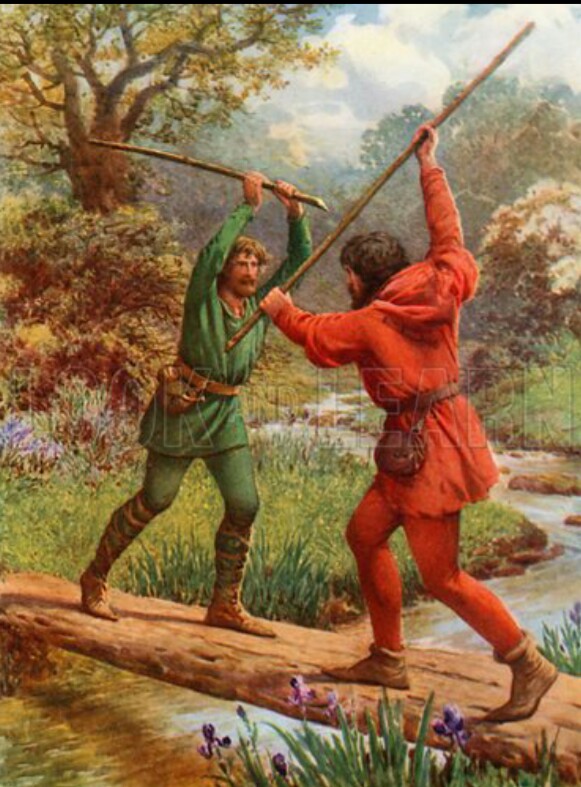
,  a fighting implement 5½ yards long  would be pretty unwieldy even for Little John (who was wielding the first quarterstaff I ever met [in a picturebook, about sixty years ago]).
</Hmm>
</digression>
But a recent survey for Mashable (I say "recent" because the Mashable report is recent; the video itself has no datestamp). But the issue of telling the time on an analogue clock has been around for some time. The late lamented Dave Allen had a routine about it which is worth 6'03" of anyone's time. And many other commentators have said that telling the time from an analogue clock is not a crucial skill for a 21st-century child. (It's just struck me that the ability to read an analogue clock is as irrelevant today as, when analogue clocks were invented, the ability to read a sun-dial became – it can be an impressive trick, but that's all.)

It's not crucial; but losing any skill is a shame. And a risk inherent in any new  technology is that it fosters dependence on it. In case of power cuts it's wise  to keep a few candles handy; and a box of matches. (Luckily, when friction matches replaced tinder boxes, power cuts were a thing of the future.)  But how many new boxes of tricks erode our abilities? Since agreeing (reluctantly...
<comparative_linguistics>
I feel the word doesn't have the force of the Spanish a regañadientes, with its implication of gritted teeth.
</comparative_linguistics>
...) to the use of SatNav,  I've noticed a reduction  in the accuracy of my sense of direction (never great).

Which brings us to alexia (see the subject line). It's related (etymologically, at least, though I have no idea whether the two disorders share any part of the same cognitive mechanism) to dyslexia. but a- instead of dys- – so not-at-all rather than mistakenly).  I wonder what Alexa would make of that. And I wonder whether 22nd-century people (provided that homo sapiens's sapience extends to the avoidance of self-annihilation for that long) will have their ability to read – while probably not entirely eradicated – at least attenuated.

Anyway, cricket calls.

b

Tuesday, 28 May 2019

Schwarzkopf and the harpsichord

Quirks of a translator's life – sitrep

In the course of my translation work (towards the Stephen Spender Prize for Poetry in Translation mentioned before in some recent posts to this blog), I've come across a word with a fascinating cluster of meanings. I've also started to use a new function of Google Sheets – a function that provides a Google Translate version (one word) on the fly.

The syntax of the new function is

=GOOGLETRANSLATE(<cell-to-translate>"<source->","<target>")

for example

 =GOOGLETRANSLATE(A4,"pt","en")

(This function call tells Google Translate to look at the Portuguese word in cell A4 and translate it into English.).

As anyone involved with language knows, meanings of words depend almost entirely on context. So the disembodied words thrown up by Google Translate in its Google Sheets incarnation  can be a bit off-the-wall.

I rather forced that incarnation into the last sentence, as it provides a link to one of the meanings of the keyword, the Portuguese cravo. This can mean "carnation", a meaning that possibly has a more than accidental link with "incarnation", if the derivation for that word (Etymonline lists several possibilities) is the Latin for flesh:

...Or it might be called for its pinkness and derive from Middle French carnation "person's color or complexion" (15c.), which probably is from Italian dialectal carnagione "flesh color," from Late Latin carnationem (nominative carnatio) "fleshiness," from Latin caro "flesh" (originally "a piece of flesh," from PIE root *sker- (1) "to cut"). OED points out that not all the flowers are this color. 
More here
Another possible meaning of cravo is (my source here is the Collins Portuguese Dictionary) "harpsichord". But these language1-to-language2 dictionaries often raise more questions than answers in a translator's mind; I suspect that the equivalent instrument might rather be a clavichord which doesn't sound or behave the same.
<example>
A strangely neglected album has Oscar Peterson playing with Joe Pass in an arrangement of excerpts from Porgy and Bess for clavichord and guitar, exploiting this unique quality of the clavichord: that the thing that strikes the string also defines its length. 
<aside subject="defines">
A deliciously apposite word. The word "determines the length" would be similarly appropriate for those of an etymological bent, as the tangent (that's what the doofer inside a clavichord is called) provides the terminus ad quem the string vibrates.
</aside>
This lets the keyboard  player bend a note, as does a blues guitarist.
</example>
In a harpsichord, on the other hand,  the strings are plucked.
<maybe_though>
(On the other hand, the clavi- bit of the word just means key [as in clef, clavicle, or the French clé] so any keyboard instrument might have been called a "clavi<something>". The makers of the Clavinova were the second (after whoever named the clavichord)  to exploit this neologizing open goal.)
</maybe_though>
Yet another possible meaning of cravo is "nail" or "stud", which – if you think of a nail driven home so that only its head is visible – accounts for the metaphorical use which for reasons best known to Google is the meaning fixed on by Google Translate (try putting that function call 

=GOOGLETRANSLATE(A4,"pt","en")

into a Google Sheets spreadsheet and you'll see what I mean: hint – Schwarzkopf.)

b

Update: 2019.05.28.08:55 – Added PS

PS In my rush to hit the <Publish> button yesterday I left out the one meaning of cravo that applied to the passage I'm translating. Again, it's metaphorical, but unlike blackhead (aha – THAT was it, Schwarzkopf, geddit?) which is animal, this meaning is vegetable: clove.

Thursday, 16 May 2019

Knowing when to fold

I just heard Terry Wogan on Desert Island Discs Revisited using the expression (when talking about ending his career) "I'll fold up my tent".

I wrote about metaphors for arriving and leaving over 3 years ago (here) but I think it's due for a new outing. As so often in this context, I quote The Man:
Elcock explains: 
While VENĪRE remained everywhere the usual verb for 'to come', two new terms conveying a more visual image were  borrowed from maritime language. The older of these, which prevailed in Spain, was PLĬCARE, first used with reference to the folding of sails (cf Port. chegar, Sicilian chicari). In Rumanian a pleca means inversely 'to go, to depart'; this is because the metaphor there was military, and referred to the folding up of tents  (cf. Eng. 'to decamp').  AD-RIPARE, 'to  come to shore', was a somewhat later creation which found favour in Gaul (cf Prov. arribá [HD: Elcock does not mention plegar here, but he has already mentioned it in another context]. From Provence it spread to Catalonia, and during the Middle Ages was carried thence to Sardinia, as arribare.   
The Romance Language (I've given this source more than once, but make no apology for that: it's very good.)
So, whereas I had hitherto relied on the decamp example as a metaphor for leaving in English, I can now add to my body of examples (in that Terry Wogan quote) the explicit metaphor of folding a tent.
<temporal_paradox>
As it happens, as that edition of Desert Island Discs dates from before the beginning of the Harmless Drudgery blog, in fact the example was already there, waiting for me to hear the repeat. But anyway...
</temporal_paradox>
But, I was thinking of the spoken language. As I said in that earlier post
<digression>
Catalan often straddles the French/Spanish camps, so I expected a pair like the Provençal ones. But Cat. plegar has a different metaphorical use: stop work, knock off  – reminiscent of primary school teachers' instructions: When you've finished, FOLD your arms on the desk in front of you.
</digression>
And the arm-folding image as a sign of work done is unequivocal ...
<digression>
(not the most apt of words in this context, considering the last two syllables...
<word_formation_speculation>
Hmm. There's something to be said on each side of that argument. If all the arguments were on the same side, it'd be univocal. 
<univocal_thought>
[The metaphor that evokes univocality is "singing from the same hymn-sheet" {unless harmony's involved, of course, but this is getting silly {Getting?}}]
<univocal_thought>
</word_formation_speculation> 
... but you know what I mean – clearly meaningful)
</digression>
...  in an English context (and I imagine in many others).
<rant>
And apropos of nothing (I just happened to see it in a fruitless quest for information just now)...

The dates of these restrictions 
may be subject to change.

No, no  no.  They ARE subject to change. What they MAY be is changed, in which case they would be subjected to change.

I do wish people wouldn't toss the subjunctive around willy-nilly with some vague it's-not-my-fault-guv "meaning".  But I must take a deep breath and ignore it. There are worse things, I know...
</rant>
Anyway, I think it's time I folded my arms.

b