Showing posts with label summary. Show all posts

Thursday, 28 November 2013

Look what I did

Guest writer today is, as usual, me - giving a summary of the ELTchat at midday (UTC) on Wednesday  28 Nov. (And, while I think of it, Happy Thanksgiving )

Student-Generated Content


There were twelve contributors, of whom five contributed a single tweet – so I’ve known livelier discussions. Perhaps lurkers could at least make themselves known (as those five did).

We spent a while deciding what SGC was, and decided not to count ephemeral scraps of language produced in class; bouncing off those is what teachers do

. Many ideas were floated, and experiences discussed, notably:

  • Learner- generated coursebook
  • Learner- generated tests
  • Learner- generated lesson-plan
  • Recordings (audio and/or video) for discussion and comment
  • Ss suggest better image/layout/structure for coursebook

In any case, what was agreed to be essential was a vehicle (blog or wiki) for storing/organizing SGC. And whatever they had produced, students were more interested and motivated (and therefore learned more) if they were involved.

Not many links were posted, normally a feature of these chats, and these two books were mentioned:

      Books
      

Links
 (These bys are sometimes vias and sometimes authors; which is which should be obvious.) 

b


 Mammon (When Vowels Get Together V5.2: Collection of Kindle word-lists grouping different pronunciations of vowel-pairs. Now complete (that is, it covers all vowel pairs –  but there's still stuff to be done with it; an index, perhaps...?)

And if you have no objection to such promiscuity, Like this.

Freebies (Teaching resources:  nearly 34,400 views**  and  4,800 downloads to date. They're very eclectic - mostly EFL and MFL, but one of the most popular is from KS4 History, dating from my PGCE, with 1637 views/740 downloads to date. So it's worth having a browse.)

** This figure includes the count of views for a single resource held in an account that I accidentally created many years ago.


Tuesday, 2 July 2013

Sleep faster, we need the beds!

I'm told that this is a Yiddish saying, and my informant had ethnic authority, so I have no reason to doubt him – except that  we were compiling copy for a CU Footlights programme at the time; so invention was in the air. (I'd better not say what he called this section of the programme; it might start a race riot. )

Anyway, the subject of the first #eltchat on 26 June 2013 recalled this [apocryphal?] note:
There are some things that can't be done quickly, and maybe learning a language is one of these. Teachers can certainly help to make the process quicker, chiefly by facilitating students in taking charge of their own learning – becoming autonomous to use the #eltchat buzzword!


There were. as usual, many strands to the #eltchat, sometimes diverging sometimes converging, sometimes getting hopelessly tangled. One of the more notable breakdowns in communication was this exchange:

It turned out to be '5K-20K'.

But these were the main strands:
  • The articles
  • Fostering  Learner Autonomy. (All roads lead here!)
  • Speed of learning. Whether it was possible and what were the drivers of that need.
  • How long language learning takes and what are its prerequisites.
  • Teaching and learning methods

The Articles

 The grist for the mill of our discussion was two articles:
  1. an American Physical Society article about learning a language quickly – here
  2. a Science NOW article about the conditions for learning a foreign language – here
(Not much was said about the 2nd of these; I've started a blogpost about it, but it may be a week or two before I get round to finishing it. Keep an eye on this blog; I'll also tweet a pointer.)

Here are a few signposts along the way:
 This was probably a typo for '1 word'.

These last two show how learner autonomy and cultural awareness kept turning up during the #eltchat.

Learner Autonomy

These next two show two themes crossing back:

Everyone agreed with this last point; LA not only helped them in the classroom, but also equipped  students who had 'finished' with the skills to continue to improve. LA was felt to be a key to motivation:
And last but by no means least, food:

On the question of food and culture, I didn't say this at the time – and in any case the example involved teaching another language – but my students (of Portuguese) really enjoyed a festa I arranged at the end of one term. There was Portuguese music, food, and conversation.

Speed of learning

There was much discussion of the speed of learning. Here are some pointers to the discussion:
 

That last one shows another recurrent theme; people were always looking to find lessons they could derive from the observations. Sometimes there were what seemed from the record like dead ends, but they were really things that would take more effort/reflection before bearing fruit. Phil Bird was a lone voice asking if anyone (else?) had thought about 'Hattie's effect sizes'. Nothing came of this question at the time, but in due course I suspect many of us will be thinking about this:

How long it takes

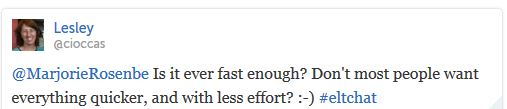
A lot of numbers were batted about, ranging from 5 (a mistake already mentioned) to 20,000. Lesley had to admit to the Australian government's figure:
But don't shoot the messenger, folks; Lesley'd be the first to admit that this was a gross under-estimate (the words 'not', same', and 'ballpark' come to mind).

Methods

There were few actual classroom-based ideas, except a general feeling in favour of immersion and surrounding – if not in the culture (the ideal) – then by cultural tokens. Watching TV – preferably undubbed – was mentioned. And Roya mentioned this:


L'Envoi (French for 'send-off' – quite appropriate I think)

Shaun closed by telling us that there would be an #eltchat break over the (Northern Hemisphere!) summer, but reminded us that the tag itself wasn't going away.

Update 2013.07.25.09.30/10:50 Header updated

Update 2020.07.20.16:45 Bunch of typo fixes, and old footer deleted