Random thoughts from a wordsmith, budding lexicographer, and 'snapper up of unconsidered trifles'.
Copies of my published work, in various stages of completion, are here.
You may need an online reader app such as eBook Viewer and Converter to access these.
Wednesday, 24 June 2026
The Sapiens and the cow
In a fairly recent ...
<tangent> OK, 17 September. There comes a time in the mid-seventies when recentness becomes a somewhat flexible measure
</tangent>
...(members only – so here's a link that will no doubt invite disbursement of some kind, if it works at all) extra edition of The Rest Is Politics Plus, which has a conversation with Rory Stewart about (you guessed it) AI (the man's obsessed), Yuval Noah Harari discusses a consequence of the break-neck unregulated development of AI. In a clear-headed and unsensational vision of the future, ignoring for the time being the possibility of malign intervention and mass extermination, he says that – in a world where the entrepre-nerds have a high enough Inanity Quotient to let AI achieve Recursive Self Improvement (AIs making the next generation of AI's ever further from human understanding or control) – 'We'll be like the other animals on the planet'. He imagines a conversation with a cow.
<parable verbatim="no, but I think I got the gist", embellishment="What do you think?">
'You [the cow] are part of a world economic system involving markets in stocks and bonds operated by algorithms that are far beyond your knowledge or control.'
The cow says 'What are stocks? What are bonds? I know what grass is; I know what fences are; I know that man looks after me and exercises some kind of mastery over me and my kind.'
Comes a time when market conditions change and the supra-national conglomerate that owns the cow goes bust. You tell the cow 'This is the end of the road.'
'Aha,' thinks the cow, 'I know what a road is – those hard bits of land that are uncomfortable to wal...'. And the abbattoir's van pulls up.
</parable>
Just over a year ago, The Pimlico Journal published a thought-provoking article:
<j'accuse>
MPs are almost certainly [HD: that is, absolutely certainly – look at the figure It's just hard to prove,]using ChatGPT to generate Commons speeches
I. The statistical evidence for believing that MPs are regularly using ChatGPT to generate Commons speeches
...
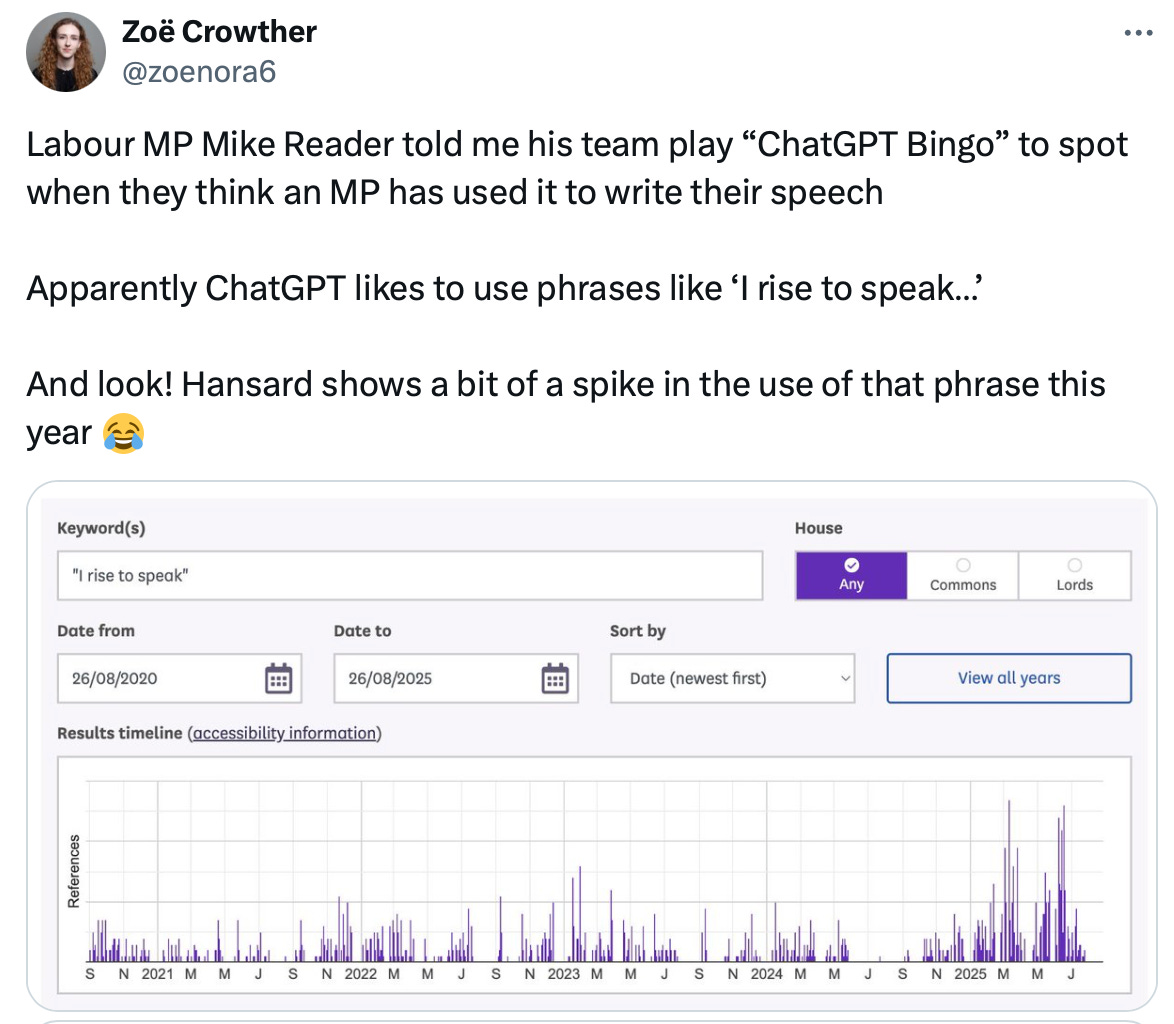
What would be far more egregious and alarming [HD: than the use of ChatGPT for constuency work, as defended here by Mike Reader, MP] is the use of AI to write parliamentary speeches. Zoe Crowther of PoliticsHome posted a chart showing a recent spike in the frequency of the phrase ‘I rise to speak’ in Hansard after being tipped off by Reader that this is a tell-tale sign of ChatGPT.
This spurred further debate, with The Times publishing an editorial on Friday with a similar view to my own: sometimes acceptable if responding to emails, not so much if being used in Parliament. The editorial ended with the question: ‘What cruel news channel will it be that splices together examples of this synthetic oratory?’
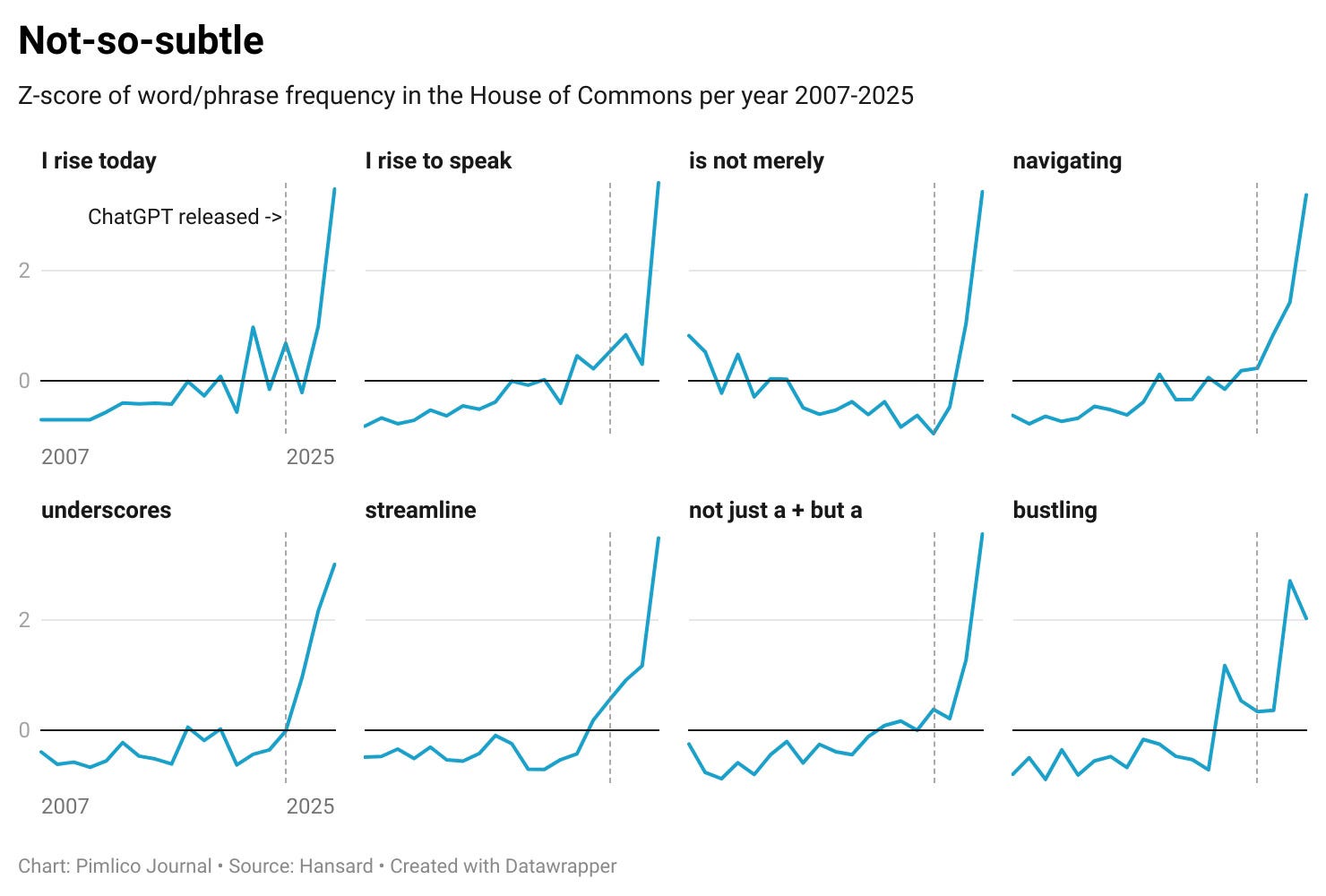
Pimlico Journal is not a news channel, but we hope to be able to rise to this challenge nonetheless. In order to do so, we will start by looking for further statistical indications that AI is being used to generate speeches in Parliament. After all, ‘I rise to speak’ is just one phrase, and with a large crop of fresh MPs, it is not outside the realms of possibility that the phrase just caught on through a sort of social contagion because newcomers thought it was somehow ‘the done thing’.
...
The following search terms were sourced by browsing articles and online discussions on what words and phrases AI-generated text overuses, as well as my own experience (some of these words, despite often being cited as disproportionately frequent in AI-generated text, have been excluded for reasons that are listed in ...
<HTTPS: 7, HD:0> Sorry. I tried to put a link here, but the Substack site involved me in a Kafka-esque verification loop that even I grew tired of. </HTTPS: 7, HD:0>
...Appendix A). Below, you’ll find a series of graphs showing ... the frequency of AI-associated words and phrases, as well as some reference words, in the House of Commons each year from 2007 to 2025. The frequencies of the word or phrase in each year were adjusted by a factor (Appendix B)...
<HTTPS: 7, HD:0 ALT="Ditto" />
... that attempted to measure how many words were spoken in total in Parliament in that year: for instance, 2025 is adjusted upwards because there have been fewer words spoken in the eight months of the year so far compared to most full years.
<glossary> The Z-score is a measure of how far a value in a set is from the mean, expressed in units of the standard deviation. And if you know what that means...
<glossary>
</j'accuse>
So this thing is here and is already worming its way into our culture. And I can't help thinking that homo sapiens is the cow in Yuval Noah Harari's parable, driven to extinction by a super-inelligent AI with RSI, just as all the other homo species were driven to extinction by the (possibly well-intemtioned) spread of homo sapiens.
This illustration from The Language Puzzle sprang to mind. I'm afraid my screen-grab cut off
Ardipithecus ramidus's chin
[no, this isn't Ardipithecus ramidus agnathus]
L'Envoi
That illustration came to mind as a result of an experiment I've been doing for the past year, putting Audible through its paces; in particular I wanted to see how useful Audible was as 'background music' to reading (my eyesight being less than perfect).
I wrote a review, 'published' within Audible...
<air-quotes> You may see from my review that the Audible app seems ro me to be lashed together with chewing gum and baler twine, so published in this case seems not to mean 'made available as a publication'. </air-quotes>
Here it is; blest if I can find it in Audible.
<review justification="I SHALL get it read somewhere>
I wish Audible would wait until their readers could read the actual printed book as published; not doing this is a disservice to the authors and also to the listeners - who get a distorted view of what the author actually meant. I first noticed this in The Book of Why, which I listened to while scanning the printed text. There were numerous cases where the reader changed the written words (usually in ways that had little or no effect on the meaning - for example, 'and so on' for 'etc', 'which' for 'that'). More serious, as the reader had a final page proof, often a piece of text - when the author had added or removed, or reworded something - was omitted or added or unreworded.
In the case of The Language Puzzle this was more obvious to me as I studied Linguistics at degree and post-graduate level, with the added awareness that I knew how linguists speak about things - so that I was (often painfully!) aware of little infelicities. For example, the reader, when the Frenchman was first mentioned, treated the name Brocas to a lavishly Gallic pronunciation; later, presumably after clarification from the author, he used the more Anglophone rendering used by linguists. There were lots of other small points, which though trivial didn't inspire confidence; for example,his stress on homo habilis varied - starting with homo habilis (the normal stress used by archaeologists, such as Prof. Alice Roberts - quoted on the book's jacket) but settling down on homo habilis (which I'd never heard before)
But the main problem was that at the page-proof stage there had been a full-scale reorganization and the 16-chapter book became a 19-chapter recording, with the three extra chapters cobbled together out of bits of formerly longer chapters. At the beginning there is a breakdown of the argument to come: ' Chapter n deals with <thing>, Chapter n+1 deals with <other-thing>... etc.', and this is a bitty mess (quite hard to follow, as it has to make reference to all the disparate cobbled-together bits). But in the final chapter there is a similar resumé which is suspiciously unbitty. I didn't check the references, but it feels as though the reorganization escaped the editor's notice. In short, the table of contents is a work of fiction.
The reader had a sing-song voice - not monotonous, but perhaps oligotonous (involving a small number of tones - which he assigned more or less at random throughout each sentence).
My score for 'story' refers to the argument - which I found unconvincing. Of one writer he wrote 'this seems to me a speculation too far' - a criticism that I often felt applied to his own surmises. For example, 'a biface hand-axe could be carried around and used when needed,, just like words' (not verbatim, but that was what he was suggesting); or a chimp's grunts show the beginnings of syntax - which is true, but only in a metaphorical sense. And his frequent resort to synaesthesia as an 'explanation' struck me as fanciful (bordering on risible).
My down-marking for 'Story' was only slightly mitigated by the fact that the sources used were so eclectic and interesting (although the conclusions drawn were so extravagant); I say 'only slightly' because the Audible version doesn't include the footnotes (or perhaps does include them somewhere not pointed to by the lamentable table of contents.
Listen to this book if you want glimpses of an impressive range of archaeological and ethnological and biological and genetic …(etc) findings, though I'm not sure this book adds much to an understanding of the development of natural language.


No comments:
Post a Comment