Saturday, 27 June 2020

Desktop iconoclasm

<rant>
I blame the desktop publishing  software ("DTP"). When I was at OUP, many moons ago, all was right (recto) with the world. A recto was, as the name suggests, a right-hand page; and on its back, as the name suggests, was a verso. Page numbering started at 1 (or i in prelims, if you were old enough to be fussy about that stuff) on a recto. Except that,  as it was the title page, or the first page of text – in either case a display page – it had no page number (or folio, if you're toeing the Hart's Rules line). A satisfying mixture of Latin, arbitrary rules, and even more arbitrary exceptions, made publishing workers feel special, acolytes in an arcane priesthood.

Then along came DTP, and any Thomasina, Ricarda, or Harriet had the keys to the tabernacle of editorial arcana; they started spraying page numbers around willy-nilly as if there were no rul... Well, I suppose there aren't any more...
<meta-rant>
(and that's another thing; "any more" as one word)
</meta-rant>
...rules, that is.
<meta-rant>
(and that's another  'nother thing; automatic hyphenation. The-/rapist, ency-/clopedia, leg-/end, te-/aching; who writes these misbegotten algorithms? Why not spend some time doing it manually... thoughtfully before dreaming up a bit of software that's guaranteed to go on getting it wrong until Hell freezes over?)
</meta-rant>
</rant>
But what it is is "enabling  technology" – a Good Thing, I suppose. Gutenberg...
<parenthesis>
(or Gänsfleisch, to give him his proper name:

According to Heinrich Wallau, writing in The Catholic Encyclopedia:
Gutenberg was the son of Friele (Friedrich) Gänsfleisch and Else Wyrich. His cognomen was derived from the house inhabited by his father and his paternal ancestors "zu Laden, zu Gutenberg". The house of Gänsfleisch was one of the patrician families of the town, tracing its lineage back to the thirteenth century."
 So, as I said here.
Johannes was as much Johannes Gutenberg as Leonard Woolf was Leonard Hogarth  (whose business just took its name from Hogarth House) 
)
</parenthesis>
...revolutionized the means of disseminating information in the fifteenth century. This put the power to spread the word in the hands of anyone who had access to a printing press (whereas previously – in the West, at least – that  power had been in the hands of  the Church, so that there were strict limitations on what that Word could be). The Church was understandably annoyed  at this encroachment on their monopoly, and argued strongly that such empowerment was a Bad Thing. (Rightly; there do have to be standards; there do have to be rules to prevent perversions of justice. But the Pope doesn't have to  brandish his imprimatur ...
<etymological-note>
and trust Holy Mother Chorch. as Father Steven used to say in my history classes, to hide the agent of a ruling behind the passive voice and in an obscure language: "it may be printed". 


</etymological-note>
... like a spoilt teenager, just because).

So, going back to my opening  rant, you may have noticed that I used the metaphor priesthood. So where does that put me in the case of the Church and Gutenberg? I have to admit, through clenched teeth, that DTP was a Good Thing. (That doesn't mean. though, that I find its giving power to the people comfortable.
<inline-PS>
My feelings on seeing an odd page number on a left-hand page, when someone's cutNpasted from a published source and then re-paginated ...
<rant rejoinder= "Eppur si muove">
(without having the common courtesy to add blank pages to keep the spreads right)
</rant> 
... need have no repercussions in the real world, however violent they may be.
</inline-PS>
 )

Enough for now.

b

Update: 2020.06.2912:05 – Added inline PS.


Saturday, 20 June 2020

Reservio Dogs...

(a tribute to Google, which helpfully suggested that I might have mis-typed, or to  use my own coining, committed a stenoglurch.)

Remember Consignia (a short-lived attempted rebranding for  grouping together all the one-off brands that used to form part of the "GPO")? As  the BBC put it at the time, under the headline Consignia: Nine letters that spelled fiasco :
A duffer. A howling waste of money. 
The most ruinous decision since the biblical scam that saw Esau swap his birthright for a bowl of stew. 
Think "Post Office Group", think trust, honour, gritty postmen braving blizzards to save a child's smile. 
Think "Consignia", the name which replaced it. Think, um, Roman general? Footballer? Tummy bug? 
More

This was not the only company in the early noughties that went in for a fancy foreign-looking ...
<apologia>
(not that I have anything against foreignness  – indeed, whenever someone starts a sentence with "So" and a pause, I experience one blissful moment of hope that they will continue "is  the French for bucket"}
</apologia>
...word that ended with a diphthong. Our local tip (or to give it its more woke name domestic refuse recycling facility) has instituted a system of reservations – called "Reservio". At first I thought this must be a child of the fancy of some Veolia (they're the recyclers) executive with no sense of the ridiculous.

But Reservio, it turns out, is another of those noughties coinings  (or very nearly – the website was registered in   2010, so there must have been a series of meetings in 2009 when the creation of this chimera was mooted.)

Translation News


Meanwhile, back at the Stephen Spender  Prize, which I suppose is nearly an annual tradition (since I entered last year too) I've been thinking about the relative fortunes of complacent and complaisant – apropos of nothing much (except that one of them cropped up in what I was doing). They don't necessarily mean the same (though there's a good deal of potential overlap, and Collins goes so far as to say that they used to be synonymous in British English and still can be in American English.

They differ, when spoken, in only the voicing of the /s/|/z/ phoneme, which (what linguists call "homonymic clash" and ordinary people call "pun") usually in the development of languages leads to the ousting of one (somewhere in this blog I've cited the case of "let" as in the legal  jargon "let or hindrance" and the tennis player's "let" – both meaning something like obstacle).
<rant fierceness="a million suns">
(and the commentator who insists on saying "let-cord", suggesting that it's something to do with the net-cord, rather than just SOMETHING GOT IN THE WAY. As a matter of fact, it usually is the net-cord that gets in the way, but it could be a pregnant albatross or a drone, anything. And not only a thing. It could be a flash of lightning. They'd still play a let. 
When this bloke (I think it's only one) says "let-cord" it  makes  me want to... count to ten and think of my Happy Place, because otherwise I might have a seizure).
</rant>
When the Great Vowel Shift made the impeding sort of "let" and the allowing sort of "let" uncomfortable bedfellows, one of them had to go; so now "let" almost always means "allow" (except for fossils like the ones I've mentioned, on passports, say – even on the red-covered pre-Brexit ones).

Well, Google displays these unattributed graphs:
The demise of "complaisant"
The rise of "complacent"

Call me old-fashioned, but I'm not a fan of unattributed citations, so I went to Collins again (whose trend charts are at least attributable, even though they stop short 2 years shorter, and don't give quite so clear a picture of the reciprocal fortunes (if I was more of a geek I'd overlay these 2 curves; I'll have to leave that to your imagination.)

The Collins charts are:
"Complaisant":( I wonder why the bottom fell out of the market in the 18th century.)

"Complacent": a steady-ish rise in fortunes

Time I continued with the Great Garden Furniture Refurbishment. There's just time for one more item of Translation news. In the John Dryden Translation Competition my entry (mentioned in an autobiographical note in this post) made the Long List (but got no further). Top quartile but no cigar, as they say. Oh well, onwards and upwards.

b

Saturday, 13 June 2020

Nabucco

My choir's latest virtual rehearsal was based on what is known in England as "The chorus of the Hebrew slaves" (so much better as the Coro di Schiavi Ebrei, as our copy had it...
<TYPO status="dubious" reason="old language?">
I think, though my knowledge of Italian is based on a course I did in 1992. the modern Italian would have degli in place of di. This would be yet another example of archaism in the 19th century text, like those I noted here
In his text for Va pensiero, Verdi (or his librettist if he had one ...? 
<stop-press date="June 2020">
Yes he did – the splendidly named Temistocle Solera
</stop-press >
...) does not use dove, in
Ove olezzano tepide e molli 
L'aure dolci del suolo natal
...

The ove shows that at one stage some Italic dialects followed the French path, without an initial d. 
<background>
Earlier in the same post I had written:
The word for 'where' has a chequered history in the Romance Languages. Simply put (which is all I'm up to) it is derived from UBI [='where'] or UNDE [='where from'], with or without an initial DE. So French où comes from UBI, Italian dove comes from DE + UBI and Spanish is 'etymologically pleonastic' when it asks 'Where are you from?'; '¿De dónde eres?' starts with DE DE UNDE, meaning 'from[from[from where]]]'.
<stop-press date="2020"> 
Catalan is like Castilian in its preference for derivation from UNDE, but without the pleonastic d: it uses plain on. So, far from adding a d at the beginning of the word, it drops one from the end.)
</stop-press>
And what in modern Italian would be aire is aure (reminiscent, to me, of the two possible forms in Portuguese of the word derived from CAUSA(M): Fr. chose, Italian and Spanish cosa, but Portuguese [modern Continental Portuguese, that is] either coisa or cousa  – to be filed under Interesting but irrelevant I suspect). 
</background>
As Metternich...
<parenthesis>
"needs citation", to use Wikipedia's passive-aggressive  gibe, but my history teacher used to say it, and what's good enough for Mr Crosby is good enough for me
</parenthesis>
...said at the time 'Italy is a geographical expression'. The name VERDI was a coded feature of political graffiti, standing for Vittorio Emanuele Rei D'Italia. (And, now I think of it, the Hebrew Slaves have an allegorical relevance: the people of that geographical expression had been "enslaved" for centuries by various imperial powers.)
</TYPO>

Covid Chronicles 

The rehearsal (like most things these days: I wonder what's happened to the share price) was done over Zoom. For my madrigals group I use a tablet, which can put  nine thumbnails on one screen; it's a small group, so two screens is the most it runs to. But with the choir – with more than forty (60 or 70 on a good day) – I prefer to revert to my desktop PC, which runs to 2/3 screensful.

But it has no integrated camera. I've found a very old webcam, which I can't get to work. The PC itself is old enough (it runs Windows 7, no longer supported by Microsoft [and this old post sums up  my feelings about computer support:
She...[MrsK] asked a passing school-leaver [in PC World] if there were any known support issues with application software (I'm paraphrasing here, you understand) and the answer was, surprisingly enough, that everything was hotsy-totsy with Windows 8. 
Well, twenty years of working with software engineers (actually, 19¾ – HP took the penny-pinching precaution of shafting me 3 months before they would have had to fork out for a 20-year award) has taught me that if anything can go wrong with new software it will. This was true of Windows 95, and with everything since. Working in 'Support', which I did for many years, involved me almost daily in fixes and workarounds and you-just-can't-do-that-any-more when people tried to get existing application software to play nice with a new operating system.
]), but the webcam pre-dates even that – the user guide doesn't mention Windows 7 (only its predecessors Windows 2000 and Windows XP).

So my participation in the rehearsals is haunted by a photo of me (taken, now I think of it, when I was using Windows XP). The picture is in a file called mugshot.bmp, which gives an idea of its lugubriousness.

Tha'sall. Time I showed my face in the Real World.

b

Friday, 5 June 2020

Brother Lawrence / in the scriptorium / with a quill

Medieval Cluedo?

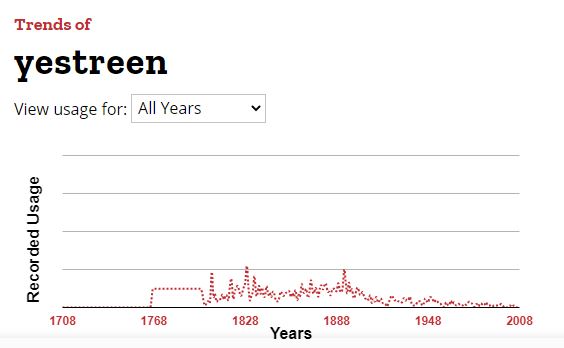
Yestreen...
<gloss>
I'm trying to get this charming abbreviation for "yesterday evening" re-adopted.


According to Collins it's Scottish and pretty rare But their "usage trends" graph shows that (back in the nineteenth century) it was all the rage.
</gloss>
... my choir sang this:
Manuscript from Reading Abbey, but probably produced in Oxford.
(see David Crystal, The Stories of English [2005], p. 108)

In  The Stories of English David Crystal says
Reading Abbey did not have a scriptorium, so the manuscript was probably copied at Oxford.
This gives the rota or "round" a double relevance to our choir, as a good few of us live in the Reading area, and both our MD and our accompanist studied at Oxford.

But why Sumer? Isn't it the wrong bird? The cuckoo arrives in Britain in April. Crystal gives the answer:
There was no contradiction, because in Middle English sumer was the only word available to describe the period between the vernal and autumnal equinoxes. The word spring to refer to the season is not recorded in English until the mid-sixteenth century.  
The Stories of English
That Crystal book has reminded me of a pipe-dream I discussed here
<digression theme="pipe-dream" likelihood="0">
Penguin missed a trick (or more likely decided that the trick wasn't worth the outlay) with this book. It was written like a coffee-table book, with two or three sorts of text and standalone features, quite like Words: An Illustrated History of Western Language (which I had a small part in publishing – but a bigger part than I wanted [and that's a whole 'nother story] ). But Penguin just squeezed it all together with tiny margins and no kind of visual clues to what sort of text was which. 
<inline_ps date="2020">
"No sort of visual clue" is strictly a bit of an exaggeration. The designer has done what he or she could in the cost-reduced circumstances of what the trade knows (or knew in my day) as a "mass-market paperback". If you know what to look for it makes sense. There's a vertical rule down the margin of the standalone features; but it's easily missed, and the reader only realizes what's happened when the syntax of two unrelated sentence parts makes the inconsistency felt.
</inline_ps> 
The reader's never sure whether the current text is part of the main argument or part of an illustrative aside. It needs changes in line-length or font or shade of paper to make it a smooth reading experience.
<sub_digression>
In fact, the writing so obviously has this sort of treatment in mind that I suspect it was written to order for another publisher but that the contract fell through. The typescript then got bought by another publisher whose needs were at odds with the book as written. Maybe not though – who knows...?
<sub_digression>
My fantasy – though I haven't discussed this with the good Professor – is to win a large amount of money and become a proper publisher. My Rights department would negotiate with Allen Lane to acquire the rights for a properly designed book, and my Design department would make this book CanDo Publishing's lead title.
<digression> 
<tangent>
In researching this post I've come across my latest nomination for a Tezzy ("Time-wasting Site of the Year".  I haven't dabbled yet, but imagine the temptation will get the better of me in the end.  Here it is, the British Library's Medieval Manuscripts Blog
</tangent>
Enough for now.

b
PS An irrelevant quandary:

My attention has been brought to this petition, and I'm in a quandary about signing it. I know I shouldn't be, as it obviously addresses a critical issue.
<parenthesis>
(My first choice of wording in that last sentence was "It clearly addresses", but while it does obviously address the issue, clarity is hardly characteristic of the way it goes about it. The "writer" has had a thought, taken a number of words in the relevant area, and spewed them out onto the page in the hope that the reader will organize them into something meaningful; with any luck, that meaning will match the meaning intended. 
I am reminded of Sheridan (père's) words (used to drum up business for a teacher of how to write)
We write with ease to show our breeding 
But easy writing's curs'd hard reading. 
) 
</parenthesis>
I want to subscribe to the gist without subscribing to the woeful wording. I do wish people would give some thought to what they're writing, rather than scatter-brainedly  conjuring up a bunch of more or less relevant words and leaving it to the reader to arrange them into a thought. How's this for a doozie?
It is important to learn about Black History and unteach this ignorance as some children may not choose to educate themselves and just listen to the people around them and be influenced causing people to hold racist views and pass them down many generations meaning the cycle of racism and systematic oppression will never end.
Fifty-five words with no punctuation. and daisy-chain syntax. The people the petition is addressed to are almost guaranteed to dismiss it as intemperate ravings.

I guess I'll sign, but with a heavy heart.

Update: 2020.06.06.16:20 – Added inline PS.

Saturday, 30 May 2020

Bras dessus bras dessous

In a trail for an Eartha Kitt program  I heard once there was a song that I had never heard in the original (although C'est si bon ...
<parenthesis>
(one of those "translations" that give up the effort of actually translating, and just throw in the odd snatch of the original – Volare is another example)
</parenthesis>
...is a commonplace on the lounge circuit in an English version):
C'est si bon,
De partir n'importe où,
Bras dessus bras dessous,
En chantant chansons
And the phrase bras dessus bras dessous took me back to my French classroom in the early '60s (possibly '63-'64, otherwise '65-'66...
<autobiographical-note>
Not in the intervening year, when we were consigned to the attention of an assistant, who –  much to our annoyance at the time – insisted that we learn and use the symbols of the IPA.  I was later to realize that – unless total immersion in the environment of the target language was possible  – IPA symbols were an almost essential ...
<parenthesis>
(and that "almost" is a craven sop to the sometimes vocal language teachers who are happy to pander to the needs of  students who can't use a decent [that is, mono-lingual] dictionary)
</parenthesis> 
...tool for learning a language.
</autobiographical-note>

...). The particular memory was of Cedric Baring-Gould's mime of walking arm in arm. My reaction was not a simplistic "Aha – bras dessus bras dessous is "the equivalent..."  (whatever that means in the context)  "....of the English" ...
<parenthesis>
(the assistant had introduced us to the less formal la main dans la main [in Françoise Hardy's "Tous les garçons et les filles de mon âge].. or "was to introduce" – all these parentheses are a bit too involved even for me...
</parenthesis>
 ...."arm-in-arm".

My association of that phrase with that mime is an example of the sort of association summed up on the right hand side of this diagram I later (much later) used in a Portuguese lesson:


I've probably uploaded this to TESconnect, but here it is anyway; and if you want to change the target language, you're welcome to the Visio sources (Microsoft-backup-willing)

The question O que é? triggers the name of the object, without recourse to the arduous and time-consuming and unnatural and error-prone left-hand route.

As I wrote in an earlier post:
My memory was of the mime performed by my French master 50-odd years ago. I've mentioned Cedric before, here. I can imagine his shade smiling down with a look of smug satisfaction (like the one he used to show the difference between 'No vacancies' and 'Complet' [HD 2020: arms  folded for the latter, hands upraised for the former]). 
At this time of year [HD 2020: I was writing about the time of the rentrée des classes], teachers of all kinds may need the fillip of this post: if you're good, what you do (probably more than what you say) will let your pupils take away from your lessons much more than you think.
I'll never forget BG's figure hunched over the enormous reel-to-reel Grundig that he always carried from class to class. (The assistant had one of the new cassette players, but BG swore by his magnétophone .)

Time for my walk, if I can get this published before Minusnet ("better than damp string")  crashes again.

b

Sunday, 24 May 2020

...if it wasn't for those pesky prepositions

This morning (that is, yesterday morning at time of going to <whatever>, my attention was caught by a charming birthday wish for Richard Wagner:
...and don't bother clicking on this screenshot, which is as dumb as can be.
Rather, give your ears a treat by going to YouTube.
<autobiographical-note subject="WCS tour, 2016">
If your YouTube experience is anything like mine (which it probably won't be) this Wagner piece is followed by a piece that Ben (the pianist on YouTube and my choir's pianist) played with us on our tour of the North-East in 2016: Abendlied.
</autobiographical-note>
You'll note that Facebook has helpfully supplied a bit of contextual information – leading me to wonder about their choice of preposition. I'm not sure what this sort of note adds.

The first response to Ben's post points to this bit of silliness on Facebook's part ...
<tangent subject="Gresham's Law?">
(not, please, behalf – although see my rant in the first update to this; the abomination has wormed its way into a kosher dictionary (Collins, I think, from memory). This seems to be yet another example of Gresham's Law as it applies to language: not Bad money drives out good, but Bad language-use drives out good).
</tangent subject>
...but, I feel, misses the point:


Facebook's note is not just otiose; it's wrong. By the same token, Oliver Twist is ABOUT Charles Dickens, that is, not.

In Facebook's defence (can I have written that? ) maybe some pictures need a bit of context-setting; and when writing a bit of generic text the right preposition in one case won't work in another. So whoever it was at Facebook who decreed We must generate some context-setting text on the fly was giving  the writer ...
<parenthesis>
(or maybe they make the mistake of leaving this sort of thing to the software engineer rather than spending money on a writer (or even, as with some enlightened and forward-thinking tech companies, a "User-Interface Engineer")
</parenthesis>
...a poisoned chalice.

That's all you're getting; a quickie. I'm thinking of more preposition-related stuff, but there's some serious tail-chasing in progress at the moment (if progress is the right word).

b


Saturday, 16 May 2020

Weighed in the balance

The other night I caught, on Radio 3, the last 15-20 minutes (enough to send me back to BBC Sounds to hear the rest) of Belshazzar's Feast.  And it was extraordinary how familiar the music was, given that I had sung it over 30 years ago – in December 1987 to be precise.
<pre-history>
Two years before that I had my audition for Wokingham Choral Society with their new MD Paul Daniel. I persuaded him to take me on, despite my limitations when it came to reading music (and at the time I didn't even have a keyboard of any kind at home to help with note-bashing) on the strength of my having "recently" sung Beethoven's Mass in C (WCS's concert piece that term) with MagSoc's choir. That recently was something of an exaggeration, but it sounded more persuasive than the more accurate 'about 12 years ago when I was looking for an unauditioned choir having been kicked out of the chapel choir').
<peccadillo>
After three years with that choir (three years that coincided with Paul Daniel's tenure, before he went on to greater things) I left WCS, to return in the early noughties, under Aidan Oliver. On the strength of being a returning member I escaped without audition. (This may have had something to do with the maestro's attitude to red tape.)
</peccadillo>
</pre-history>
The rehearsals went well until three or four weeks before the concert, when Paul Daniel began to feel a pain in his shoulder. A physiotherapist and member of the choir kept telling him to get it seen to, but he tried to work though the pain.  Finally, on the Friday before the concert he saw a specialist and was told that if he conducted at the concert it might be the last concert he conducted.
<hearsay>
(well anyway, that's what the chairman said  when he told us on the Saturday morning, and it's at least plausible)
</hearsay>
So at incredibly short notice they found a new conductor, Brian Wright whose biography mentions the piece.
<pre-history>
 (although that was with the RPO; he cut his teeth with WCS.)
</pre-history>
Four things struck me about the concert :
  • The venue: it was a sports hall, converted pro tem – not a great success acoustically
  • The conductor, a northerner, didn't like the way we said brass. He didn't try to change it, but said he felt more comfortable with choirs who said /bræs/. I think Walton, a Lancastrian, would probably have agreed.
  • From the horse's mouth (that is, Walton's) he corrected the printed score with respect to the triplet when the choir sings 'weighed in the balance'. (I'm afraid the details escape me.)
  • Also on the programme was Paco Peña, whose performances I had enjoyed twice in the late '60s.
    <autobiographical-note>
    One of these was at the Guildford Festival. My oldest sister was a student at the University of Surrey, which was linked in some way with Battersea Technical College. Linking the two sites was a shuttle minibus, on which I stowed away disguised as a student (I was in the fifth year – or "Year 11" in new money).
    The concert was called something like "Three aspects of the guitar", and was divided between John Williams (classical),  Paco Peña, (flamenco) , and Chris Spedding (a late replacement for a jazz guitarist, though "jazz" is not a very apt description of his one hit, "Motor bikin'"). 
    At the end, John Williams announced that, having met for the first time that afternoon, they were going to play together. With his three-finger (classical) tremolo his Repertoire included Tárrega's Recuerdos de la Alhambra (that clip demonstrates both the technique and the piece). Paco Peña, with his four-finger (flamenco) tremolo (how VERY DARE they use the little finger?) knew the tune well enough to improvise an accompaniment. And Chris Spedding would do his thing. Hmm? (His solo contribution to the concert proper didn't inspire confidence.) 
    The two acoustic guitars started, confirming Fernando Sor's opinion:...
    <no-source>
    Sorry, can't place it. I believe I saw it on the sleeve notes to John Williams and Julian Bream's first Together album.
    <no-source>
    ,...(something about the only sound more beautiful than a guitar being the sound of two). So we eyed Chris Spedding's VOX AC30 with dread. 
    In the event his contribution was far from intrusive; and when the music finished – after a moment when we hoped (vainly) for more – there was the sort of ovation that I had never been part of before (and have never been part of since). It was not a matter of a few people standing up and others joining them. It was unanimous (in a way that does justice to the roots of the word: one mind). 
    <second-concert>
    To describe my other late ‘60s Paco Peña concert would be even more self-indulgent than usual. 
    </second-concert> >

     </autobiographical-note>

You've got to draw a line somewhere.. Life's just one AOB after another

b