Showing posts with label context. Show all posts

Tuesday, 15 September 2015

Sounds like my sort of thing

An article in last Saturday's Times (yes, I know, The Times [sigh]) was a less than glowing review of Richard Dawkins's new book. Not having read (nor intending to read)  it (the book, that is), I don't mean to add to the review, but one assertion quoted leapt to my attention as dubious:


Really? I was saying /'mɑ:li:bəʊn/ (in the brief few turns it took to buy me out of a game of Monopoly™  in those days) several decades before Transport for London was even dreamt of. I wish the reviewer had been more punctilious with his punctuation, as on the basis of this it's nigh-on impossible to determine which bits of the assertion are those of Dawkins. But I imagine the Marylebone instance is his, as is the faintly ridiculous 'classic [BK: Really? Has he any idea of what 'classic' means?] struggle between two memes'. But this isn't a review, so I'll lay off.

Excuse my use of IPA symbols...
<rant flame="simmer">
 I have ranted about this before, somewhere  in the UsingEnglish forums, but I can't find  where. So some readers may get a sense of déjà-lu  – but probably not. (And I did mean -lu.)  Anyway, here I go again. 
When you know your audience (and that word is crucial  –  when people can hear you) it's OK to say things like 'lear sounds like leer'. 'Sounds like' is meaningful only if there's a known sound to compare. But when you're writing – say, in an online forum – it's not so easy. What  if one of your readers has just learnt bear, pear, tear (NOT the lachrymal sort) or wear, so that the /eǝ/ sound is uppermost in their short-term memory of English sounds? You've told them that leer is pronounced  /leǝ/. 
Or suppose one of your readers mispronounces law as /lǝʊ/  –  a common enough mistake in an ESOL classroom   –  and you write that a word  'sounds like law'. Again, you've misinformed them. And I don't think that's too strong a word, at  least not in a language-teaching context.  If the teacher wants to communicate something, it's part of the job to make sure it's understood correctly. 
People complain about 'having to learn a whole new alphabet'. That's nonsense, particularly in the case of English  – which can be adequately transcribed using the letters of the alphabet (most with 'their own' sound – b ⇨ /b/, k ⇨ /k/, s ⇨ /s/, and so on) with a dozen or so new symbols). The system can be taught in a few lessons, makes dictionaries infinitely more informative, absorbing and rewarding, makes modelling and correcting sounds easier and clearer, supports increased learner autonomy.... And yet many learners (and even quite a few teachers, to my utter bewilderment – as I can't conceive of learning a new language [except by total immersion] without using the IPA) resist the idea of learning/teaching IPA symbols. 
</rant>
... but old habits die hard (and dye deep).

<digression>
There are various stories about etymology of that word. [Marylebone, remember?] This site says
...In the thirteenth century when the language of the aristocracy was French, St-Mary-by-the-Tyburn would have been St-Mary-a-le-Bourne (‘bourne’ being the French for a small stream) and from this we arrive at the word ‘Marylebone’ as we know it today.  
Based on this etymology and a progression of phonetics, the correct way of pronouncing ‘Marylebone’ is widely considered to be ‘Marry-leh-bon’ – although in reality this is rarely heard.
As to the meaning of "a progression of phonetics" your guess is as good as mine – though I imagine it may mean something like 'a number of both phonetic and phonological changes' ; after all, those 13th-century origins pre-dated the Great Vowel Shift. 
I once gleaned, from a source that I regarded at the time as authoritative (although as this was in the late '60s I no doubt set the bar pretty low), that ‘-le-bone' just meant 'the good', as le was feminine at the time,  and the convention of doubling a word-final consonant before adding an e for the feminine (for example bon/bonne, cadet/cadette, Bourgignon/Bourgignonne... 
<mini-rant status="stillborn">
No, I won't but... If people would just pronounce the /n/ when they say Bœuf Bourgignonne.  PLEASE.
</mini-rant> 
... etc.) had not yet been adopted by the Académie – which had surely ... (nope, not until the mid-17th) not yet been set up.  Still, -a-le-bourne is plausible enough, and I'm not going to lose any sleep over it either way. On the one hand, beware folk etymologies, especially on special-interest web sites; on the other hand, what's the point  of saying 'St Mary the Good' at all, unless there were a... aha, maybe Mary Magdalene was 'Mary the Bad' (not so 'bad', though, as to stop her being canonized in the end [for all that, by all accounts, she was no better than she SHOULD be, if you catch my drift, and note the colour of this parenthesis. St-Mary-the-Not-So-Bad-Really-(just-not-the-one-in-the-blue-frock), perhaps]).
</digression>

And by the way, while we're on the subject of what was said and when., in that (i.e. Saturday; do keep up) night's televised version of An Inspector Calls, some of the dialogue was surely in Priestley's original. Just before the Great War, it makes sense for both Sheila and the Inspector to say during the 31st minute, 'Why had this to happen?' (where an 21st-century speaker would say 'Why did this have to happen?' – or would they? Maybe it's the sort of Northern English syntax that's still current... I can imagine Sir Geoffrey saying it.)

On the other hand, bits of the dialogue stick out like... something very sticky-outy [I'm avoiding clichés like the pl... um, like something jolly bargepole-y]. Would Gerald really have said 'It's a question of the bottom line'? (the context is a bit uncertain, as I can't find the reference, but he certainly used the expression the bottom line, which Etymonline says is  attested from 1967.)

Well, must be off.


b

PS A couple of clues:

Dildo's met an awful aria. (5,6)
Dumb-show of involuntary movement – that's imitative. (7)

Update: 2015.09.16.08:55 – Whoops... fixed in maroon.
Update: 2015.09.21.15:45 – Added long-overdue clarification in red.
Update: 2016.01.29.15:10 –  Supplied answers to clues, and deleted footer (as I will do in other posts when I get 'a round tuit'. The latest info. is on my other blog.)

PPS The answers: it's been so long that it took me a while to work them out – DIDO'S LAMENT and MIMETIC

Friday, 11 July 2014

The sportscaster's present, pt II

This page addresses a use of the present that is peculiar to sports commentators:

<explanatory_note>
Like newspaper headlines and personal anecdotes ("So I'm walking down the street yesterday, and this guy comes up to me and he says ..."), sportscasting has a special affinity for the present tense. But unlike other uses of the historical present—which typically refer to past events, thus "historical" present—the sports announcer is calling a game that is playing out before our very eyes. If ever there were an appropriate time to use the present, surely this is it. So what's so strange about it?
...
Both "Louise kicks the ball" and "Louise is kicking the ball" are present tense, of course. But what makes the sportscaster present remarkable isn't tense. It's a distinction known as aspect, which refers to the period over which an action takes place. The "is kicking" construction has progressive aspect, because it refers to an event that unfolds over time, whereas "kicks" is the older, simpler form that is used for a variety of purposes, including habits ("Be careful—that horse kicks" does not mean the horse is necessarily kicking right now) and verbs of thought or emotion ("I think I'll kick the ball").
</explanatory_note> 
I would like to consider another, also peculiar to sports commentators, but using an analogue of a device that has long been used by language teachers (both MFL [Modern Foreign Languages] and ESOL [English for Speakers of Other Languages]).

This device is the timeline diagram. It lets students in one timeframe (the now of the lesson) think about language that deals with events that happen at different times. Timelines have been used in language teaching for many years. I remember my own French master, the sainted Cedric Baring-Gould who I’ve mentioned several times before, drawing something like this to investigate the difference between habitual action in the past and an event:

Passé                                 Présent                                            Futur

           Passé imparfait
         L M M J V etc
      > .  .  .  .  . >
         J’allais tous les jours…


>----------------------------------------------------|-------------------------------------------------->

        Passé composé
      
     Un jour, pendant que  j’allais …,
                   J’ai trouvé qqc

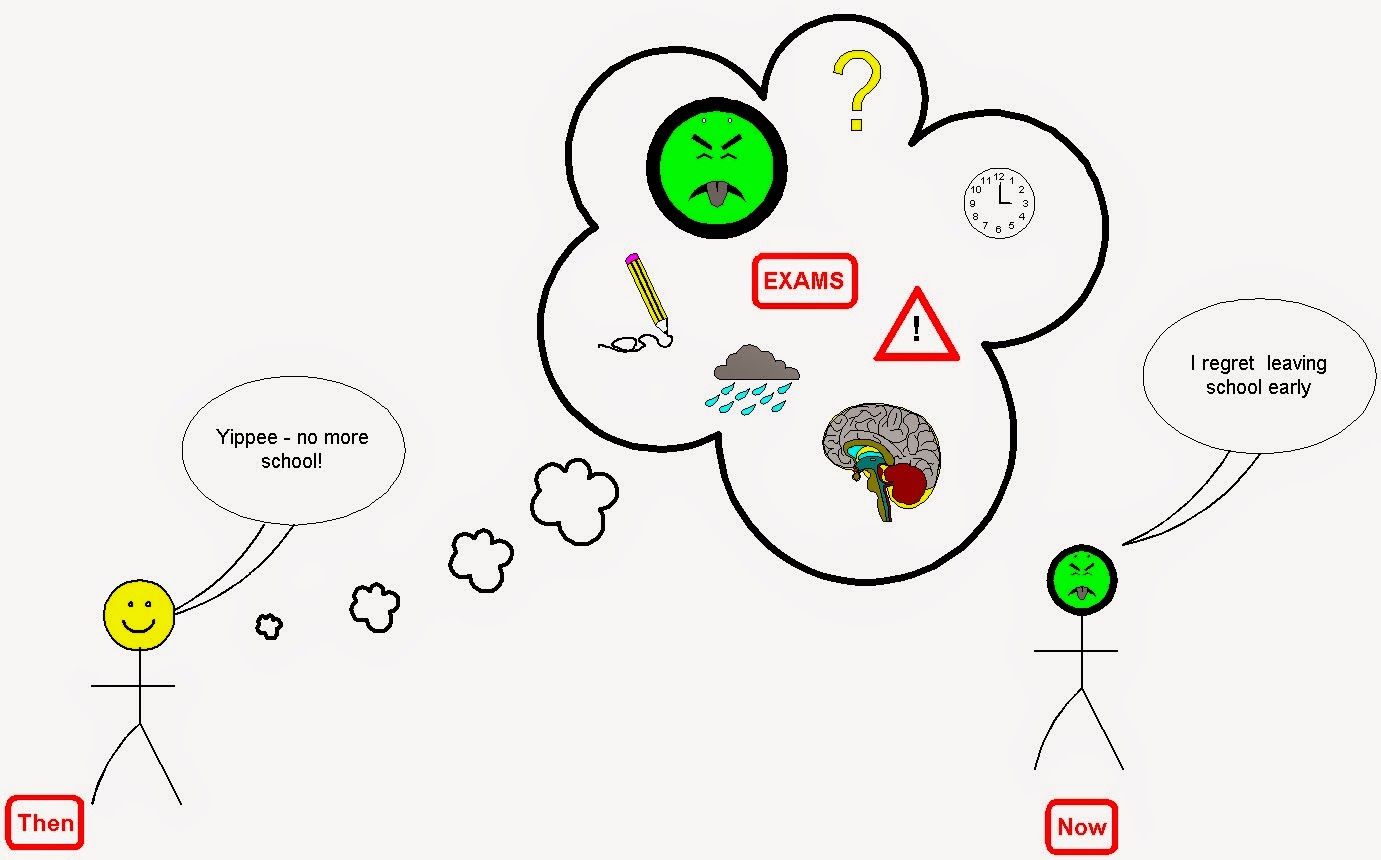
With a bit more time and artistic inspiration, a diagram like this can become quite impressive. Here’s one  I did for an ESOL class a few years ago, where the diagrammatic paraphernalia has been reduced to Then and Now boxes, but the same principle is at work – time progresses from left to right, and the language used at any point refers to that time:


‘Regret leaving’
Versus
‘Regret having left’

Instead of such diagrams, which can freeze time while we look more closely at what’s going on, sports commentators have video playbacks. So they can say things like:

[technical aside: ‘Can we freeze it there?’]
‘Now if he crosses it there, it’s a certain goal.’

The simple present to express a conditional! This is one in the eye for the zeroth/first/second-type† merchants. Given the right visual context, the simple present can be used to frame a perfectly clear conditional. And supposing there’s a Pedant among the Pundits:

[technical aside: ‘Is it possible to stop the action  there?’]
‘If he had crossed it at that stage, it would have been a certain goal.’

What has this achieved? It requires the audience to tune out of a video-context and start parsing formal syntax. In what way is this better?

b

[Time off for bad behaviour. Back soon.]

Update 2014.07.10.15.30 – Added this note:


This, I realize on second reading, may need some explanation. It is a reference to a system of classification of conditionals, widely used in the ESOL world (and possibly also now in the MFL world, which I have not been involved in as a teacher for 10 years). Some people find it useful. Have a look here. It seems to me to lead to unnecessary ratiocination (or, to use a computer internals metaphor, 'thrashing' – when the computer spends all its time trying to decide what to do).

Update 2014.07.21.10.30 – Added this note:
For the purposes of the argument, it's not essential that you agree with the distinction (between 'regret leaving' and 'regret having left'). In fact, I'm not sure I do any more (it's about 8 years old). If I redid it now, I would at least redraw it. What matters, in this context, is just the principle of using a graphic to freeze time while a student considers appropriate language at different times.

 Update 2014.07.31.09.30 – Added explanatory note in maroon, which explains the 'part II' in the title.

Update 2017.09.26.15.40 – deleted old footer.

Update 2018.03.06.14.40 –  typo and format tweak.

Monday, 7 April 2014

Correcter than thou

A couple of matters arising from a semi-idle hour's worth of Radio 4 listening, one about context and one AOB about hypercorrection – that is, getting something wrong because of trying too hard (and misguidedly) to get it righter than THEM (who didn't go to the right school and probably hold their knife like a pencil my dear would you credit it?)
 <digression theme="hypercorrection" amuse_bouche="hígado">
Hypercorrection is particularly likely to happen when two languages rub up against each other. The earliest example I know of is in the Satyricon, in 'Trimalchio's Feast'. Trimalchio is a social climber who lays on a flamboyant (and tasteless) feast. One of his affectations is to pronounce a Latin c [k] with a fricative à la Grecque χ. The way this is presented in the text (written a while before the foundation of the IPA) was 'instead of commodus he says cHommodus)'.
I know an amuse-bouche should come first, but I've already taken too long over this, so the liver will have to wait.
</digression>
Context:
This week's Book of the Week is about Louis Armstrong (another subject of hypercorrection, now I think of it: he and his family say /lu:ɪs/, but white folks said 'No, it's from the French, silly: LOO-WEE'). One of the events related was when he announced, in a KKK area, that the band wanted to dedicate their next number to the Memphis police force; and they went on to play 'I'll be glad when you're dead, you rascal you'. The narrator explained that this didn't cause a riot because of Louis Armstrong's delivery.

I thought this was ridiculous at first. Yes, he mixes words with skat singing, so that his words can become unclear, but the first line was clear. Why didn't they see that they were the butt of Armstrong's humour?

Then  I thought again. For the last 50+ years...
<digression>
There's scope for an autobiographical note here about my middle brother going to the Crawdaddy in the early sixties. But times's wingéd chariot is breathing down my neck, as is its wont.
</digression>
...I've been listening to Black Americans (and English artistes mimicking them). At the time of Armstrong's jibe the white audience didn't have that familiarity. The nearest they came to hearing Black American speech extended only to the pastiche of  'Yes Massa' and 'Ah'm  comin' home Mammy' familiar from black-face acts.

Hypercorrection:
In 'Start the Week' at least two people said /mə'kɪzməʊ/. The second speaker, the less well educated, may have been following Tom Sutcliffe's lead ('He's saying /k/, and he talks proper; I'd better do the same.') But Mr Sutcliffe should have known better.

When the word first arrived in (American) English in the mid-20th century it would (unquestionably) have had the /ʧ/ of the Spanish machismo (the -ism associated with being  excessively macho – "male (but in an animal sense, without the gentility of being varonil ['like a man']†". Being macho is aping the Alpha-male.

But people with a certain education (they listened to opera music, and so knew that the chi of 'Voi chi sono' [with a /k/, as in chiaroscuro {and English words borrowed  from Italian owe much more to music and art than words borrowed from Spanish} ] wasn't like the ci of  'La ci darem la mano'), seeing machismo  with an o at the end, concluded wrongly that it must be Italian; so they misapplied the rule  
'ch' before 'i' -> [ki]
Hence the horrid '/mə'kɪzməʊ/', or worse still /[mɑ'kismo]/ (with the foreign vowels implying 'I'm nearly bilingual, don'cherno).

The problem is that once a word is naturalized, all bets are off. The l in could was originally hypercorrect (as explained elsewhere) what's hypercorrrect becomes correct. I am a prescriptivist in a descriptivist's clothing. I have to admit that at some stage the cry But it should be pronounced with a /ʧ/ because it's there in the original will become irrelevant to the (at that future time) current state of English. And at the cusp there will be arguments about whether that time has come. For me, in this case, IT HASN'T!

b
Update 2014.04.09.09.35 – Added this PS

† Not to mention hidalguía ["gentlemanliness"], which is another thing entirely. And hidalgo [hijo de algo – 'son of something'] could make for a fascinating aside that I don't have time for now.... 

Update 2014.04.09.12.25 – Fixed square brackets. IPA-nerds may have been quite upset! (But the rest of you needn't worry unduly: it's a phoneme-VS-phone thing.)

Update 2014.04.18.17:40 – Added pointer to new hígado post.

Update 2014.04.21.16:55 – Updated footer


 Mammon When Vowels Get Together V5.2: Collection of Kindle word-lists grouping different pronunciations of vowel-pairs. Now complete (that is, it covers all vowel pairs –  but there's still stuff to be done with it; an index, perhaps...?) 


And here it is: Digraphs and Diphthongs . The (partial) index has an entry for each vowel pair that can represent each monophthong phoneme. For example AE, EA and EE are by far the most common, but there are eight other possibilities. The index uses colour to give an idea of how common a spelling is, ranging from bright red to represent the most common to pale olive green to represent the least common.

Also available at Amazon: When Vowels Get Together: The paperback.

And if you have no objection to such promiscuity, Like this.

reebies (Teaching resources: over 40.000 views  and nearly 5,600 downloads to date**. They're very eclectic - mostly EFL and MFL, but one of the most popular is from KS4 History, dating from my PGCE, with over 2,000 views and nearly 1,000 downloads to date. So it's worth having a browse.)

** This figure includes the count of views for a single resource held in an account that I accidentally created many years ago.

Sunday, 30 March 2014

What do you mean, 'Hard to learn'?

HMM... – it's† all about context. That piece says:
After all, what makes a language easy or hard?  Is it the writing system? Grammar rules like adjective agreement? The arbitrary use of genders for nouns? Don’t even get me started on cases and declension! I would argue that it is none of those things (or perhaps all of those things!) More important than any one facet of a language is the perspective from which you look at the language. What is your native language? How many languages have you learned? How old are you? In what environment are you learning the language? All of these factors play a role in how challenging we may find a specific language.
More here
That is, it all depends on the learner.  Well yes, selbstverstehenlich. {Isn't German great? It 'understands itelf'.} If your language uses tones phonemically, for example, you'll find it easier to acquire another language that does the same  – unlike English, which uses tone only for paralinguistic features. But we are where we are; I speak usually to users of a few Indo-European languages, and for my typical speech community it makes sense to say something like 'Learning Chinese is difficult' (for reasons adumbrated here).

But this has got to be a quickie, and I'll just give an example of the way context influences things. The example may seem a bit of a stretch, but that's context for you: it makes sense for me, because I'm the sort of person it makes sense for – DUH.
<autobiographical_note date_range="early 70s">
This morning I was listening to a recently rediscovered Letter from America.  That context recalled for me the last days of Nixon. I wondered whether it would mention that judge ... what was his name?...

At this moment a totally irrelevant memory cut in. Before Douglas Adams became a confirmed Footlighter he wrote and played in an ensemble called Adams, Smith, Adams. The 'Space, the final frontier .... to boldly split infinitives no man has split before' passage that ultimately appeared in print in The Hitchiker's Guide to the Galaxy first saw the light of day in a monologue that, as I remember, opened an Adams, Smith, Adams revue in 1972[??? Early 70s anyway.]. Another gem from that revue was the line 'the Mercedes-Benz, that Rolls Royce of motor cars'.

But the relevant memory was  sung to the tune of Maria:
Sirica. I've just met a judge called Sirica
...[etc]
The most scrupulous judge I ever heard  – Sirica.
So I got to that name before Alastair Cooke confirmed it.
</autobiographical_note>

I'm not sure how this is relevant to the issue of context , except in that expectations ["'Chinese is hard' versus 'AC will mention Sirica'"] are influenced by everything that one has seen and done to date. Of course.

b

PS Now for another bash at That Door (with my new toy, a proper plane not the Surform thing I've been using [sponsored, presumably, by the makers of Band-Aid]). And then I'll make more than one inroad into that #WVGTbook (V5.<next>) Index.

† Update 2014.03.31.10:15 – Fix typo. (One of these days I'll get that darn apostrophe right. I know the rule, but still....)

Update 2014.05.02.14:15 – Updated footer:


 Mammon When Vowels Get Together V5.2: Collection of Kindle word-lists grouping different pronunciations of vowel-pairs. Now complete (that is, it covers all vowel pairs –  but there's still stuff to be done with it; an index, perhaps...?) 

And here it is: Digraphs and Diphthongs . The (partial) index has an entry for each vowel pair that can represent each monophthong phoneme. For example AE, EA and EE are by far the most common, but there are eight other possibilities. The index uses colour to give an idea of how common a spelling is, ranging from bright red to represent the most common to pale olive green to represent the least common.

Also available at Amazon: When Vowels Get Together: The paperback.

And if you have no objection to such promiscuity, Like this.

Freebies (Teaching resources: over 40.300 views  and well over 5,600 downloads to date**. They're very eclectic - mostly EFL and MFL, but one of the most popular is from KS4 History, dating from my PGCE, with well over 2,000 views and nearly 1,000 downloads to date. So it's worth having a browse.)

** This figure includes the count of views for a single resource held in an account that I accidentally created many years ago.